Most people learn yoga in a group class, and for many that works well. But sometimes a one-to-one lesson makes more sense: you are coming back after a break, you want help with a specific pose, group timings never fit your week, or you simply learn better with someone’s full attention.
An individual lesson costs more than a class pass and puts one teacher in charge of your hour. That makes it worth a few questions before you book. A good teacher will welcome every one of them. If someone reacts badly to being asked, that reaction is itself an answer.
This guide walks through what to ask, why each question matters, and what a reasonable answer sounds like. If you are still deciding between formats more broadly, our guide to choosing a yoga class, studio or online covers that step.
First, be clear about what you want
Before you ask the teacher anything, ask yourself one question: what should be different after a few lessons? “I want to feel less stiff in the morning” is a workable goal. So is “I want to learn the basics before I join a group class” or “I want to build a short home practice I will actually do.”
A vague goal is fine as a starting point, but the clearer you are, the easier it is for the teacher to say honestly whether they can help, and the easier it is for you to judge later whether the lessons are working. If a teacher promises a specific outcome, especially a health outcome, treat that as a warning sign rather than a selling point.
Ask about training and experience
You do not need to become an expert in yoga credentials, but two questions are worth asking directly:
- What training have you completed, and with whom? A common baseline is a 200-hour teacher training, often listed as RYT 200. Yoga Alliance, one of the larger registries, describes RYT 200 as a foundational 200-hour programme and runs a public directory where you can look a teacher up. Registration tells you a training was completed; it does not by itself tell you someone teaches well.
- How long have you been teaching, and who do you usually teach? A teacher who mostly works with athletes may be a poor match for a stiff beginner, and the reverse is also true. You are looking for experience with people like you, not the longest CV.
It is also fair to ask whether they have taught people with your specific situation, whether that is an old injury, pregnancy, or simple nervousness about starting. Listen for specifics in the answer rather than reassurance.
Ask how the lesson will be adapted to you
The whole point of an individual lesson is that the practice fits your body, not the other way round. Ask how the teacher will adjust for your fitness, any pain or injuries you have, and any movements you would rather avoid.
If you have a medical condition, an injury that is still healing, or you are pregnant, speak with your doctor before starting, and tell the teacher what your doctor has advised. A yoga teacher is not a clinician, and a private lesson is not medical treatment, even when it is tailored to you. A careful teacher will say this themselves.
A reasonable answer to “how will you adapt this?” sounds concrete: which poses they would start with, what they would leave out, and how they would progress over a few weeks. “Don’t worry, I’ll take care of you” without detail is less reassuring than it sounds.
Ask how a lesson actually runs
Practical questions save awkwardness later:
- How long is a lesson, and how much of it is active practice?
- Will you get things to practise between lessons, and how will the teacher check your progress?
- Can you ask questions during the lesson, or is there time set aside at the end?
Feedback matters more in a one-to-one setting because there is nowhere to hide, for you or for the teacher. Ask how they correct students. Watching, verbal cues, and demonstration are all common. You want a teacher whose way of giving feedback you can actually live with, because you will be hearing a lot of it.
Ask about touch and adjustments
Some teachers use hands-on adjustments; some rarely touch students at all. Neither is automatically right or wrong, but you are entitled to know before the first lesson, and you are entitled to say no, at the start or at any point during a lesson.
A simple way to raise it: “Do you use hands-on adjustments, and how do you ask for consent?” A professional answer describes a clear practice, for example asking each time, offering verbal alternatives, and treating no as a complete answer. If the question itself seems unwelcome, keep looking.
Ask about the practical terms
Money and logistics are normal things to discuss, not rude ones:
- What does a lesson cost, and is there a discount for booking several?
- What is the cancellation policy, for you and for the teacher?
- Where do lessons happen, and what is provided? If the teacher comes to your home, ask what space and equipment they expect.
- Is the first lesson a trial, and is there any obligation to continue?
Get the answers in writing if you can, even if that is just a message confirming what you discussed. Clear terms protect both sides, and teachers who work professionally tend to have them ready.
Online or in person?
Individual lessons work over video too, and that widens your choice of teacher well beyond your city. An online lesson is usually cheaper and easier to schedule, and it can be a good fit if your goal is building a home practice. The trade-offs: the teacher cannot see your alignment from every angle, hands-on adjustment is impossible, and a weak internet connection can spoil the flow. If you go online, ask how the teacher wants your camera placed and how they handle corrections without being in the room.
In person costs more and limits you to teachers nearby, but the feedback is richer. For a first-ever lesson, many people find in person easier. There is no wrong choice here, only the one that fits your budget, your goal, and your week.
A short checklist to copy
Before you book, you should be able to answer these eight questions:
- What do I want to be different after a few lessons?
- What training has the teacher completed, and can I verify it?
- Have they taught people with my goals and my situation?
- How will they adapt the practice to my body and health?
- How does a lesson run, and how will I get feedback?
- How do they handle touch and consent?
- What are the fees, cancellation terms, and logistics?
- Do I feel comfortable asking this person questions?
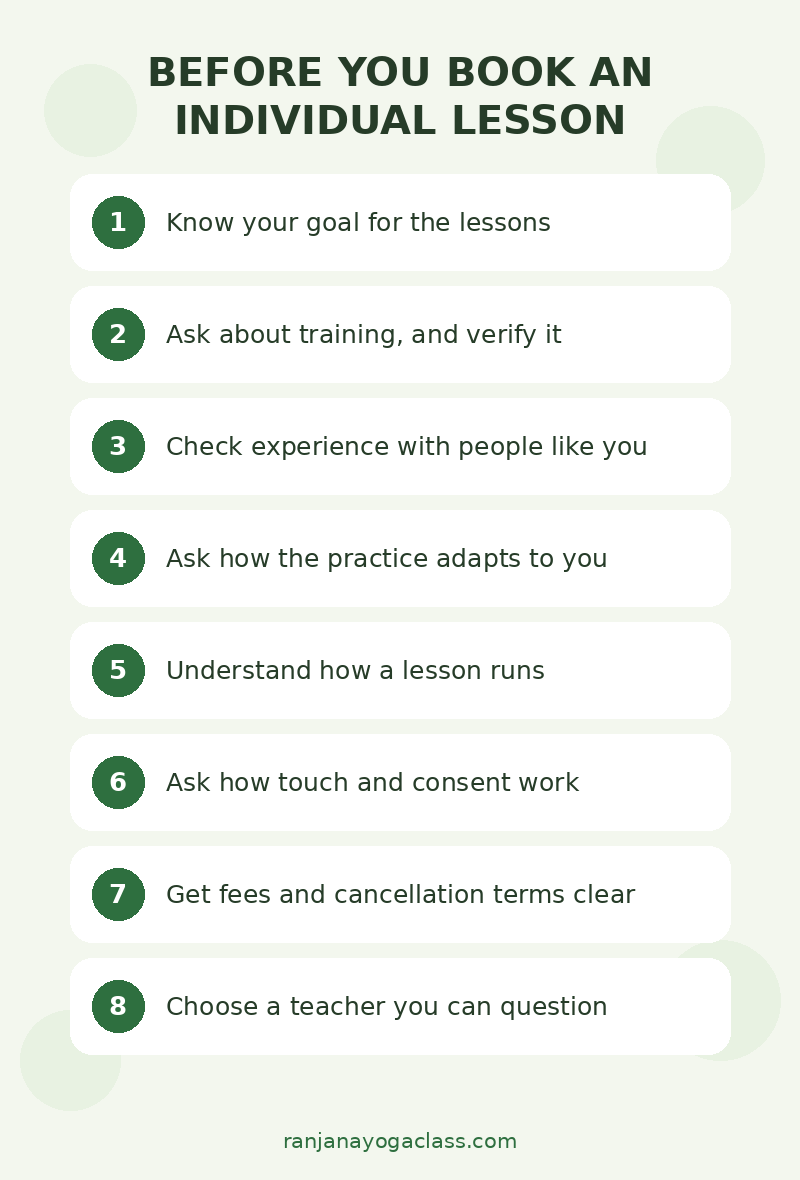
That last one matters more than it looks. An individual lesson is a working relationship, and it only works if you can speak up in it.
When an individual lesson is not the answer
A private lesson is a good tool for learning yoga, but it is not the right tool for everything. It is not a substitute for medical care, physiotherapy, or counselling. If your main need is treatment for a condition, start with the appropriate professional, and let yoga support that plan rather than replace it.
And if what you actually want is company, routine, and a lower price, a well-chosen group class may serve you better. Our comparison of yoga and Pilates is one example of thinking through what kind of practice suits you before spending money on it.
The short version: know your goal, ask direct questions, and expect direct answers. The right teacher will make that easy.
Sources and further reading
- Yoga Alliance, Find a Yoga Teacher – public teacher directory and an explanation of the RYT 200 credential.
- On this site: How to Choose a Yoga Class: Studio or Online for Beginners and Yoga vs Pilates: What Is the Difference and Which Should You Try?