
If you have had lower back pain for months, you may have been advised to try yoga or physiotherapy. But how do the two compare? And does the research tell us which one to choose?
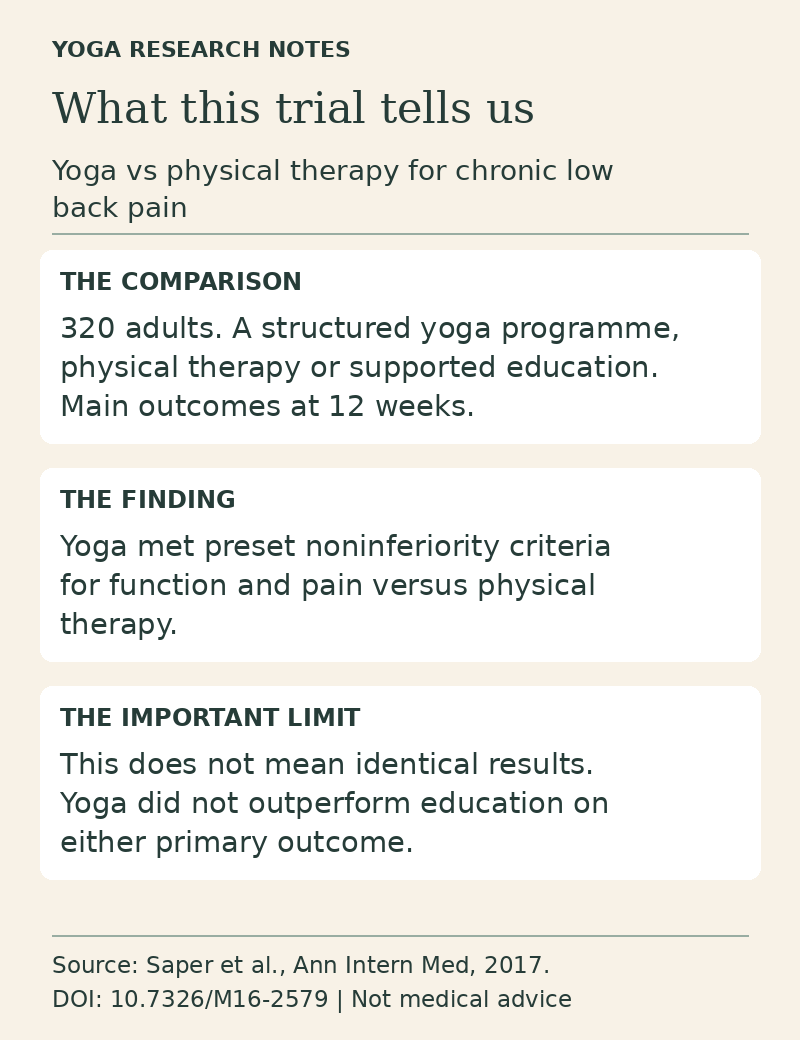
A study published in 2017 compared a yoga programme, physical therapy and back-pain education in 320 adults. After 12 weeks, the yoga programme met the researchers’ test for being no worse than physical therapy within limits they had set before the trial began. Yoga did not, however, give better results than education on the two main measures. [1]
Those findings need a little explanation. The study used small, supervised yoga classes designed for people with chronic low back pain. It did not test an ordinary yoga class or a routine from a video. The results are worth knowing about, but they cannot tell you whether a particular class is right for your back.
Who was the study about?
Robert Saper and colleagues studied adults aged 18 to 64 whose lower back pain had lasted at least 12 weeks. This is what researchers mean by chronic pain. The participants had nonspecific low back pain, meaning no particular spinal condition had been identified as its cause. People with specific causes, such as spinal stenosis, were excluded. [1]
The trial took place at a Boston hospital that serves people who may struggle to access care, along with seven community health centres. Most participants had low incomes, and the group was racially diverse. On average, they had moderate to severe pain and difficulty with everyday activities because of their backs.
Including people from these settings was a strength of the study. It gave researchers information about patients who are not always well represented in exercise trials. Still, the results do not automatically apply to older adults, every healthcare setting or every cause of back pain.
Participants were randomly assigned to three groups: 127 to yoga, 129 to physical therapy and 64 to education. Everyone could continue their usual medical care.
What did the yoga group do?
The yoga group was offered one 75-minute class each week for 12 weeks. Classes included relaxation, breathing, yoga philosophy, postures and a final relaxation. The instructors were trained to teach the study’s programme. [1]
Classes were small, with fewer than five participants for each instructor. Props and changes to the poses were available. Participants were also encouraged to practise at home for 30 minutes a day and received a manual, a DVD and equipment.
This amount of support is important when reading the results. A large class, a fast-paced session or an instructor who does not adapt for back pain may offer a different experience. The study’s findings should not be treated as evidence for any yoga class someone happens to find.
What did the other groups receive?
The physical therapy group was advised to attend fifteen one-hour appointments during the same 12 weeks. Physical therapy, often called physiotherapy, included individual work with a therapist and supervised aerobic exercise. Treatment was based on assessment, with graded exercise and help with fear of movement when needed. There were instructions and supplies for home practice too. [1]
So the comparison was not yoga versus massage, or yoga versus a short appointment. Both programmes involved professional support and work at home.
The education group received The Back Pain Helpbook, a reading schedule, newsletters and brief check-in calls from staff. The book covered self-management, stretching, strengthening, emotions and fear of movement.
That group was not left without help. Education was an organised approach to managing back pain, alongside usual medical care. This matters because people sometimes describe the trial as yoga being compared with “doing nothing”. That is not what happened.
What does “noninferior” mean here?
The study was a noninferiority trial. Instead of asking whether yoga was better than physical therapy, its main question was whether yoga would be worse by more than an amount the researchers had agreed was acceptable before starting. [1]
They measured two things: pain and back-related difficulty with daily activities, often called function. The limit was 1 point on a 0-to-10 pain scale and 1.5 points on the function questionnaire. The version of the function questionnaire used here ran from 0 to 23. Higher scores meant more difficulty.
The researchers compared the results, including the uncertainty around the differences, with those limits. Yoga met the noninferiority test for both measures after 12 weeks.
In everyday language, the yoga programme did well enough in this trial to meet the study’s standard for not being meaningfully worse than physical therapy. That does not mean the results were identical. It does not mean everyone improved, or that a person can swap any physiotherapy programme for any yoga class.
How much did people improve?
All three groups improved on average over the first 12 weeks. The table shows the average reductions in pain and back-related difficulty. A lower score means an improvement on both scales. [1]
| Programme | Average reductions after 12 weeks |
|---|---|
| Yoga | Function: 3.8 points on the 0-to-23 scale. Pain: 1.7 points on the 0-to-10 scale. |
| Physical therapy | Function: 3.5 points. Pain: 2.3 points. |
| Education | Function: 2.5 points. Pain: 1.4 points. |
The function results were adjusted for differences in participants’ starting scores. The main analysis included everyone who had been randomly assigned to a group, with statistical methods used to account for missing follow-up information.
It would be easy to compare the numbers in the table and pick a winner. But an improvement within one group is not the same as evidence that its treatment works better than another. The researchers had to analyse the differences between groups as well.
Yoga met the noninferiority test against physical therapy. However, yoga was not statistically better than education for either main outcome. Physical therapy was better than education for pain, but not for the main function comparison.
This is why saying “yoga beat physiotherapy” or “yoga works just as well for everyone” would misrepresent the study.
Did some people improve more than others?
Yes. The researchers also counted participants whose function score improved by at least 30%. In that analysis, about 48% of the yoga group, 37% of the physical therapy group and 23% of the education group reached that level of improvement. [1]
These figures help show what averages leave out. Some people had a substantial improvement; others had less improvement or did not reach that threshold.
This was a secondary analysis, not the main comparison the trial was designed around. The researchers also did not adjust these extra analyses for the greater chance of finding a result when many tests are run. The percentages should not be used on their own to claim yoga was better than physical therapy.
What happened to medication use?
At 12 weeks, people in the yoga and physical therapy groups were less likely than those in the education group to report taking any pain medicine during the previous week. The differences were 21 percentage points for yoga and 22 percentage points for physical therapy. [1]
This was based on participants’ reports. It does not show that yoga treats medicine dependence, and it is not advice to stop a prescription. Most comparisons involving individual types of medicine did not show a significant difference. The trial was not large enough to give firm answers about particular drug types.
If you want to change a pain medicine, discuss that with the person who prescribes it.
Did the improvements last?
The researchers followed participants for another 40 weeks. Average improvements in the yoga and physical therapy groups were maintained at one year. [1]
During this period, they compared yoga drop-in classes with home practice, and physical therapy booster appointments with home practice. They did not find significant differences between the maintenance options.
Only about half of those eligible attended any maintenance sessions, though. That makes it harder to judge whether those extra classes or appointments added much benefit. The result should not be read as proof that follow-up support is unnecessary.
Were there side effects or problems with the study?
Adverse events were reported by nine people in yoga, fourteen in physical therapy and one in education. These were mostly mild joint or back pain that settled. There was no significant difference between yoga and physical therapy in how often related adverse events happened or how severe they were. Neither programme was risk-free. [1]
There were also limits to the study:
- Participants knew which treatment they were receiving. Because pain and function were self-reported, their expectations could have affected their answers. The staff collecting and analysing the results did not know participants’ treatment groups.
- Attendance was lower than planned. The middle attendance figure was seven yoga classes and seven physical therapy appointments. Fewer than half met the study’s definitions of sticking with treatment.
- More follow-up information was missing in physical therapy. Statistical methods can help with missing data, but cannot remove all the uncertainty it creates.
- Starting function scores differed between groups and had to be accounted for in the analysis.
The authors also warned that the results might not apply to ordinary community yoga classes without this specific programme. That is a particularly useful point for anyone thinking of trying yoga because of this study.
What does the wider research say?
A Cochrane review published in 2022 looked at 21 trials involving 2,223 participants. Its search covered research available up to August 2021. Compared with no exercise, yoga led to small average improvements in pain and function at around three months. The differences were below the review’s thresholds for an improvement considered clinically important. [2]
Compared with other exercise aimed at back pain, there was probably little or no difference in function. The evidence about differences in pain was very uncertain. Yoga caused more adverse events than no exercise, mainly increased back pain, but its risk appeared similar to other exercise.
The US National Center for Complementary and Integrative Health also describes a small possible benefit for low back pain and notes that yoga programmes differ. Its back-pain information lists yoga among the nondrug options in the American College of Physicians guideline, with low-quality evidence supporting that option. [3,4]
The World Health Organization has a separate guideline on nonsurgical care for chronic primary low back pain in primary and community care. It covers a broader care question than this one comparison of yoga, physical therapy and education. [5]
What does this mean if you have back pain?
This trial gives you something specific to discuss with a healthcare professional. A supervised yoga programme adapted for chronic nonspecific low back pain helped some participants and met the trial’s comparison with physical therapy. It did not show that yoga is the best choice for everyone.
If you are considering a class, ask whether it is designed for people with back pain, whether the instructor can adapt it and what to do if symptoms increase. Discuss your condition with your doctor or physiotherapist first. NCCIH advises people with health conditions to discuss their needs because some yoga poses and practices may need changes. [3]
Do not use this article as a pose routine, cancel recommended rehabilitation because of it or push through worsening symptoms. The right advice depends on what is causing your pain and what you can manage.
Persistent pain, or pain that affects daily life, deserves medical advice. Back pain with new bladder or bowel changes, loss of feeling around the genitals or anus, or pain, weakness or numbness in both legs needs urgent medical care. Sudden severe pain, rapidly worsening pain or feeling generally unwell also needs prompt clinical advice. These warning signs come from NHS guidance, not the trial. Use the appropriate local emergency service when needed. [6]
For someone choosing between yoga and physiotherapy, the study does not settle the decision. Your assessment, preferences and access to suitable support still matter. The clearest finding is about the particular yoga programme tested: it met the trial’s noninferiority criteria at 12 weeks, but did not outperform education on the main outcomes.
Sources
- Saper RB and colleagues. Yoga, Physical Therapy, or Education for Chronic Low Back Pain: A Randomized Noninferiority Trial. Annals of Internal Medicine. 2017;167:85-94. DOI: 10.7326/M16-2579. Full study. PubMed record.
- Wieland LS and colleagues. Yoga for chronic non-specific low back pain. Cochrane Database of Systematic Reviews. 2022;11:CD010671. Review and plain-language summary.
- NCCIH. Yoga: Effectiveness and Safety. Updated August 2023.
- NCCIH. Low-Back Pain and Complementary Health Approaches: What You Need To Know.
- World Health Organization. WHO guideline for non-surgical management of chronic primary low back pain in adults in primary and community care settings. 2023.
- NHS. Back pain. Page reviewed March 2026.
Explore more yoga articles or read about Ranjana Sinha.