
Pratipaksha bhavana is commonly introduced as cultivating the opposite or a counteracting perspective. The phrase appears in Yoga Sutras 2.33 and 2.34, in the discussion following the yamas and niyamas, yoga’s ethical restraints and observances.
A familiar summary says to replace negative thoughts with positive ones. That can be a useful first pointer, but it leaves an important question open: what does negative mean in this particular passage? The next verse supplies detail that a motivational slogan can miss.
This guide reads the two verses together. It explains their vocabulary, compares interpretations and uses a few clearly labeled modern examples. It is a guide to a philosophical teaching, not a treatment for unwanted thoughts or distress.
Start with the setting of Sutra 2.33
The passage comes after the lists of yamas and niyamas. The Internet Encyclopedia of Philosophy places these within the ethical framework of Patanjali’s yoga, rather than treating them as optional decorations around a posture practice.
The Centre for Yoga Studies presents S. Ramaswami’s explanation of 2.33 in terms of reasoning contrary to the yamas and niyamas. In this reading, the problem is not simply that a thought feels unpleasant. It is that a line of reasoning pulls against the commitments being studied.
That distinction changes the question. Instead of asking how to make every feeling cheerful, ask what the thought encourages and how that relates to the ethical context. An uncomfortable recognition of a mistake is not automatically something to replace with praise.
For an overview of the wider text, see our Yoga Sutras guide. Here the focus is the relationship between these two particular verses.
What the words bring into focus
The Centre for Yoga Studies renders vitarka here as negative deliberation or reasoning, and pratipaksha as the opposite side. Its glossary for bhavana includes cultivation, forming in the mind and reflection.
Integral Yoga Magazine presents a range of meanings too. It gives opposite side or opposition for pratipaksha, and cultivation or reflection among the meanings of bhavanam. A short dictionary equivalent is an entry point, not a complete instruction.
The same Sanskrit term can need attention in another context. Integral Yoga’s discussion points to vitarka elsewhere in the Yoga Sutras. Do not assume that an English adjective selected for 2.33 must fit every occurrence throughout the work.
You may see bhavana, bhavanam or bhavanā in different presentations. Keep the verse number and named translation beside the spelling so that a small difference in presentation does not distract from the explanation.
Why translations of 2.33 sound different
The Centre for Yoga Studies uses the language of being oppressed by negative deliberation and cultivating the opposite side. Integral Yoga Magazine presents Swami Satchidananda’s familiar positive-thought formulation alongside Rev. Jaganath’s more explicit reference to the yamas and niyamas.
Yoga Sutra Study also places Satchidananda’s wording beside Edwin Bryant’s language of counteracting thoughts. The translations share a concern with a response, but their everyday English associations are not identical.
Counteracting can suggest addressing a tendency that interferes with a commitment. Positive can be misunderstood as cheerful, flattering or optimistic regardless of the facts. Reading the commentary helps prevent that shortcut.
A useful study note records the Sanskrit, the translation and the explanation separately. A teacher’s illustration can clarify a verse without becoming a literal translation of it.
Sutra 2.34 adds the missing detail
The next verse names harmful deliberations, beginning with harming, and describes several dimensions of them. The Centre for Yoga Studies translates these as actions done directly, brought about or approved; preceded by greed, anger or delusion; and varying in degree.
It then describes their fruits in terms of suffering and ignorance. These are claims within the text’s ethical and philosophical account. They should not be converted into a diagnosis of why an individual became ill or experienced hardship.
The detail matters because responsibility is not reduced to what someone did with their own hands. Causing or approving an action is also part of the examination. Nor is an action automatically harmless because its motive feels mild.
Read this as a connected explanation rather than a checklist for judging everyone around you. A short article cannot settle every difficult case of intention, responsibility or consequence.
| Verse 2.34 | What it names | Study question |
|---|---|---|
| Role | Doing, causing, approving | What is my part? |
| Motive | Greed, anger, delusion | What drives this? |
| Degree | Mild, medium, intense | Am I excusing it? |
| Result | Suffering and ignorance | What may follow? |
Does cultivating the opposite mean suppression?
Eyal Shifroni’s discussion emphasizes investigation rather than hiding an existing emotion. Drawing on B. K. S. Iyengar’s interpretation, he asks readers to study causes and conditions and consider the results of acting from the tendency.
That emphasis is worth keeping alongside the shorter positive-thought translation. Pretending an impulse is absent is different from examining it. So is repeating an encouraging sentence while continuing the same harmful behavior.
Yoga Sutra Study explicitly says not to berate yourself when contrary thoughts arise. Its explanation connects the response with cultivating another tendency, not with deciding that the first thought makes a person worthless.
This guide does not provide a clinical account of thought suppression. It makes the more limited reading point that these commentaries need not be reduced to denying what is present.
A modern example: taking credit for work
Imagine a group project in which you are tempted to present another person’s contribution as your own. This is a modern illustration, not a story from the sutras.
A purely cheerful replacement might be that everything will work out. That avoids the ethical question. A counteracting response could instead acknowledge the other person’s work, name your own contribution accurately and correct a misleading impression.
The change is not merely in the emotional tone. It changes what you are prepared to do. Reading 2.34 alongside 2.33 invites attention to motive, participation and likely effects rather than optimism alone.
A second example: approving an unfair action
Suppose people in a group mock someone who is absent and you encourage it because you want to belong. You did not begin the exchange, but your approval still has a role in the situation. Again, this is an illustration, not a quoted traditional example.
A counteracting response might be to stop adding approval and redirect the discussion toward a concrete issue that can be addressed fairly. If you helped spread an inaccurate claim, correcting it matters more than privately imagining yourself as kind.
The point is not that every social situation has one obvious answer. It is that the next verse widens the examination beyond direct action, making the short instruction more specific than simply improving a mood.
What this teaching should not become
It should not become a demand to enjoy unfair treatment, excuse abuse or give up a necessary boundary. Changing a response does not require declaring an unsafe situation acceptable.
It is also not a requirement to monitor every mental event. An unwanted thought arising is not the same as choosing, causing or approving an action. This article cannot determine the meaning of a person’s symptoms or provide individual mental-health advice.
If distress or recurring thoughts interfere with daily life, seek appropriate professional help. Do not use a philosophical slogan as a reason to postpone support or stop treatment.
Some modern sources connect this passage with neuroscience, physical inversions or particular meditation methods. Those claims and practices require their own evidence and safety guidance. None is necessary to understand the two verses introduced here.
A simple way to study the passage
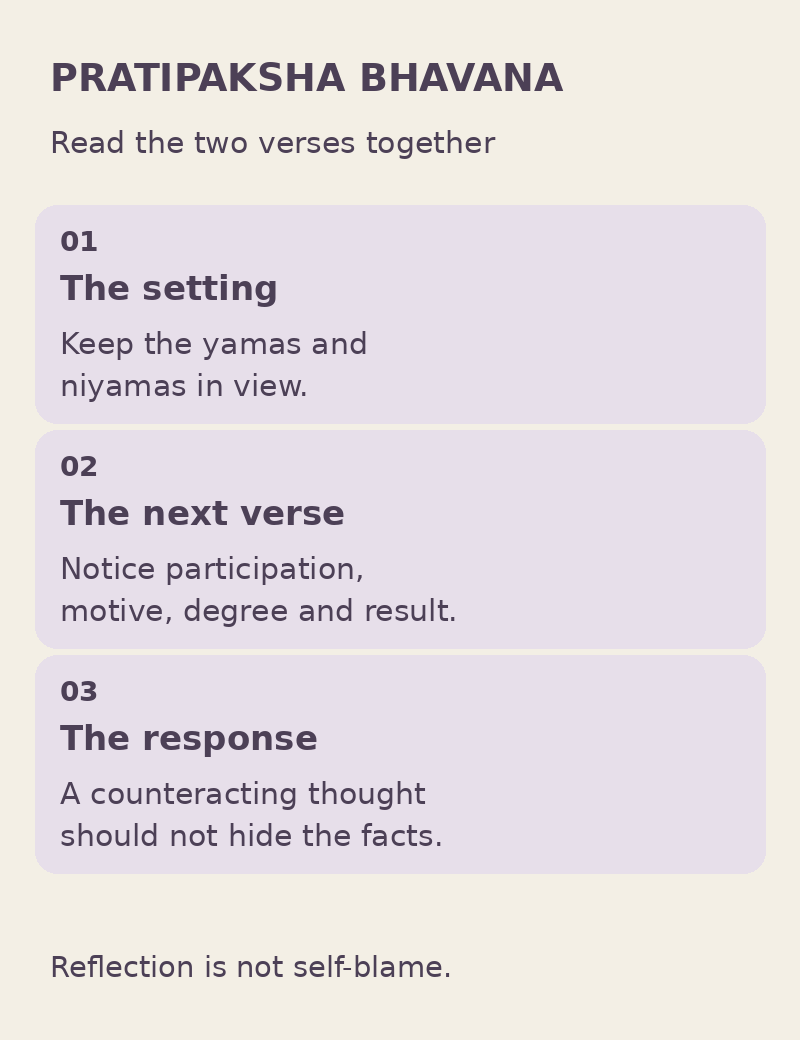
Read 2.33 with the preceding lists, then read 2.34 before deciding what the short phrase means. Compare two named translations and note how each explains vitarka and the counteracting response.
Choose one ordinary example and identify the ethical issue without diagnosing your personality. Ask whether the proposed response changes conduct or only changes the words used to describe it. Keep the example separate from the translation.
There is no need to create an elaborate self-scoring system. If a difficult case remains unclear, that is a useful question for a qualified teacher rather than a reason to force a neat answer.
The bottom line
Pratipaksha bhavana is better understood with its setting intact: ethical commitments, contrary reasoning and the fuller examination in Sutra 2.34. The opposite is not necessarily the most cheerful sentence available.
Read the two verses together, notice differences between commentators and connect reflection with an accountable response. Keep both self-blame and unsupported health promises out of the explanation.