Kaivalya is a term for liberation or absolute freedom in classical yoga philosophy. It is also translated as independence, isolation or aloneness. Those English words need context: the Yoga Sutras is not simply recommending that a person spend more time by themselves.
In this setting, kaivalya concerns purusha, the principle of consciousness, being free from the confusion that identifies it with prakriti, nature, including the mind. It names the goal being discussed, not a mood after a quiet class.
This guide focuses on the meaning of that goal, the final verse of the Yoga Sutras and the limits of familiar English translations. It is a study guide, not a method for producing an altered state or certifying spiritual attainment.
Why the translation can sound confusing
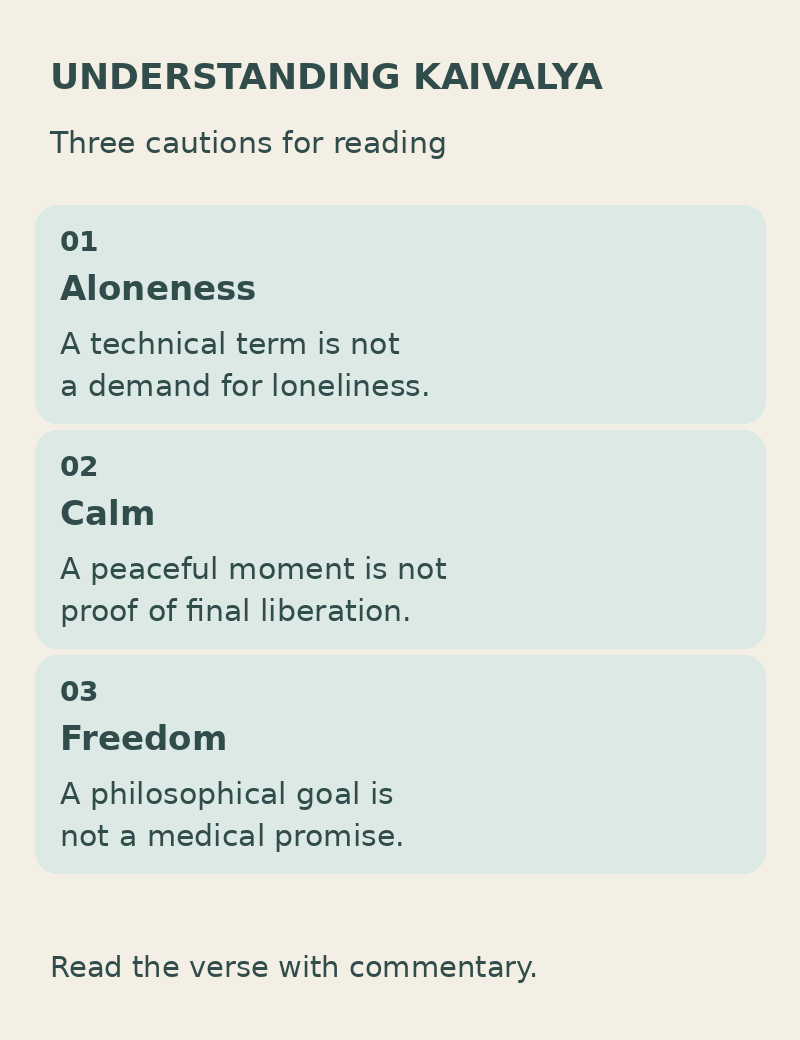
The Centre for Yoga Studies lists independence, freedom, emancipation, solitude, isolation and aloneness among the renderings of kaivalya. Each directs attention toward separation or freedom, but the everyday associations differ.
Isolation can suggest being cut off from friends. Independence can suggest managing money or daily tasks without help. Neither everyday meaning by itself explains the technical philosophical claim.
Integral Yoga Magazine explains the word through distinguishing pure consciousness from the ego-based self that seems to possess consciousness. Its discussion presents aloneness as a way of explaining liberation from ignorance, not as a requirement to be socially abandoned.
When reading, keep the Sanskrit word beside the translation. Ask what is independent of what, rather than letting a familiar English meaning settle the question too quickly.
The setting: purusha and prakriti
The Internet Encyclopedia of Philosophy explains classical Yoga through the distinction between purusha, conscious self, and prakriti, nature. The mind belongs to the latter category in this account, alongside the changing world it encounters.
This is why kaivalya is not simply the mind becoming more confident or the body becoming more flexible. The text’s account asks a different question about consciousness and what it is identified with.
These are philosophical positions, not findings established here by psychology or neuroscience. You can understand how an argument works without presenting its metaphysical conclusion as a medical fact.
Nor should the vocabulary become a reason to disregard ordinary needs. A discussion of consciousness does not remove the need for sleep, care, relationships or practical responsibility.
Kaivalya in Yoga Sutra 2.25
Sutra 2.25 links kaivalya with the ending of the conjunction discussed in the preceding verses. Integral Yoga Magazine presents translations explaining that when ignorance is absent, the confusion of seer and seen ends, and the seer’s independence is described.
The Centre for Yoga Studies uses different wording, referring to the non-appearance of the conjunction and the seer in its abstraction. Its collected commentary by S. Ramaswami explains the passage through the removal of avidya and the aloneness of purusha.
Reading the surrounding discussion is essential. The verse does not ask you to leave a relationship, move to a remote place or refuse assistance. The separation being explained is within the philosophical account of seer and seen.
| English word | Useful emphasis | Do not assume |
|---|---|---|
| Freedom | Release from confusion | Every wish is a rule |
| Independence | Awareness in its own nature | No help is ever needed |
| Aloneness | A technical distinction | Social withdrawal is the goal |
| Liberation | The aim of the path | One calm moment proves it |
The final verse: Yoga Sutra 4.34
The fourth chapter is commonly called Kaivalya Pada. The Internet Encyclopedia of Philosophy identifies liberation as its central subject. The closing verse, 4.34, returns explicitly to kaivalya.
Rama Prasada’s English translation, hosted by Wisdom Library with commentaries, presents two formulations. One concerns the gunas becoming latent when their purpose for purusha is fulfilled. The other concerns the power of consciousness being established in its own nature.
Integral Yoga Magazine describes the same verse through the return of the gunas to their origin and the establishment of awareness in its own nature. The formulations approach the conclusion from different sides of the philosophical framework.
A short paraphrase should preserve both sides instead of replacing the verse with a promise of permanent pleasant feelings. The subject is the text’s account of freedom, not a guarantee about the emotional tone of every future afternoon.
What are the gunas doing in that explanation?
The gunas are the qualities or constituents of prakriti in this system. The Internet Encyclopedia of Philosophy introduces sattva, rajas and tamas and explains their role in both nature and the mind.
In the final verse’s account, their purpose in relation to purusha has been completed. The translated commentary at Wisdom Library develops the language of their becoming latent through an inverse process.
This is a technical account within the tradition. It should not be turned into a claim that a person’s body disappears, that the whole shared world visibly stops, or that a reader can verify liberation by looking for a special physical sign.
For introductory study, note the main relationship: the account of nature’s qualities and the account of consciousness are both involved. You do not need to invent a physical diagram that explains more than the sources establish.
Is kaivalya the same as samadhi?
They are related terms in the Yoga Sutras, but they should not be exchanged casually. Samadhi concerns meditative absorption or integration in the text’s discussions. Kaivalya names the freedom toward which the wider account is directed.
Our samadhi guide explains why even samadhi is not one simple label for feeling relaxed. Learning that vocabulary does not justify calling every unusual sensation kaivalya.
When a teacher describes their relationship, ask which passage and commentary they are using. A list of experiences assembled from several sources can hide important distinctions instead of clarifying them.
How does it relate to viveka?
Viveka is discernment. In the Yoga Sutras discussion, it is connected with the means toward freedom rather than simply being another name for the goal. The Centre for Yoga Studies links the terms in its glossary and commentary collection.
Keeping means and goal distinct helps explain the structure. Learning to describe a distinction is not identical with realizing the final state. Equally, the demanding description of the goal does not make careful introductory study pointless.
This article concentrates on kaivalya’s meaning and the closing verse, rather than presenting a sequence of exercises to reach it. A general guide cannot set a reliable timetable for that claim.
What about moksha and other words for liberation?
Britannica’s account of moksha introduces liberation from samsara, the cycle of death and rebirth, while emphasizing that Indian religious traditions differ in their accounts of bondage and release.
That wider comparison is helpful, but a shared English word does not make the underlying teachings identical. A source discussing kaivalya in classical Yoga may not make the same claims about self and reality as an Advaita Vedanta or Buddhist text.
Begin by identifying the tradition and passage. Comparing their answers is more accurate than announcing that all terms mean exactly the same thing, or that a difference in wording proves complete disagreement.
What this word cannot tell you about a person
A preference for solitude does not certify kaivalya. Neither does unusual confidence, a report of bliss or a claim that ordinary rules no longer apply. This guide cannot assess an individual’s attainment.
The philosophical language of freedom should not be used to excuse mistreatment, remove consent or tell someone that health care is unnecessary. A teaching can be studied respectfully while those practical limits remain intact.
If reflection becomes distressing or interferes with daily life, pause and seek suitable support. There is no need to force an experience in order to understand a definition.
The bottom line
Kaivalya is the Yoga Sutras’ language of freedom, with independence or aloneness describing a technical relation between consciousness and nature. It is not simply loneliness, relaxation or the ability to manage without help.
Read Sutras 2.25 and 4.34 with commentary, notice how translations handle the gunas and consciousness, and keep understanding a teaching separate from claiming to have attained its goal.