
Viveka is often translated as discernment or discrimination. In yoga philosophy, it concerns recognizing a meaningful difference rather than accepting an appearance or assumption without examination.
Its technical role in Patanjali’s Yoga Sutras is more specific than making sensible everyday choices. Viveka-khyati concerns sustained discernment between the seer and the seen, often explained through the distinction between purusha and prakriti.
This guide introduces that textual setting, compares translation choices and explains why an ordinary moment of clarity is not a certificate of liberation. It does not teach an intensive meditation method or make claims about treating illness.
What does viveka mean?
The Centre for Yoga Studies gives discrimination and discernment among the meanings of viveka. Its glossary also describes distinguishing things according to their actual properties. That gives a useful starting point: noticing a difference accurately rather than merely having a strong opinion.
Discrimination has another familiar meaning in English, unfair treatment of people. That is not what the philosophical term asks you to cultivate. Here the word concerns distinguishing or discerning, not ranking people by worth.
Even discernment needs context. A careful practical judgement, an intellectual distinction and the liberating knowledge described in a commentary are not automatically the same achievement. Ask which level the source is discussing.
Viveka-khyati in Yoga Sutra 2.26
Sutra 2.26 contains the compound viveka-khyati alongside aviplava, commonly explained as unwavering or uninterrupted. The Centre for Yoga Studies renders the verse in terms of unwavering recognition of discrimination.
The English translation of Bhoja’s Rajamartanda presented by Wisdom Library uses undisturbed discriminative knowledge. Integral Yoga Magazine presents Swami Satchidananda’s rendering in terms of uninterrupted discriminative discernment.
The shared emphasis is not simply noticing one thing once. The verse concerns a stable kind of knowing in the text’s account of removing ignorance. The different English labels should be read beside the commentary rather than treated as separate techniques.
| Term | Starting meaning | Question to keep open |
|---|---|---|
| Viveka | Discernment | What differs? |
| Khyati | Knowing or recognition | How does this commentary explain it? |
| Aviplava | Unwavering | Why is a passing insight not enough? |
| Upaya | A means or approach | What goal does the passage name? |
What are the seer and the seen?
In this setting, the seer refers to purusha, the principle of consciousness. The seen belongs to prakriti, nature, including the mental as well as the physical. The Internet Encyclopedia of Philosophy explains this framework in its account of classical Yoga.
That inclusion of the mind is important. The distinction is not simply a clever mind observing an inconvenient body. Thoughts, judgements and mental changes are also on the side of what is known or observed within this philosophical model.
S. Ramaswami’s commentary collected by the Centre for Yoga Studies describes Sutra 2.26 through complete, unwavering knowledge of the distinction between purusha and prakriti. Bhoja’s commentary similarly explains discriminative knowledge in terms of the qualities being distinct from the soul.
These are positions within a particular account of reality. A beginner can learn what the argument says without claiming that it has been proved by a brain scan, or that a brief reflection establishes its conclusion.
Why the surrounding discussion of avidya matters
The Yoga Sutra Study explanation of 2.26 connects the verse with the preceding discussion of avidya, mistaken understanding or ignorance, and the conjunction of seer and seen. It explains viveka-khyati as the means of addressing that confusion.
Read that as part of the text’s path toward freedom. It is not a statement that a person who experiences illness or hardship simply failed to think clearly enough.
Nor does ignorance here mean low intelligence or lack of schooling. A person can know many facts while the commentary still asks a different question about identification and consciousness. The philosophical issue is not settled by winning an argument.
Our Yoga Sutras introduction provides the wider map. In this article, the narrower question is what sustained discernment means within that map.
Why one good decision is not viveka-khyati
Integral Yoga Magazine explicitly distinguishes the discernment discussed in 2.26 from simply telling one color or everyday object from another. Its explanation concerns the refined discernment between mind and Self.
That prevents an easy exaggeration. Choosing a suitable class, correcting a mistaken assumption or pausing before a reply can be responsible actions. None by itself proves that the unwavering state discussed in the verse has been reached.
A modern example can still make a lesson approachable. Suppose you realize that you have mistaken a prediction for a fact. Correcting the statement is useful. Describe it as a practical act of checking understanding, not as evidence that you have completed the classical path.
Discernment belongs to a wider discipline
The Internet Encyclopedia of Philosophy presents the eight limbs of yoga as part of the means toward discriminative discernment. The Yoga Sutra Study commentary also connects the development of this knowledge with study, contemplation and practice.
This is different from treating viveka as a clever mental shortcut. The teaching places it within a sustained discipline, not a contest to produce the most impressive explanation of a Sanskrit term.
It also means a general article cannot responsibly promise a fixed timetable. Learning the vocabulary, understanding a commentator’s argument and claiming realization are different matters. There is no need to pretend the last has happened in order to begin the first.
Viveka in the fourth chapter
Sutra 4.26 returns to the theme. The Centre for Yoga Studies translates the passage in terms of the psyche inclining toward discrimination and having a propensity toward abstraction. Its glossary offers independence, freedom and isolation among the renderings of kaivalya.
The commentary by S. Ramaswami explains the mind as moving toward kaivalya, with purusha-prakriti-viveka becoming dominant. This continues the same technical concern rather than introducing a new rule for shopping, planning or social confidence.
Read then in the verse as part of an ongoing argument. Removing the sentence from its setting can make a description of the path sound like an instruction that applies immediately after any pleasant experience.
How it differs from vairagya and jnana yoga
Vairagya is commonly introduced as dispassion or non-attachment. Viveka concerns discernment. The ideas can be connected in a teaching, but replacing both with a general instruction to let go hides their different roles.
Jnana yoga names a path of knowledge and inquiry in traditions that may use a different philosophical framework. The word viveka appears beyond the Yoga Sutras, so check whose account of self and reality a source is explaining.
This guide stays with the Yoga Sutras passage rather than declaring every use of discernment identical. Learning where a term appears is a better beginning than combining several systems into a single universal slogan.
Reading without turning the idea into self-judgement
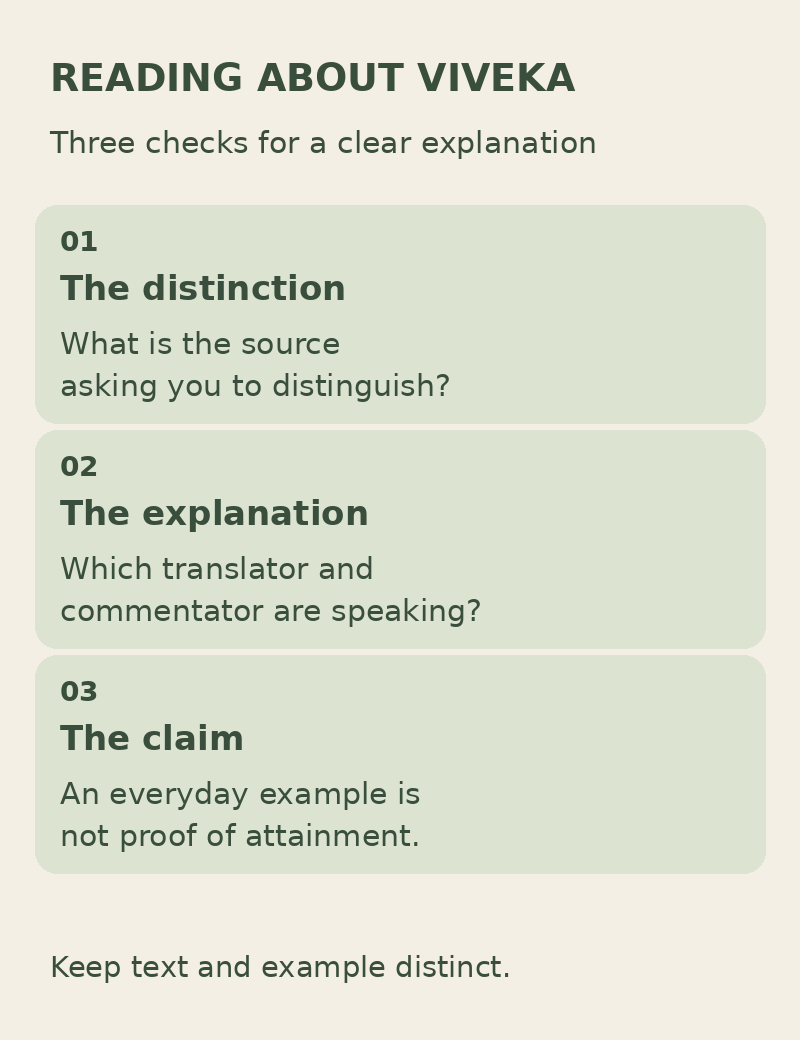
Begin with a named translation of 2.26 and its commentary. Write down what is being distinguished, how the source explains unwavering knowledge and what the surrounding verses are addressing.
Then mark any modern example separately. An illustration about checking a timetable or revising a judgement can help a discussion, but it is not a replacement for the text’s account of purusha and prakriti.
Leave uncertain points as questions. A clear question to a suitable teacher is more useful than announcing an inner state you cannot explain. Equally, no claim of spiritual insight should remove your ability to ask questions, keep boundaries or seek professional care.
If inward reflection becomes distressing, pause it. A philosophical term is not a reason to ignore practical needs or force an unfamiliar experience.
The bottom line
Viveka means discernment, with a specific role in the Yoga Sutras as sustained recognition of the distinction between seer and seen. The word is wider than everyday good judgement and more precise than a vague feeling of clarity.
Study the translation and commentary together, keep practical examples modest and do not confuse learning the idea with certifying attainment.