
Vritti is a Sanskrit word often translated in yoga as a modification, activity or fluctuation of the mind. In the opening chapter of Patanjali’s Yoga Sutras, it covers more than distracting thoughts: the discussion includes accurate knowledge, error, imagination, sleep and memory.
That wider meaning matters. If vritti becomes a synonym for bad thinking, the five-part classification stops making sense. Accurate understanding and remembering something can also belong to it.
This guide explains the vocabulary and the passage around Sutras 1.5–1.11. It is a reading guide, not an instruction to force the mind blank or a test of mental health.
What does vritti mean in this passage?
The Internet Encyclopedia of Philosophy describes vritti broadly in terms of mental states and activities, including thoughts, ideas and cognition. The Centre for Yoga Studies presents the five groups as right perception, wrong perception, imagination, deep sleep and remembrance.
Translations such as thought wave, modification and fluctuation offer different ways into the subject. None should be mistaken for a claim that a literal wave can be seen moving through the brain. A metaphor can introduce an idea without supplying a medical explanation.
Keep the Sanskrit word beside the English rendering when studying. It helps you notice when two books are discussing the same term with different wording, rather than assuming they have discovered separate kinds of mind.
Where the five vrittis appear
Sutra 1.5 introduces a fivefold classification and the distinction commonly written as klishta and aklishta. Sutra 1.6 names the five activities. The following verses explain them individually.
That sequence prevents a common reading mistake. The five names are not five stages that everyone must complete in order. Nor are they five personality types that divide people into permanent groups.
Our Yoga Sutras introduction covers the work as a whole. Here the focus is narrower: understanding this particular classification and why its categories are not interchangeable.
| Vritti | Starting meaning | Reading caution |
|---|---|---|
| Pramana | Valid knowledge | Confidence alone is not evidence |
| Viparyaya | Error or mistake | Not a label for disagreeing people |
| Vikalpa | Imagination or verbal construction | More specific than all creativity |
| Nidra | Sleep, especially deep sleep | Not proof of meditative attainment |
| Smriti | Memory or recollection | Not identical with a latent impression |
Pramana: valid knowledge
Sutra 1.7 identifies perception, inference and reliable testimony as means of valid knowledge. The interpretive translation presented by Yoga Education explains these as knowing through perception, reasoning and communication from knowledgeable others.
An ordinary illustration is checking a class time. You might read the current timetable, reason from a stated schedule, or ask the organizer. These are modern examples to make the distinction familiar, not examples quoted from the sutra.
Being very certain is not itself another source of valid knowledge. A strong feeling about the timetable still needs to be checked against the actual information. The category concerns how knowing is understood, not how confidently a sentence is spoken.
Viparyaya: taking something to be what it is not
Sutra 1.8 concerns erroneous knowledge. The translation comparisons hosted by Sanskrit Documents describe it in terms of misinterpreting reality or taking an understanding as correct when it does not match the object.
For a simple illustration, imagine reading an old timetable as if it were the current one. The page exists, but the conclusion about today’s class is mistaken. New information can reveal the error.
This is not permission to call every disagreement viparyaya. First establish what the other person means and what evidence is available. The Sanskrit word should make inquiry more careful, not replace an argument with an insult.
Vikalpa: why imagination needs a fuller explanation
Imagination is a common introductory rendering of vikalpa. The Internet Encyclopedia of Philosophy gives a more specific account involving words or expressions without a corresponding actual object, and discusses metaphor as an example.
This helps explain why the term cannot simply mean every useful creative act is wrong. Expressions such as time flying can be understood without describing a physical object with wings. The relation between words and what they refer to is part of the question.
Different introductions emphasize fantasy, verbal construction or imagination. Record which explanation your translator gives rather than flattening them into a rule against making art, planning a project or enjoying a story.
Nidra: why sleep is included
Sleep can seem surprising in a list of mental activities. Sutra 1.10 treats nidra as a distinct vritti. The encyclopedia explains the traditional argument partly through the recollection, after waking, of having slept.
This is a philosophical account of mind and experience. It should not be presented as a complete modern description of sleep physiology or as evidence that ordinary deep sleep is the same as samadhi.
It also does not make the list an instruction to reduce necessary sleep. Reading a category in a classical text is different from receiving advice about an individual sleep problem.
Smriti: memory or recollection
Sutra 1.11 concerns retaining or recalling what has been experienced. In the Yoga Education translation, the explanation emphasizes the reproducing of an earlier impression rather than adding characteristics from elsewhere.
A simple modern illustration is remembering the room where a class took place. That act of remembering is different from the room itself and different from a new perception of it.
The technical definition is not a guarantee that every ordinary recollection is perfectly accurate. Do not use it to certify a disputed memory or claim that a teacher can recover an exact hidden event.
Klishta and aklishta are a separate distinction
The Vedyog commentary on Sutra 1.6 distinguishes the five named categories from their afflictive or non-afflictive character. The Internet Encyclopedia of Philosophy relates that distinction to the goal of yoga and the kleshas.
It is therefore too simple to mark imagination as always bad and accurate knowledge as automatically the final goal. The text places these activities within a larger account of practice and liberation.
English terms vary. The comparison notes at Sanskrit Documents include beneficial and problematic, while other sources use painful and not painful or colored and uncolored. Read the explanation, not only the short adjective.
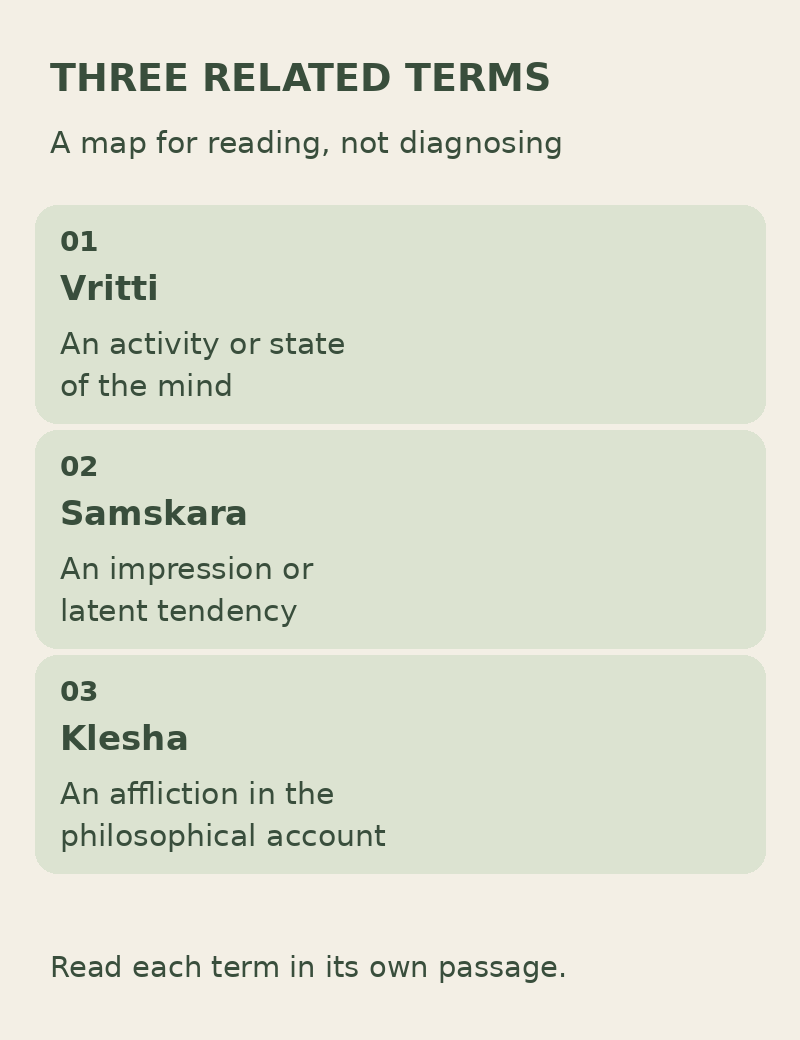
Vritti, samskara and klesha are not one list
A vritti is discussed here as an activity or state of mind. Samskara points toward an impression or latent tendency in the traditional account. A klesha is an affliction, with its own fivefold list elsewhere in the text.
The encyclopedia explains a relation between active mental states, their impressions and later memory. That relation does not make the words synonyms. Remembering a conversation, the disposition left by experience and an affliction influencing a response are different explanatory ideas.
Do not diagnose yourself or someone else by assigning a Sanskrit label to every reaction. These distinctions belong to a philosophical framework and do not replace health assessment, practical evidence or listening to another person.
Does yoga mean fighting every thought?
Sutra 1.2 connects yoga with citta, vritti and nirodha. YogaBasics collects translations using restraint, control, quieting and sustained direction. Their wording needs commentary and context rather than an improvised instruction to struggle harder.
Sutra 1.12 then places practice and non-attachment together. A short introduction cannot turn that wider path into a technique for instantly stopping all thought.
For study, compare how an edition explains nirodha with its account of the five activities. If an exercise becomes distressing, stop and seek suitable guidance. An uncomfortable experience is not something to force through merely to match a slogan.
The bottom line
Vritti is wider than distracting mental chatter. The fivefold classification includes knowing, error, imagination, sleep and memory, while klishta and aklishta introduce another distinction about their character.
Read the surrounding verses, keep translator choices visible and separate vritti from samskara and klesha. The aim of this guide is clearer understanding of the text, not a score for how few thoughts you can have.