Nada yoga is commonly introduced as the yoga of sound. Its subject is more than choosing a relaxing playlist: traditional accounts connect sound, attention and contemplative absorption within a spiritual understanding of practice.
The name can appear on music workshops, chanting sessions and descriptions of inward meditation. Those activities are not automatically the same method. Before joining a class or interpreting a passage, ask what the teacher means by nada and what the session actually involves.
This guide explains the vocabulary and some source differences. It does not teach advanced inner-sound practices, prescribe breath retention or interpret ringing in the ears as spiritual progress.
What does nada yoga mean?
Yogapedia introduces nada yoga as union through sound and distinguishes external sound from an internal or unstruck sound. The Himalayan Yoga Institute describes a path exploring consciousness through sound, with connections to music and devotional practice.
These are explanations of a spiritual tradition. Statements about cosmic vibration, subtle centres or consciousness should be identified as teachings, not presented as established findings in acoustics or medicine.
For a first orientation, keep the central question modest: how is sound understood and attended to in this particular teaching? That is more useful than assuming that every pleasant musical experience is a complete nada yoga practice.
Ahata and anahata: the important distinction
Ahata is often explained as struck or produced sound. A played string, a bell or a human voice offers a familiar example of an externally produced sound. Anahata is commonly translated as unstruck and has a different role in traditional contemplative accounts.
The distinction is not simply loud versus quiet. Turning a recording down does not establish that an unstruck sound has appeared. Nor does the label identify a frequency that can be purchased or a sensation that proves attainment.
In a Yoga magazine account, Swami Satyananda also distinguishes the meanings of anahata, unstruck, and anahad, without limit. English spellings can hide that difference. Read the explanation supplied by the source rather than treating every similar-looking word as interchangeable.
| Term or activity | Useful starting point | Avoid assuming |
|---|---|---|
| Ahata | Produced or struck sound | Every sound is a prescribed exercise |
| Anahata | Unstruck sound in traditional accounts | A ringing ear proves realization |
| Music listening | A real musical experience | Enjoyment equals meditative absorption |
| Nada yoga class | A label that needs explanation | All teachers use one method |
Nada in the Hatha Yoga Pradipika
The fourth chapter of the Hatha Yoga Pradipika gives substantial attention to nada within its discussion of absorption. A public-domain translation on Wikisource describes inner sound, changes in its perceived qualities and the mind becoming absorbed.
The Essential Way presents a short passage numbered 4.65–68 introducing nada practice. Online editions can divide and number passages differently. When comparing sources, check the actual wording and translator rather than relying on the number alone.
The passage belongs to a larger practice text, not an isolated promise that a beginner can obtain a particular state by copying a few lines. Descriptions of sounds and spiritual results are part of that text’s account. They are not a diagnostic checklist or evidence that a recording treats illness.
This overview deliberately leaves the passage’s physical techniques to qualified individual teaching. Reading about a method does not establish that it is suitable for you to perform.
Why a playlist is not the whole teaching
Sandra Anderson’s Himalayan Institute article explains nada as an inward sound in the text’s contemplative setting and explicitly distinguishes it from something found on a playlist. Its emphasis is the prepared, concentrated mind rather than a particular piece of equipment.
Other modern introductions begin with external music. The Himalayan Yoga Institute discusses classical music, devotional singing and mantra within its broader explanation. These emphases need not be forced into one identical class plan.
A teacher might use music as an entry point, while a commentary discusses an advanced inward state. Ask which level is being described. Otherwise, an introductory listening activity can be mistaken for the complete goal of the tradition.
Our music and meditation guide addresses the separate practical question of whether to add audio to an ordinary attention exercise. Nada yoga’s historical and spiritual vocabulary is a different subject.
How it relates to japa and kirtan
The boundaries overlap in some teachings. The Himalayan Yoga Institute includes mantra recitation, chanting, bhajans and kirtan in its discussion of how sound is explored. That tells you about its approach, not a universal classification for all communities.
Japa centres on repetition of a mantra or divine name. Kirtan concerns devotional singing or musical recitation in particular religious settings. Nada yoga draws attention to sound and contemplative absorption, but should not erase the words, devotion or community behind a chant.
Calling a devotional song sound practice does not make its language meaningless or remove its religious context. Learn whose teaching you are encountering and what participation means before deciding whether to join.
Four levels of sound are a teaching model
The Yoga magazine explanation discusses para, pashyanti, madhyama and vaikhari as levels of sound, moving between subtle and audible descriptions. It connects them with its account of consciousness and practice.
Study these as terms within that account. Do not convert them into a universal scale of measurable frequencies, a hearing test or a ranking of people’s experiences. A translation can help explain a model without proving every metaphysical claim it contains.
Similarly, a traditional comparison with a flute, a bee or a bell need not describe an actual instrument playing nearby. The source’s purpose and surrounding explanation matter.
Do not turn ear symptoms into a spiritual test
The US National Institute on Deafness and Other Communication Disorders defines tinnitus as perceived sound without an external source. It can include ringing, buzzing, humming and other sounds.
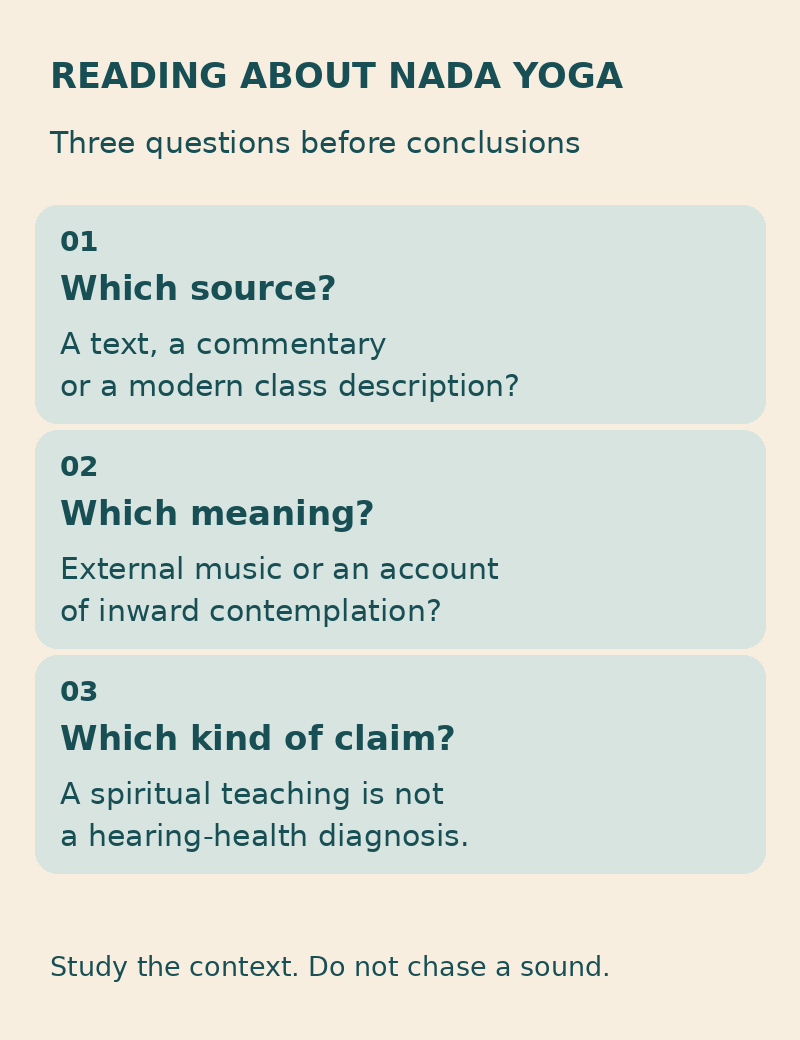
That overlap in everyday descriptions is a reason for care, not a reason to diagnose yourself from a yoga text. A general article cannot decide whether a sound is tinnitus, another hearing concern or something else.
If you have tinnitus, NIDCD advises seeing a primary care doctor as a first step; further assessment may involve an ear specialist or audiologist. Do not delay assessment because someone calls an unexplained sound a sign of awakening.
This guide does not recommend blocking the ears, pressing the eyes, holding the breath or intensifying inward listening to chase a sound. If a practice becomes distressing, stop and seek suitable guidance.
Questions to ask about a modern class
- Which teacher, text or tradition informs the session?
- Does it involve music, devotional chanting, spoken instruction or inward attention?
- What do the words mean, and can you listen without joining a chant?
- Does it include physical techniques beyond ordinary sitting and listening?
- Can you stop, ask questions or choose another activity without pressure?
A class description should make these differences clear. A photograph of a musical instrument does not tell you whether the session is a concert, a devotional gathering or an intensive meditation workshop.
Be cautious when a course promises guaranteed healing, a fixed date for realization or a special frequency that resolves every problem. The sources used here do not establish those promises as medical facts.
The bottom line
Nada yoga concerns sound within traditions of contemplation, not simply a soothing soundtrack. Learn the difference between produced sound and the traditional idea of unstruck sound, read passages in context and ask what a modern teacher actually offers.
Keep spiritual explanations separate from health assessment. You can study this vocabulary respectfully without chasing unusual sounds or claiming an experience you have not had.