
In yoga philosophy, samskara is often explained as a mental impression, tendency or latent trace. It helps describe how earlier experience and action can condition what happens in the mind later.
The word is easy to reduce to a slogan about breaking bad habits. Its textual setting is wider: it appears in discussions of memory, meditation, conditioning and liberation.
This guide introduces that philosophical vocabulary. It does not diagnose hidden causes of behaviour, identify past lives, or claim that a yoga exercise can erase trauma or unwanted memories.
What does samskara mean?
The Centre for Yoga Studies lists tendencies, psychological imprint, mental impression and habitual potency among the meanings of samskara. Sanskrit dictionaries collected by Wisdom Library also include preparation, refinement, training and recollection, alongside ritual meanings.
There is no single English word that works perfectly in every passage. Impression suggests a trace left by an experience. Tendency suggests a possibility of responding in a familiar direction. Latent points to something not currently active.
In a yoga discussion, these words belong to a model of mind and practice. They should not be treated as names for objects that a teacher can locate in a scan, a muscle or a person’s posture.
An impression is not the same as an active thought
A useful introductory distinction is between what is happening in the mind now and a trace or disposition that may influence later activity. An active thought is present; a latent impression need not be appearing as a clear thought at that moment.
In his Himalayan Institute explanation, Pandit Rajmani Tigunait describes a cycle in which thought and action leave impressions, and impressions influence further thought and action. This is an account within yoga’s teaching about karma, not a clinical test.
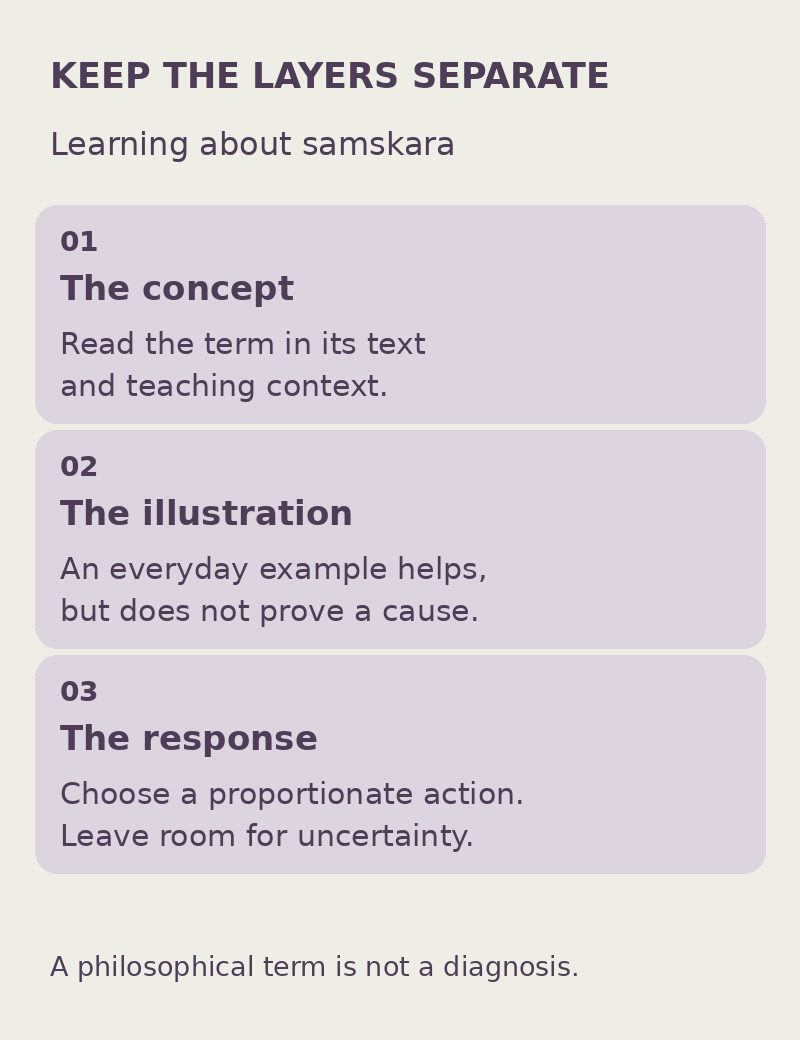
For an ordinary illustration, imagine reaching for your phone when there is a pause in a task. You may notice the action before noticing any deliberate decision. The example makes repeated responding easier to discuss; it does not prove that you have identified a specific samskara.
Related words without mixing them together
| Word | Starting explanation | Keep in mind |
|---|---|---|
| Samskara | Impression or latent tendency | Meaning depends on context |
| Vritti | Activity or movement of mind | Not simply the same as its trace |
| Smriti | Memory or recollection | Related to, not identical with, impression |
| Samsara | The cycle of birth and rebirth | A different word and concept |
The Centre for Yoga Studies groups samskara with vritti and smriti in its related vocabulary. These short descriptions help with orientation, but a translator’s explanation of the actual passage still matters.
Vasana is another related term, commonly discussed as a disposition or inclination. Teachers do not always draw its boundary with samskara in precisely the same way. Do not assume that every diagram online expresses one agreed classification.
Where it appears in the Yoga Sutras
The Centre for Yoga Studies indexes samskara in several parts of the Yoga Sutras, including verses 1.18 and 1.50. That spread is a reminder that the concept is not limited to a beginner’s discussion of routine.
Verse 1.50 is particularly useful for avoiding the idea that every impression is simply bad. The Centre renders it in terms of tendencies born from the preceding experience opposing other tendencies. Yoga International’s commentary explains it through impressions born of intuitive wisdom.
Notice the word preceding. The verse refers back to a discussion of meditative insight. It is not a promise that repeating any preferred sentence will cancel every unwanted pattern.
Our Yoga Sutras introduction explains why translation, commentary and surrounding verses should be read together. Keep a teacher’s contemporary example separate from the short wording of the sutra.
Are all samskaras negative?
No simple list of bad habits captures the term. The discussion of verse 1.50 includes an impression associated with insight, while the Himalayan Institute account describes impressions of different strengths and qualities.
That does not mean the traditional goal is merely collecting pleasant habits. The wider text concerns liberation, and its account of practice is more demanding than a general self-improvement plan.
It also does not mean that a strong preference is proof of spiritual progress. Enjoying one kind of class, feeling quiet for an afternoon, or noticing less distraction cannot certify the state discussed in the text.
Why habit is a useful but incomplete translation
Habit points toward repeated behaviour that is familiar in everyday life. Samskara can refer to the latent impression or potency involved in a philosophical explanation of such patterns, rather than only the outward behaviour.
Consider the difference between a visible action and an explanation for why it recurs. The action might be interrupting someone. The explanation could involve expectations, learned responses, the immediate situation and other factors.
Calling the action a samskara does not settle those causes. It should not replace listening to the person, checking the present circumstances or taking responsibility for a practical repair.
Use the vocabulary to make a question clearer, not to end the question before it has been investigated.
Samskara and samsara are different
The words look and sound similar in English spelling. Samskara, with the additional k, is the word discussed here as impression or conditioning. Samsara refers to the cycle of birth and rebirth in Indian religious and philosophical traditions.
Britannica’s samsara entry discusses that cycle and the search for release. The traditions differ in how they explain the person, continuity and liberation, so even that short definition needs its own context.
You do not need to turn an everyday reflection on repeated behaviour into a factual claim about a previous life. A general article cannot verify that an event happened in another birth or assign it as the cause of someone’s present difficulty.
Why the same word also names ceremonies
Samskara also has a well-established ritual use. Britannica describes samskaras as sacraments or rites associated with stages of Hindu life, with considerable variation by community and custom.
A naming ceremony and a mental impression are therefore not rival dictionary answers. They are different uses of the same Sanskrit term in different settings.
When reading, first identify the subject. Is the source discussing ceremonies, a philosophical account of mind, or another use such as refinement or preparation? Context prevents a technically correct definition from becoming the wrong explanation for the passage.
A small reflection, not a method for erasing impressions
If the idea interests you, choose an ordinary, manageable repeated action rather than a painful memory. Write down what actually happened and what you noticed, without claiming to uncover its ultimate cause.
For example: a notification appeared, you opened it, and you lost your place in a reading task. A practical response might be moving the phone away while reading. That is an ordinary planning choice, not a classical technique or proof that a samskara has been removed.
Leave room for uncertainty. Perhaps the interruption was necessary, the task was unclear, or the setting was too noisy. A Sanskrit label does not make those facts irrelevant.
Do not use this reflection to force yourself or someone else to revisit distressing events. Stop if it becomes overwhelming and seek appropriate support.
Do not turn philosophy into blame or treatment
It is not responsible to tell a person that illness, abuse or misfortune happened because of hidden impressions they failed to purify. This guide cannot determine such causes, and a spiritual explanation must not excuse another person’s harmful actions.
Nor should a teacher promise that a posture, breath exercise or meditation will delete trauma, recover accurate hidden memories or replace professional care. Learning a philosophical term does not establish a medical mechanism.
You can study yoga’s account of conditioning while describing health concerns in ordinary language and seeking qualified assessment. The two activities answer different questions.
Questions for further study
- Which meaning of samskara is being used in this passage?
- What is the difference between the translated text and the commentary?
- How does the surrounding discussion explain memory or meditation?
- Is an example being offered as an illustration or as a claim about a real cause?
- What remains uncertain after reading the explanation?
Clear source notes are more useful than deciding that every familiar reaction reveals a hidden spiritual problem.
The bottom line
Samskara is a context-dependent term often introduced in yoga as an impression or latent tendency. Read it beside the text’s account of mind and practice, distinguish it from samsara and ritual uses, and keep modern examples modest.
The vocabulary can support careful study without becoming a diagnosis, a judgement of worth or a promise that unwanted experience can be erased.