
Sadhana is commonly translated as spiritual practice. It refers to the means used in working toward a spiritual or religious aim, not to one universal yoga sequence.
You may hear the word used for a personal discipline, a community gathering, a course of practice taught within a lineage, or a written ritual text. The surrounding tradition tells you more than the word alone.
This guide explains those different uses. It does not prescribe a spiritual programme, teach initiation-dependent methods, or promise that a routine will produce enlightenment or a health result.
What does sadhana mean?
Oxford’s A Dictionary of Hinduism introduces sadhana as a means of accomplishing something and, in religious use, a practical means to a spiritual end. The Centre for Yoga Studies also gives meanings connected with means, accomplishment and going toward a goal.
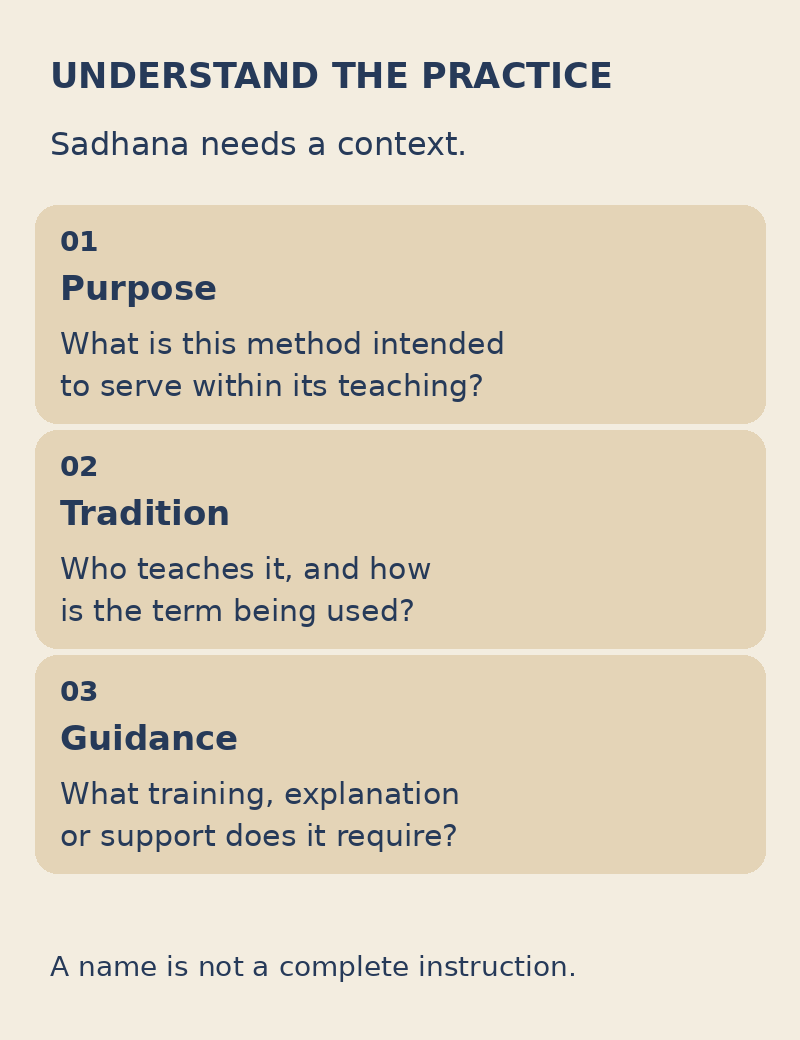
That makes the relationship between method and purpose important. What is being practised? What is it intended to serve? How does the teaching explain the connection?
In a yoga setting, a teacher might describe study, ethical observances, meditation, devotion or appropriately taught physical practices as parts of sadhana. These are possible forms, not a compulsory checklist for every person.
A person undertaking such practice may be called a sadhaka. Learning the word does not establish a rank or certify spiritual achievement.
Why it is more than a new word for routine
A routine describes something done regularly. Sadhana usually adds a relationship to a spiritual purpose or path. The same outward activity can therefore be understood differently in different settings.
Reading a book for entertainment, studying it for an examination, and studying a religious text with a teacher are not identical activities simply because all involve reading. Purpose and context help explain the difference.
In an Integral Yoga Magazine interview, David Frawley presents yoga as sadhana rather than only a workout or wellness activity. His explanation includes values, study and ways of living alongside formal practice.
That is a teaching account within a spiritual framework. It should not be converted into a scientific claim that adopting the label changes the effects of an activity.
Different settings, different meanings
| Setting | Possible meaning | Useful question |
|---|---|---|
| Yoga teaching | A spiritual discipline or course of practice | What aim and methods are taught? |
| Personal practice | A regular commitment within a path | What guidance supports it? |
| Community event | A shared session with a particular format | What happens during the session? |
| Tantric text | A specific ritual or meditation manual | What training or permission is needed? |
These uses overlap, but they should not be treated as interchangeable. An event listing and a classical text may use the same word for very different things.
Sadhana in the Yoga Sutras
The second chapter of Patanjali’s Yoga Sutras is conventionally called Sadhana Pada. The Centre for Yoga Studies identifies the word with that chapter title, and the Integral Yoga interview discusses the chapter’s concern with practice.
The title is often introduced as a chapter about practice or the means of realization. It does not mean the chapter is a ready-made modern morning workout.
For the wider setting, read our introduction to the Yoga Sutras. A translation and its commentary are more useful than treating a chapter heading as a complete instruction.
When a teacher connects a contemporary practice with this text, ask which passage and interpretation they are using. A modern application can be thoughtful without being presented as an exact sequence dictated by Patanjali.
How is it related to abhyasa?
Abhyasa is another term often translated as practice. The Centre for Yoga Studies lists it among concepts related to sadhana. Related does not mean the words have precisely the same function in every passage.
Our abhyasa guide focuses on practice and steadiness in the opening chapter of the Yoga Sutras. Sadhana is useful here as the broader question of the means and spiritual framework being followed.
Do not turn this into a rigid dictionary rule that must work everywhere. Sanskrit terms gain meaning from the text, commentary and teaching situation. Ask how the speaker is using them rather than relying on an English synonym alone.
Can ordinary life be sadhana?
Some teachers extend the idea beyond a formal session. In Isha’s explanation, Sadhguru describes using everyday activities and conduct as part of sadhana. The Integral Yoga interview also discusses work and daily life within a spiritual discipline.
These accounts help explain why the word may appear outside a meditation room. They do not mean that every ordinary action is automatically the same as a specific religious practice.
A useful reading distinction is between a broad teaching about approaching life and a precise instruction for a particular method. The first does not erase the training, commitments or beliefs associated with the second.
Must sadhana be done alone?
Not as a universal rule. Some introductory descriptions emphasise individual practice. Yogapedia even says it must be practised alone, while 3HO explicitly describes both individual and group sadhana.
That disagreement is a reason to avoid presenting one website’s instruction as the definition for all traditions. A group session may have its own recitations, music, movement and expectations.
If you see a community event advertised as sadhana, ask whether it is open to newcomers and what participation involves. Observing, joining a chant and receiving a formal practice are different kinds of involvement.
Does it have to happen before sunrise?
Some communities give early morning a special place. 3HO’s account, for example, describes an early-morning format but also says that people unable to practise then can choose another time.
This is not evidence that everyone must lose sleep or follow the same timetable. Nor does a tradition’s account of auspicious timing establish a measured biological advantage for every reader.
Ask what belongs to the method you are learning and what can be adapted. Do not infer a universal requirement from a sample community schedule.
What about fixed-day challenges?
You may encounter courses or commitments framed around a set number of days. The number and its explanation belong to that programme, not to the basic meaning of sadhana.
For example, 3HO presents specific day counts within its teaching. This guide does not treat those counts as scientifically established deadlines for changing habits, rewiring the nervous system or achieving a permanent inner state.
Before committing, ask what the programme requires, how missed sessions are handled, and whether the method can be adjusted. A clear explanation matters more than an impressive promise.
Religious context deserves care
Britannica describes a more specialised use in Hindu and Buddhist Tantric settings, including written practices involving mantras, gestures and visualisation. That is not simply another name for a general stretching class.
A beginner’s definition is not sufficient instruction for those practices. Learn about the relevant tradition and seek appropriate guidance rather than assembling ritual elements from unrelated websites.
You can also ask respectful questions about belief and participation. Understanding a term does not oblige you to adopt a religious identity or take part in a practice whose meaning has not been explained.
Questions before joining a sadhana session
- Which tradition or teacher provides the method?
- What happens during the session, and what is its stated purpose?
- Is it suitable for newcomers, or does it require prior training?
- Are chanting, touch, movement or particular beliefs expected?
- What can I observe, decline or adapt?
- Who can explain questions or difficulties afterward?
These are practical questions, not a test of devotion. An unfamiliar Sanskrit name should not prevent you from understanding what you are being invited to do.
The bottom line
Sadhana names spiritual means and practice, with forms that depend on the tradition and aim. It can involve a formal session and, in some teachings, a wider approach to daily life.
Start with context: whose teaching, which purpose and what guidance? That gives the word more substance than treating it as a fashionable label for any routine.