Yoga and walking are not competing versions of the same activity. Walking can be a way to get somewhere, enjoy company or build aerobic activity. Yoga is a wider practice that may include postures, breathing, meditation and other elements.
If you are deciding where to begin, compare a particular yoga class with a particular kind of walk. A supported class and an uphill walk have different demands from a vigorous flow and a short stroll.
This guide looks at the practical choice without prescribing a routine, promising weight loss or treating either activity as best for everyone.
What do you want from the activity?
A useful first question is whether you want to explore yoga itself, add purposeful walking to your day or simply find an enjoyable way to move. Those are different aims, and each can lead to a reasonable choice.
Walking may fit a journey to work, a visit to the shops or time with a friend. The NHS suggests these ordinary opportunities as ways to build a walking habit. You do not have to travel to the countryside for a worthwhile walk.
A yoga class offers a different setting: time set aside for a taught practice, often with options to change positions or use support. Ask what is taught rather than assuming the word yoga means only stretching.
Yoga varies more than the label suggests
NCCIH describes yoga as an ancient and complex practice rooted in Indian philosophy. Many contemporary classes emphasise physical postures, breathing techniques and meditation, while classical yoga includes other elements too.
Styles range from gentle to physically demanding. A class may involve repeated standing transitions, supported rest, attention to breathing or a mix of these. The pace, instruction and available alternatives matter more than a promotional photograph.
Before starting, ask whether the class involves kneeling, wrist loading or getting down to the floor. If those are difficult, discuss suitable options instead of expecting yourself to adapt without help.
Walking also has different forms
A short comfortable walk, a brisk fitness walk and a long hilly outing are not interchangeable. Distance alone does not describe the challenge: surface, gradient, weather and your current ability all matter.
There is also a difference between walking for aerobic activity and using walking as a meditation practice. Paying attention to steps can be part of a contemplative practice, but it does not establish that the pace meets an aerobic goal.
You can value an easy stroll without calling it a workout. You can also choose a purposeful walk without turning it into a race or a target set by somebody else’s device.
Yoga and walking compared
| Question | Yoga | Walking |
|---|---|---|
| Main form | A taught or personal practice | Moving along a route |
| Effort | Varies with the class | Varies with pace and terrain |
| Starting help | Qualified teacher and suitable options | A suitable route or supported group |
| Access | Space, class access and any props | A usable route and suitable footwear |
| Useful check | Positions and transitions | Surface, distance and return route |
The table helps you compare actual options. It does not tell you which will feel easier on a particular day.
When does walking count as aerobic activity?
The CDC lists fast walking among examples of moderate-effort aerobic activity. It also explains that intensity depends on the person: an activity that feels moderate for one person may feel vigorous for another.
The NHS describes a brisk pace as one where you can still talk but cannot sing. This is a general effort guide, not an instruction to push through symptoms or ignore advice about your health.
If you are inactive but able to walk, the NHS recommends increasing distance gradually. Starting at a manageable level is more useful than trying to reach a brisk pace immediately because a general article mentions it.
Yoga is not automatically equivalent to a brisk walk for this purpose. Some postures can be demanding without supplying the same kind of sustained aerobic work. Look at what the session involves and how it fits your broader activity needs.
What about strength and bone health?
The CDC separates aerobic activity from muscle-strengthening work and includes some yoga postures among strengthening examples. That does not mean every class sufficiently challenges every major muscle group.
Walking should not be assumed to replace all strengthening activity either. A regular walking habit can be valuable while leaving other kinds of movement to consider.
Harvard Health describes walking as weight-bearing activity, meaning you carry your body weight against gravity. Its bone-health guidance also discusses resistance and balance as separate exercise features. This is a reason to consider a varied programme, not to declare walking or yoga a complete solution for bones.
If bone health is a concern, seek advice on suitable exercise rather than copying difficult poses or adding hills without considering your circumstances.
Which is easier to fit into a busy day?
Walking may fit an existing journey, while a class may need a fixed time and travel. But a nearby walking route is not automatically usable, and home yoga is not automatically practical in a crowded or unsuitable space.
For walking, consider the whole outing, including getting home. Check crossings, surface changes, available rests, toilets if needed, lighting and the conditions you expect on the return journey.
For yoga, consider class length, transport, changing space and how much personal guidance you want. Ask whether equipment is available and whether the teacher can explain alternatives clearly.
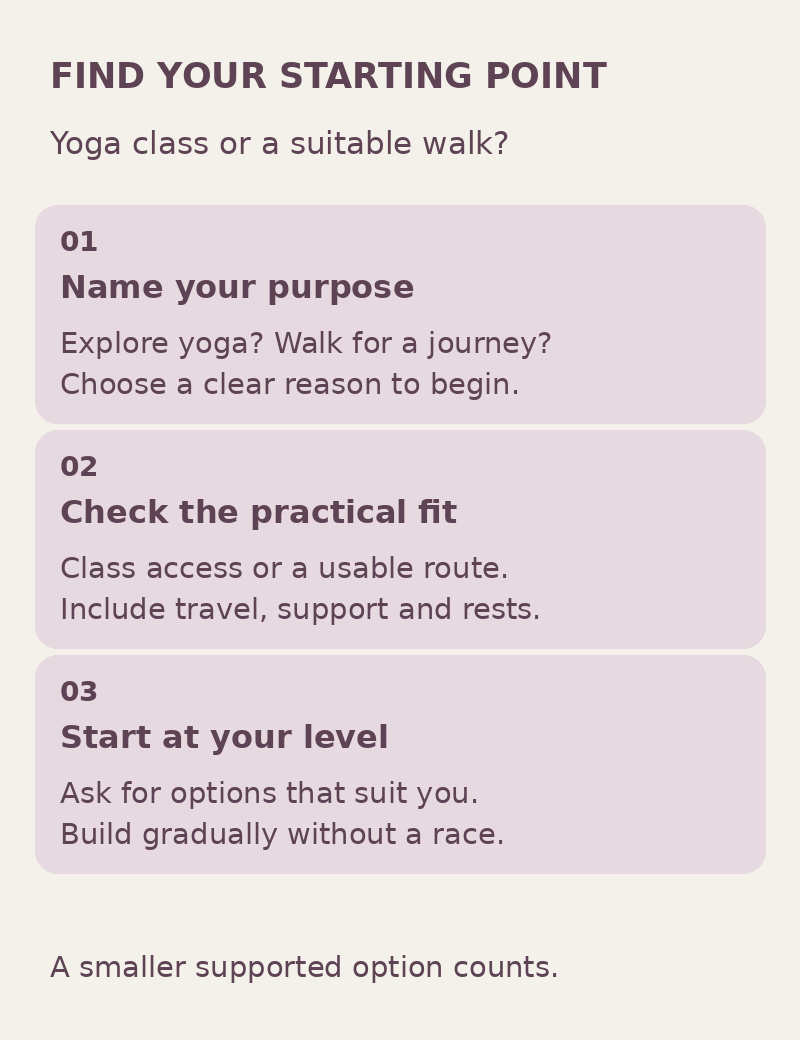
Compare the real time commitment, not an ideal version of your day. A small option that fits may be more workable than a large plan that needs everything to go perfectly.
Walking needs practical preparation too
Mayo Clinic recommends comfortable, supportive shoes that fit well, clothing matched to the weather and carefully chosen routes. It advises safe, well-lit locations and an indoor option when outdoor conditions are unsuitable.
The NHS notes that ordinary comfortable shoes or trainers can be enough for a shorter walk if they provide support and do not cause blisters. More challenging routes may call for different preparation.
A route that suits another walker may not suit your balance, endurance or mobility aid. Ask about steps, gradients and surfaces before joining a group rather than relying on the word easy.
Would company help?
Yoga classes and walking groups can both offer a regular social setting. The kind of company may differ: a taught class may include quiet periods, while a group walk may leave more room for conversation.
As one example, Ramblers Wellbeing Walks in England describes short, volunteer-led walks at slow to steady paces. Its website advises contacting organisers to check whether a route meets particular access needs.
That is an example of supported walking, not a promise that every area has the same service. Ask local organisers about pace, distance, breaks and whether the group stays together.
Do you need yoga after every walk?
No. Choosing both activities does not mean that every walk must be followed by a class or a stretching sequence. A demanding yoga session still adds effort, and rest does not need to be filled.
If you enjoy combining them, consider your total activity and how you feel during and afterward. Tell your teacher about other exercise and ask for a suitable starting point.
Do not assume discomfort after walking proves that something needs a deeper stretch. Persistent or unusual pain deserves assessment rather than adding movements to test the painful area.
When individual advice matters
NCCIH recommends qualified yoga instruction and notes that injuries can occur. Existing injuries, health conditions, pregnancy and older age may change which yoga practices are suitable.
Mayo Clinic also suggests checking with a healthcare professional before beginning a walking programme if you have a long-term condition or recent injury. If walking is not suitable for you, that does not make yoga automatically suitable; both may need adaptation.
Stop for pain, dizziness or concerning symptoms. Seek urgent help for chest pain, fainting or severe breathing difficulty. An activity comparison cannot decide what is causing a symptom or prescribe a return to exercise.
Choose yoga if exploring that practice interests you. Choose walking if moving along a suitable route fits your aims and circumstances. You can enjoy both, choose something else or begin with a smaller supported option, without needing a universal winner.