
People who practise yoga often say it lifts their mood and helps them sleep. Researchers have now tested a standard 45-day yoga programme in a controlled trial, and a small group of participants also had brain scans before and after. The results are mostly encouraging, with some useful exceptions. [1]
A trial published in November 2026 in Scientific Reports randomly assigned 139 healthy adults in Pune, India, to either a supervised yoga programme or a waiting list. After 45 days, the yoga group reported better mood and sleep than the control group, and improved on one of two kinds of memory test. Brain scans in a smaller subgroup showed changes in how several brain networks connected with each other. [1]
Those findings come with important limits. The comparison group did nothing new, so the results cannot separate yoga itself from the effects of joining a group activity. The study was short, and everyone who took part was a healthy volunteer. This article explains what the researchers did, what changed, what did not, and what the study cannot tell us.
The study at a glance
| Who | 139 healthy adults aged 18 to 55 in Pune, India |
|---|---|
| What | The Common Yoga Protocol, a standard sequence of postures, breathing, relaxation and meditation |
| Compared with | A waiting-list group given general advice to stay active |
| How long | 45 days, with tests before and after |
| Main measure | Mood, using a standard questionnaire called PANAS |
| Other measures | Sleep quality, memory and attention tests, and brain scans in 43 people |
Who took part?
The researchers, led by Sarika Chaturvedi, recruited volunteers from a university campus through flyers and staff announcements. Participants were healthy adults aged 18 to 55 who did not smoke or drink alcohol and were not already practising yoga or another exercise programme. [1]
People with major neurological or psychiatric illness, recent surgery, uncontrolled diabetes, high blood pressure, epilepsy or heart disease were excluded, as were pregnant women. This means the results describe healthy, motivated volunteers. They do not directly apply to people managing a health condition, older adults or children.
Of the 139 participants, 70 were randomly assigned to the yoga programme and 69 to the waiting list. The trial was registered before it began (Clinical Trials Registry of India, CTRI/2023/06/054192) and was funded by the Central Council for Research in Yoga and Naturopathy, part of India’s Ministry of Ayush. [1]
What did the yoga group do?
The yoga group practised the Common Yoga Protocol, a standard routine developed in India for the International Day of Yoga. It combines loosening exercises, yoga postures, breathing practices, relaxation through yoga nidra and meditation. Because it is standardised, other researchers can test the same programme, which is one reason this trial is useful. [1] [2]
Sessions lasted about 50 minutes and were supervised by the same instructor throughout the study, with video recordings used as training aids. Participants joined in four batches over 2023 and 2024. They were also encouraged, though not required, to practise breathing and meditation before bed. [1]
The waiting-list group received general advice about staying physically active and was offered the yoga classes after the 45-day period ended. This kind of comparison group is called a passive control, and it matters when interpreting the results, as explained below.
What improved?
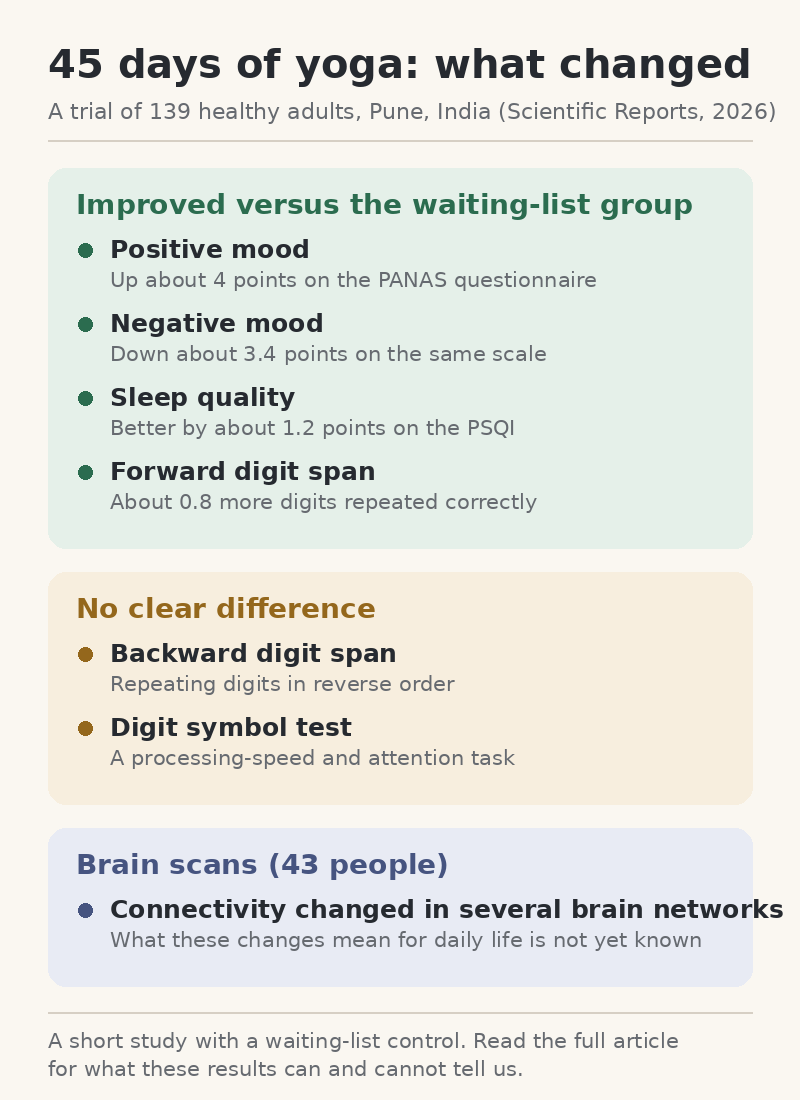
Mood was the main outcome the researchers cared about, measured with a widely used questionnaire called PANAS (the Positive and Negative Affect Schedule). [3] After 45 days, the yoga group’s positive mood scores rose by about 4 points on average compared with the control group, and their negative mood scores fell by about 3.4 points. Both differences were statistically significant. [1]
Sleep quality, measured with the Pittsburgh Sleep Quality Index, also improved more in the yoga group, by about 1.2 points on a scale where lower scores mean better sleep. [1] [4]
On the cognitive tests, the yoga group improved on the forward digit span test, which measures how many digits a person can repeat back in order. They gained about 0.8 digits on average compared with controls. The total digit span score also improved. [1]
What did not improve?
Two other test results did not show a clear difference between the groups. The backward digit span test, where people repeat digits in reverse order, did not improve significantly. Neither did the digit symbol substitution test, a measure of processing speed and attention. [1]
These null results are worth knowing. They mean the trial did not find a broad improvement across every measure of thinking and memory, and headlines claiming a general brain boost would go beyond the data.
What did the brain scans show?
Fifty participants were selected for brain scans, and 43 of them completed scans before and after the 45 days: 21 in the yoga group and 22 in the control group. [1]
In the yoga group, the researchers found changes in the resting connectivity of several large-scale brain networks, including networks involved in movement, attention, language and the cerebellum. Changes in one attention network were linked to the improvements participants reported in positive mood. [1]
Brain connectivity findings like these are genuinely interesting, but they need careful reading. A change in how regions connect on a scan does not prove better thinking in daily life, and a small scanned subgroup cannot show whether the changes last or what they mean over years.
How reliable are the results?
Several points deserve attention before treating these findings as settled.
First, the control group did nothing new. People in the yoga group attended supervised group sessions, so some of the benefit could come from structure, attention, social contact or expectation rather than yoga itself. The researchers say this openly in their paper. [1]
Second, 11 people left the yoga group during the study, compared with 3 in the control group, mostly for personal time reasons. The analysis replaced missing values with group averages, a common approach that can make results look tidier than they are. [1]
Third, 45 days is short. The study cannot say whether the benefits last, grow or fade once the programme ends. The volunteers were also people who chose to join a yoga study, so they may have been unusually open to its benefits. [1]
Finally, the authors suggest the programme could have potential for preventing cognitive decline. The trial itself did not measure decline, included no one with memory illness and followed people for only six and a half weeks, so that suggestion goes beyond what this study can show.
Did anyone get hurt?
Two serious medical events occurred during the study, a road accident and one case of vomiting blood. Both were judged unrelated to the yoga programme, and no other harms were reported. [1]
The programme was supervised and designed for general audiences, and the participants were healthy adults screened before joining. That screening is part of why the safety picture looked clean.
What does this mean for you?
This trial adds reasonable evidence that a standard, supervised yoga programme can modestly improve mood and sleep quality in healthy adults over 45 days, along with one aspect of short-term memory. It does not show that any particular class or home routine will do the same, and it says nothing about treating depression, insomnia or memory problems.
If you are curious about yoga for sleep or focus, our beginner guides to yoga for sleep and yoga for focus cover gentle starting points. If you have a health condition, it is worth discussing any new exercise programme with your doctor first. Health agencies advise the same, because some practices may need to be adapted. [5]
The fairest summary is the narrow one: in this particular study, with these particular volunteers, 45 days of the Common Yoga Protocol improved mood, sleep and forward digit span more than waiting did. Larger and longer studies with active comparison groups will tell us how much of that is the yoga itself.
Sources
1. Chaturvedi S, Rao P, Rao R, and colleagues. Common yoga protocol improves cognitive functions and neural connectivity: a randomized controlled fMRI study in healthy adults. Scientific Reports. Published 9 November 2026. Full study.
2. Ministry of Ayush, Government of India. Common Yoga Protocol.
3. Watson D, Clark LA, Tellegen A. Development and validation of brief measures of positive and negative affect: the PANAS scales. 1988. PubMed record.
4. Buysse DJ and colleagues. The Pittsburgh Sleep Quality Index: a new instrument for psychiatric practice and research. 1989. Journal record.
5. National Center for Complementary and Integrative Health. Yoga: Effectiveness and Safety.