
Walking meditation is a simple practice in which you walk slowly and rest your attention on the feeling of your steps. Start with five to ten minutes on a short, quiet path, and return to your feet each time your mind wanders.
This is general education, not medical advice. If you have balance problems or a health condition, speak with your doctor before starting.
What is walking meditation?
Walking meditation is a practice where you walk slowly and pay close attention to the feeling of each step. Instead of sitting still, you let movement be the anchor for your attention. It is used in many traditions, and it suits people who find sitting uncomfortable or who feel sleepy when they sit. The National Center for Complementary and Integrative Health describes mindfulness practices as a group of approaches that include meditation while moving.
How do you do walking meditation step by step?
Walk slowly along a short, clear path and rest your attention on the sensations of your feet touching the ground. Choose a quiet space of about ten to twenty paces, indoors or outdoors.
- Stand still and take two or three slow breaths.
- Let your hands rest gently in front or behind you.
- Begin to walk slowly, lifting, moving and placing each foot.
- Notice the feeling of your feet, calves and balance.
- When you reach the end, pause, turn slowly and walk back.
- When the mind wanders, notice it and return to your steps.
- Finish by standing still for a breath or two.
How is it different from ordinary walking?
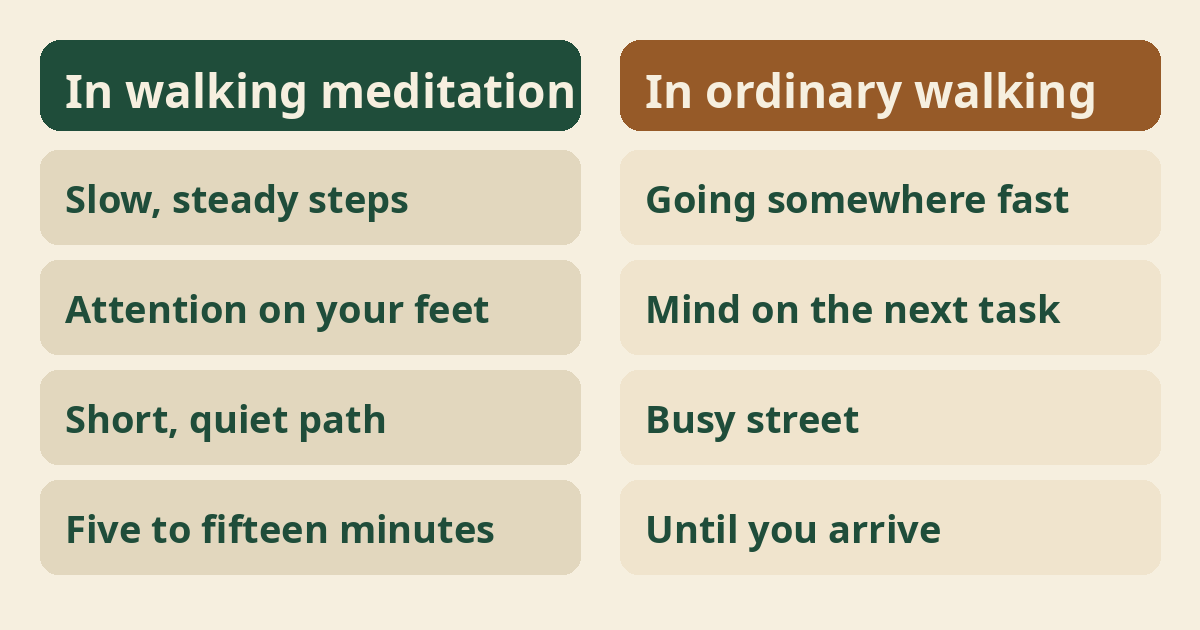
In ordinary walking you are going somewhere, and in walking meditation the walking itself is the point. The pace is slower, the path is short and your attention stays with the experience of moving. There is no goal and no destination. You can also use this practice during a normal walk by noticing your steps, your breath and the sounds around you for a few minutes.
What are the benefits?
Many people find it calming, grounding and easier to keep up than sitting practice. It gives the body something to do, which can help restless people settle. It can also be a gentle way to take a break from screens. Walking meditation is not a treatment for any condition, but it can fit well alongside other healthy habits such as regular movement and good sleep.
How long should you practise?
Five to fifteen minutes is a good length for beginners. You can build up slowly if you like it. Many people alternate a short walking session with a short sitting one. Our guide on how long you should meditate covers the same idea for sitting practice.
Where is the best place to practise?
A quiet, flat, safe stretch of ground such as a hallway, garden path or empty room works well. Choose somewhere free from traffic and obstacles so that you can relax your attention. Outdoors, a park or terrace is fine. Wear comfortable shoes or go barefoot on a clean, safe surface. Avoid uneven ground if your balance is not steady.
What should you focus on while walking?
Start with the soles of your feet, then widen to your breath or the whole body in motion. Some people count steps, and some silently note lifting, moving and placing. Pick one simple focus and stay with it. If you like, pair your steps with your breath, for example three steps in and three steps out. Keep the breath natural and never force it.
What if your mind keeps wandering?
That is normal, and noticing it is the practice. Each time you notice a wandering thought and come back to your feet, you are training attention. Do not scold yourself. If you feel very restless, walk a little faster for a minute and then slow down again. Our guide on common obstacles to meditation offers more help.
Is walking meditation good for people who cannot sit?
Yes, it is a useful option for people with stiff hips or knees, or those who tire when they sit. If walking is hard for you, consider a chair-based practice instead. Our guide to chair yoga for beginners shows gentle, seated options. People with balance problems, dizziness or health concerns should talk with their doctor and practise near a wall or rail.
How does it connect with yoga?
Yoga treats attention as something you train through posture, breath and awareness, and walking meditation applies the same idea in motion. Our article on the eight limbs of yoga shows where concentration and meditation sit on the traditional path. Walking meditation can be an easy bridge between movement practice and stillness, especially if you are new to both.
How can you fit it into a busy day?
Use ordinary moments: the walk from your car, a hallway between meetings or a few minutes in the garden. You do not need a special place. Slow your pace, feel your feet and take a few full breaths. These small pauses add up. A morning session also pairs well with a brief sitting, as in our guide to morning meditation.
What should you be careful about?
Keep your eyes open, stay aware of your surroundings and stop if you feel dizzy or unwell. Do not practise near roads, stairs or water. If you have a health condition, talk to your doctor about how much movement is suitable. If meditation brings up distress, pause and speak with a trusted teacher or health professional.
How does breathing fit in?
Keep your breath natural and let it follow your steps rather than directing it. Many beginners try to control their breathing while they walk, which can feel tense. It is enough to notice the breath as it is. As you become comfortable, you can match a slow in-breath with a few steps and a slow out-breath with a few more. If you feel dizzy or short of breath, stop and rest. Our guide to pranayama for beginners describes gentle breathing practice for sitting.
What posture helps?
Stand tall, keep your shoulders soft and let your gaze rest a few steps ahead on the ground. Avoid looking at your feet or your phone. Keep your arms relaxed, either in front, behind or by your sides. A soft gaze keeps your head level and helps you stay balanced. If your neck or shoulders feel tight, pause and roll them gently before you carry on.
How can you tell it is working?
Signs include feeling slightly calmer, more aware of your body and more able to notice thoughts without following them. Progress is usually quiet. You may find it easier to pause before reacting, or to return to the present when you drift off. Some days will feel restless, and that is fine. A short note after each session can show you patterns over a few weeks. Do not measure success by how still your mind becomes.
What if it feels awkward at first?
That is common, and it passes as the practice becomes familiar. Walking slowly on purpose can feel odd, especially if someone might see you. Start indoors, or choose a private corner of the garden. After a few sessions the slow pace starts to feel natural, and many people look forward to it as a quiet break in the day.
Common myths about walking meditation
A few misunderstandings can put people off. Here are the ones that come up most.
- Myth: it must be extremely slow. A gentle, natural pace is fine.
- Myth: you must walk in circles. A straight path is fine.
- Myth: it is not real meditation. It is a long-standing practice.
- Myth: you need a teacher. Beginners can start alone with simple steps.
Can you do it with a group?
Yes, groups often walk in a line or circle in silence, which some people find supportive. If you prefer practising with others, ask a local yoga or meditation teacher. Practising alone at home is also perfectly fine. Whatever you choose, keep the instructions simple and the pace comfortable. Consistency matters more than the setting.
Where to read next
For a calm, beginner-friendly start, Ranjana Sinha’s Begin Where You Are is written for people who want simple steps. Our guide to starting a home yoga practice adds a gentle routine you can follow at home.
Frequently asked questions
What is walking meditation?
A practice of walking slowly and paying attention to the feeling of each step. It is used as an alternative or a companion to sitting meditation.
How long should I do walking meditation?
Five to fifteen minutes is enough for most beginners.
Is walking meditation as good as sitting?
It is a different style. Many people find it easier. Choose the one you can keep up.
Where should I practise?
A quiet, flat, safe path indoors or outdoors, away from traffic.
Should I walk barefoot?
You can, on a clean, safe surface. Otherwise comfortable shoes are fine.
Can walking meditation help anxiety?
It may help some people feel calmer, but it is not a treatment. Speak with a doctor if anxiety affects your daily life.
The bottom line
Walking meditation is an easy, gentle way to practise attention, especially if you find sitting hard. Keep it short, keep it safe and let your steps be the anchor.

