
Beginners should not practise Ashtanga yoga every day. The traditional method uses six days a week, but it is built up slowly over time, and rest days are part of the practice. Start with two or three days a week and add more only as your body recovers well.
This is general education, not medical advice. If you have an injury or health condition, speak with your doctor and a qualified teacher before starting.
Can you do Ashtanga yoga every day?
Traditionally yes, but most modern practitioners and teachers suggest rest days, and beginners should not practise every day. Ashtanga is a set sequence of poses linked with breath, and it is physically demanding. The traditional approach asks students to practise six days a week, with a rest day on the seventh and on moon days. That is a long-term goal built up over years, not a starting point. The National Center for Complementary and Integrative Health notes that yoga is generally safe when taught well, but that injuries can happen, which is a good reason to build up slowly.
What does a rest day do?
A rest day gives muscles, joints and the nervous system time to recover and adapt. Without rest, tiredness, sore joints and a flat mood can build up. Rest does not have to mean doing nothing. A gentle walk, slow breathing or a short meditation is a calm way to spend a rest day. Our guide to pranayama for beginners has easy options.
How many days a week should a beginner practise?
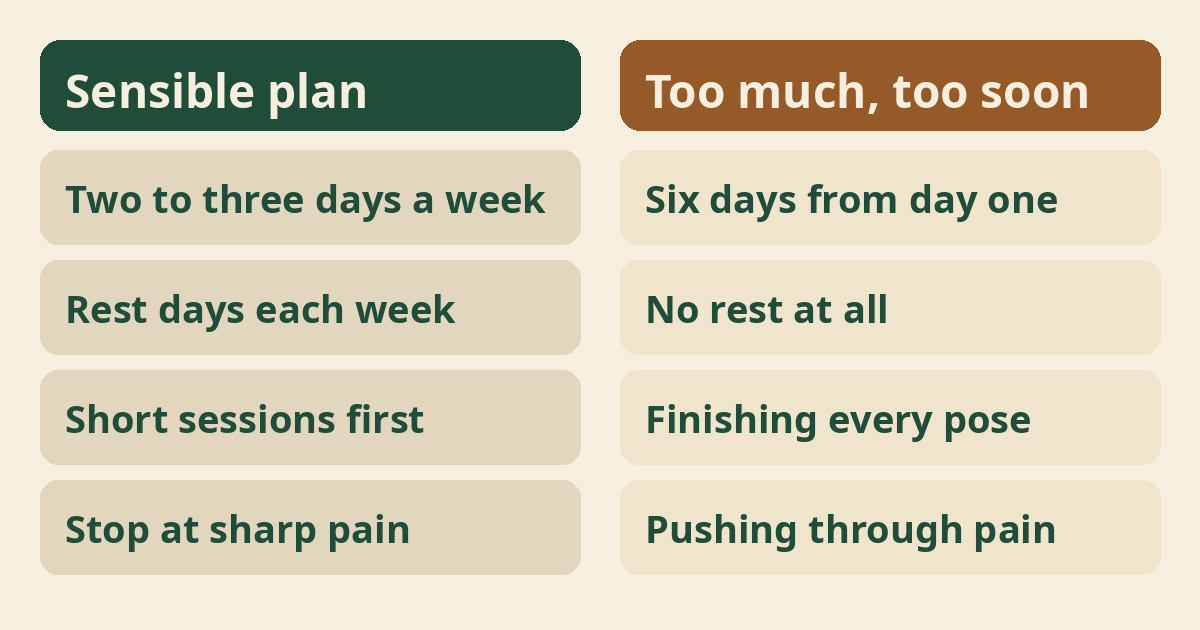
Two to three days a week is a sensible start, and many people add days slowly over several months. Listen to your body. If you feel sharp pain, unusual tiredness or dizziness, take extra rest. A teacher can adjust the sequence so that you do only the poses that suit you at first. Fewer, well-done sessions are better than many rushed ones.
- Weeks one to four: two days a week, short sessions.
- Months two to three: three days a week if you feel well.
- Later: add a fourth day only when recovery feels easy.
- Always: keep at least one full rest day each week.
How long is a typical practice?
A full traditional session can last about ninety minutes, but shorter versions are common and fine for beginners. Many teachers begin with the opening sequence and a few standing poses, then add more as strength and flexibility grow. If you are short on time, a twenty-minute practice with breath awareness is better than skipping. Do not feel you must finish the whole series on any day.
Does Ashtanga build muscle?
It builds strength and muscular endurance, especially in the arms, shoulders, core and legs, but it is not designed for large muscle growth. Many poses use your body weight, which develops useful strength. People who want to add muscle size usually combine yoga with other strength training. Our guide to the benefits of yoga covers more of what regular practice can offer.
What are the signs you are doing too much?
Sharp or lasting pain, constant fatigue, poor sleep, irritability and joint soreness are common warning signs. If these appear, cut back and rest. Pain in the wrists, knees, hips or lower back that does not ease is worth a visit to a doctor or physiotherapist. Do not push through pain to complete a sequence. A good practice should leave you feeling steady, not wrecked.
How should you build up safely?
Start with the basics, learn the breath and add poses one at a time with a qualified teacher. Ashtanga rewards patience. Learn the sun salutations first, then standing poses, and add more only when the earlier ones feel comfortable. If you have an injury, a health condition or are pregnant, ask your doctor before you begin.
Is a daily mix of styles better?
Many people do better with a mix, such as Ashtanga on some days and gentler yoga or breathing on others. Variety lets you recover while still keeping a daily habit. For example, practise Ashtanga three days, gentle yoga on two days, and take two days off. If you like a daily routine, our guide to starting a home yoga practice offers a gentler base.
What should you eat and drink around practice?
Practise on a fairly empty stomach, drink water through the day and have a light meal afterwards. Traditional teachers suggest waiting a few hours after a large meal before practising. A light snack an hour before is fine if you feel faint without it. Sip water as needed rather than gulping large amounts mid-practice. Avoid very heavy or spicy foods right before class, which can make twists and forward bends uncomfortable.
Is morning the best time?
Morning is traditional, but any time that you can keep up consistently is fine. Early morning practice is quiet and fits many schedules. If you are stiff at that hour, spend longer on a gentle warm-up. If you are an evening person, practise then, but leave enough time before bed so that the energy settles. Choose the time that suits your sleep and your day.
How do you handle a missed day or a bad day?
Skip the guilt, take rest and return when you feel ready. Some days your body will feel tight or tired, and the best practice is a shorter one or none. Over a year, the pattern matters more than any single session. If you miss a week, restart with a gentler session rather than trying to catch up. Patience protects both your body and your habit.
What about breath and meditation?
Breath is central in Ashtanga, and a short sitting at the end of practice helps you settle. Even if you take a rest day from poses, you can keep up simple breath awareness. If you want a calm daily habit, a short morning sitting works well. See our guide to morning meditation for a start.
How does it fit the yoga tradition?
Ashtanga takes its name from the eight limbs of yoga, of which posture is only one. The traditional path also includes ethics, self-discipline, breath control, withdrawal of the senses, concentration, meditation and absorption. Our guide to the eight limbs of yoga explains each limb. Seen this way, a daily practice does not have to mean a daily physical workout.
Who should take extra care?
People with joint injuries, high blood pressure, pregnancy, heart conditions or recent surgery should speak with a doctor first. They should also tell their teacher and choose a class that can offer modifications. This is general information, not medical advice. If any pose causes pain, dizziness or breathlessness, stop and rest.
What should a sensible weekly plan look like?
A simple plan alternates practice days with rest or gentle days and keeps one full day off. For example: Monday Ashtanga, Tuesday gentle yoga or walk, Wednesday Ashtanga, Thursday rest, Friday Ashtanga, Saturday gentle yoga, Sunday rest. Adjust to your energy, work and sleep. The best schedule is the one that you can keep up for months without injury or burnout.
Common myths about daily Ashtanga
Some beliefs push people toward too much, too soon. Here are a few worth rethinking.
- Myth: you must practise six days a week. That is a traditional ideal, not a beginner’s rule.
- Myth: more is always better. Recovery is part of progress.
- Myth: you must finish the whole sequence. A shorter practice is fine.
- Myth: pain means you are getting stronger. Sharp pain is a warning.
How do you know when to add days?
Add a day when your current routine feels easy, your sleep is good and you recover quickly. Increase by one day at a time and watch how your body responds for two to three weeks before adding another. If you feel worse, return to the previous level. Patience over months matters more than speed over weeks.
Where to read next
For a calm, beginner-friendly start, Ranjana Sinha’s Begin Where You Are is written for people who want simple steps. Our guide to starting a home yoga practice adds a gentle routine you can follow at home.
Frequently asked questions
Can I do Ashtanga yoga every day?
Beginners should not. Start with two or three days a week, and add days slowly. Traditional practice includes rest days.
How many days a week is Ashtanga practised?
Traditionally six days, with one rest day. Most beginners build up to that over a long time, if at all.
Does Ashtanga build muscle?
It builds strength and endurance, but it is not designed for large muscle growth.
How long should an Ashtanga session be?
Beginners can start with twenty to forty minutes. A full session can be around ninety minutes.
What are signs of overtraining?
Lasting pain, constant fatigue, poor sleep and irritability. Cut back and rest.
Is Ashtanga safe for beginners?
It can be, with a qualified teacher and slow progress. Check with your doctor if you have health concerns.
The bottom line
Daily Ashtanga is not a beginner’s goal. Build up slowly, keep rest days and listen to your body. A calm, regular routine over months will serve you better than a hard push over weeks.

