Ashtanga and Iyengar are two of the most established named methods in modern yoga, and they offer genuinely different classroom experiences. A led Ashtanga class asks you to keep moving with your breath through a set sequence. An Iyengar class asks you to slow down, study each position and use support to understand it. Neither is a watered-down version of the other.
This comparison explains how each method teaches, what a class expects from you and the questions that help you choose a starting point. The aim is to help you pick a real class near you, not to decide which method is better in the abstract.
Two methods, two emphases
Ashtanga yoga in its modern form was shaped by K. Pattabhi Jois in Mysore, India, building on teaching he received from T. Krishnamacharya. The word ashtanga itself refers to the eight limbs of yoga described in the Yoga Sutras: posture is one limb among ethical, breathing and meditative practices.
Iyengar yoga is named after B.K.S. Iyengar, who developed his own method of teaching hatha yoga. The Iyengar Yoga Association Southeast notes that this method also integrates the eight limbs, with a distinctive emphasis on correct alignment in each posture and the use of props to individualize positions for each student.
You may see Ashtanga spelled Astanga in older writing; both spellings refer to the same method. The practical difference is not in the name but in how the two methods arrange a lesson: one built around a flowing, memorized series, the other around detailed instruction and adaptation.
| Question | Ashtanga | Iyengar |
|---|---|---|
| Movement | Continuous flow linked to breath | Pose by pose, with time to adjust |
| Sequence | Fixed series in a set order | Lessons vary with the group and level |
| Props | Not central to the method | Central teaching tools |
| Breathing | Breath coordinated with movement | Breath awareness first; pranayama later |
| Class feel | Dynamic and physically demanding | Deliberate, precise and supported |
How an Ashtanga class moves
YogaBasics describes five principles behind the practice: ujjayi pranayama, a slow audible breath used throughout; drishti, a specific focal point in each posture; vinyasa, the synchronization of breath with movement and transitions; bandha, engaged body locks for stability; and regular daily practice.
A class usually opens with repeated sun salutations. The Guardian’s comparison notes that these are designed to heat the body and raise the heart rate, after which a continuous series of postures follows. Because the postures flow without long pauses, the practice is more aerobically demanding than slower styles.
You will meet two class formats. In a led class, the teacher calls the sequence and everyone moves together. In a Mysore-style class, named after the method’s home city, each student practices the memorized series at their own pace while the teacher gives individual help and adjustments.
How an Iyengar class teaches
Ashtanga teacher David Garrigues describes Iyengar as a static learning model: you enter a posture slowly enough to correct errors on the way in, analyzing your position before you commit to it. He contrasts this with learning through rhythmic movement in Ashtanga, while stressing that both kinds of learning occur in both methods. This is a teaching comparison, not an instruction to rush into a position.
An Iyengar class builds that analysis into the teaching. Expect demonstrations, precise verbal instructions and time to study one action at a time. The Iyengar Yoga Institute of Los Angeles describes progressive learning, where beginners repeat foundational actions and add detail gradually.
Props are part of that instruction. IYASE explains that teachers use blankets, bricks and belts to individualize each posture to a student’s needs, and its beginner guidance notes that you will be shown how to use them. A prop is not a shortcut to discard; it is a way of learning what a position asks of you.
A fixed series or a changing lesson
Ashtanga is built on six series of postures practiced in a fixed order. Students begin with the primary series, known as Yoga Chikitsa, and a teacher introduces later series only when a student is ready. Garrigues explains why the method asks for consistency: in a dynamic learning model, your progress depends on repeating the same movements until they become accurate.
Iyengar teaching does not use one fixed sequence. The Los Angeles institute states that its classes are not all the same and that sequencing varies with the students’ level and condition. A beginner course repeats foundational standing, sitting and recuperative postures so that you can learn them over time.
Neither approach is automatically better. Some students like knowing exactly which postures come next and watching measurable progress through a series. Others prefer varied lessons built around a theme. Ask a studio what its classes actually do rather than assuming.
Breathing is introduced differently
Ashtanga teaching commonly coordinates an audible breath with movement. Ask how your teacher introduces this, rather than forcing a sound or pace. YogaBasics notes that additional pranayama techniques are reserved for advanced students. The Guardian observes that the combination of rhythmic breathing and a focused gaze can give the flowing practice a meditative quality.
Iyengar teaching introduces formal breathing practice later. The Los Angeles institute describes building breath awareness in beginning classes and teaching pranayama as a separate discipline after a foundation in posture. The Guardian likewise describes Iyengar breathwork as initially more basic, on the principle that strength and precision in the postures come first.
In either class, you should never feel you must force your breathing to keep up. If an instruction about breath is confusing or uncomfortable, tell the teacher and return to ordinary breathing while you ask.
Effort, pace and practice rhythm
Do not mistake a slower class for an easier one. The Guardian notes that holding Iyengar postures for longer periods builds stamina and strength in the arms and legs, while setting up support and following detailed instruction also takes attention. Equally, do not mistake a flowing class for mindless exercise: the fixed sequence, gaze points and counted breath ask for sustained attention.
Traditionally, Ashtanga encourages practice six days a week, with rest days on Saturdays and on full and new moon days. Treat that as the tradition’s rhythm for established students, not an entry requirement. When you begin, choose a frequency you can sustain comfortably, whatever the method.
The most useful question is not which style works harder but which teaching style you will return to. A demanding class you attend once teaches less than a manageable class you attend for a year.
Choosing an entry point
YogaBasics is honest that Ashtanga is physically challenging, yet beginners are still welcome: the primary series opens with movements suited to newer students, and the Mysore format gives individual instruction and lets you progress posture by posture. A led beginner course in Ashtanga can also work well if the teacher introduces the sequence gradually.
IYASE describes beginner Iyengar classes as introducing foundational standing, sitting and recuperative postures, the use of props and the names of poses in both Sanskrit and English. Its classes are tiered by level, so you can build from a beginner course toward more advanced work.
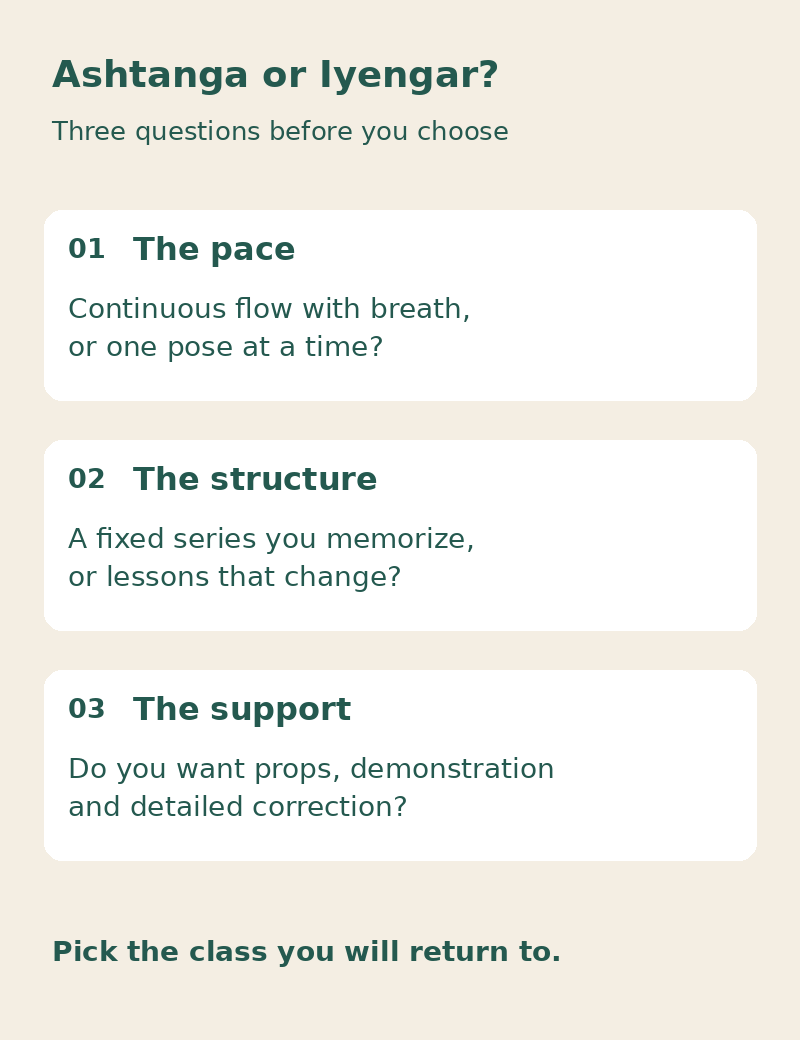
A complete beginner can start with either method if the specific class welcomes beginners. Ask what the first session assumes you can do, and choose the answer that matches your actual situation rather than the one that sounds more impressive.
Health needs come before style labels
NCCIH recommends learning yoga from a qualified instructor and notes that injuries can occur. It advises pregnant people, older adults and people with health conditions to discuss their individual needs with a health care provider and their instructor, and recommends that people new to yoga avoid extreme practices.
Neither label settles these questions for you. Ask whether the session includes repeated wrist loading, kneeling or other movements you need to avoid. Iyengar’s use of support can help many bodies, but IYASE itself advises people with serious limitations to contact a studio first about an appropriate class or teacher rather than assuming any class will fit.
Whatever you choose, explain relevant health needs before class, ask how to come out of any position, and stop if you feel pain, numbness, dizziness or difficulty breathing. Seek appropriate care for symptoms that concern you or persist.
Questions to ask before your first class
- Is this a led class or a self-paced Mysore session?
- What does the first class assume I can already do?
- How are postures corrected: demonstration, verbal cues or hands-on help?
- Which props are used, and will someone explain their purpose?
- How can I rest or modify a position without disrupting the group?
- What training does the teacher hold in this particular method?
If both methods are available near you, try a beginner session of each. Notice where you could breathe comfortably, ask questions and imagine returning next week. That experience will tell you more than any comparison chart.
For more background, read our Ashtanga vs vinyasa comparison, our Iyengar yoga guide and our yoga props guide. Then bring your questions to a real teacher.