Reclined Butterfly and Savasana both let the floor support much of your body, but they arrange the legs differently. In Reclined Butterfly, the soles meet and the knees open to the sides. In the familiar form of Savasana, the legs extend forward and rest apart.
The useful choice is not which pose is more relaxing in theory. It is which arrangement lets you rest without a stretch, joint pressure or the effort of holding yourself in place. You can also choose neither.
The difference is more than the shape of the feet
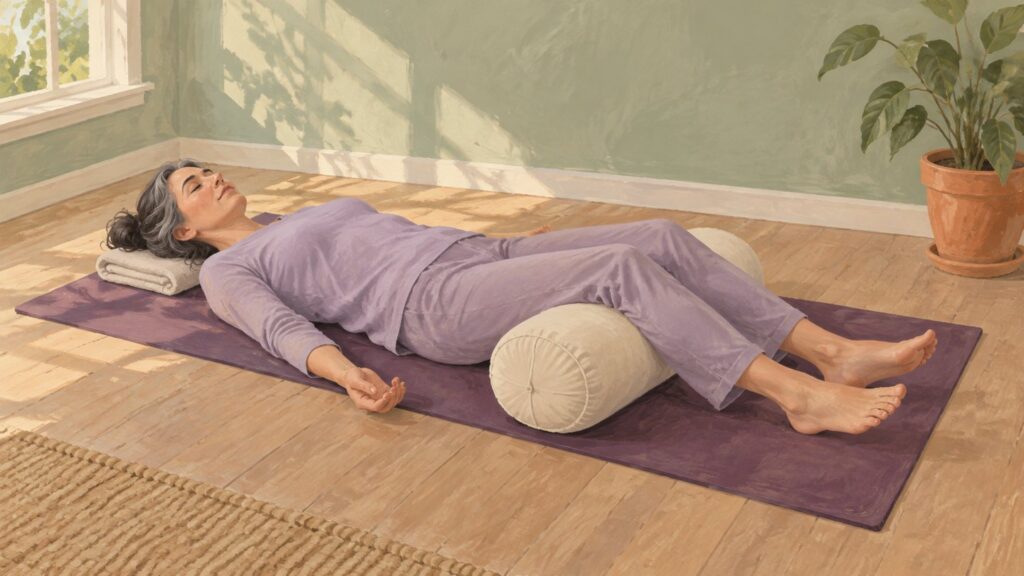
Reclined Butterfly, or Supta Baddha Konasana, keeps the knees bent while the thighs open outward. The feet do not need to be pulled close to the pelvis, and the knees do not need to approach the floor. Supports can meet the thighs where they comfortably rest.
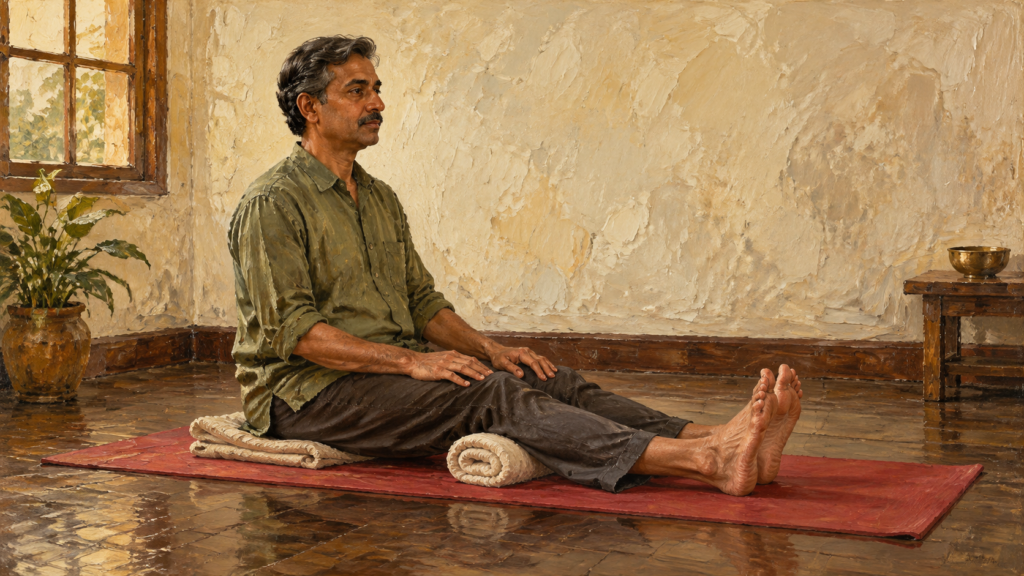
Savasana, also called final relaxation, commonly uses extended legs with the feet resting apart. It does not require the same outward opening at the hips. But straight legs and a flat floor are not compulsory: support beneath the knees or a different resting position may suit you better.
These are two ways to arrange rest, not two flexibility tests. For the individual pose descriptions, see our Reclined Butterfly and Savasana guides. This comparison focuses on deciding between them.
Ask whether you want a hip-opening position at all
Reclined Butterfly adds a bent-knee, outward-open leg position to the rest. You might enjoy that arrangement with full support. You might instead spend the whole time monitoring a pull at the inner thighs or wishing the knees would settle.
If your purpose is simply to rest, you do not have to include a hip stretch. An extended-leg or supported-knee Savasana option can remove that particular demand. Choosing it is not skipping part of the practice.
Support needs to meet the legs, not press them lower
HealthLink BC’s medically reviewed Reclining Bound Angle guidance says to support the knees at a comfortable level rather than strain to bring them close to the floor. A block, pillow or folded blanket is there to take the weight of the leg, not persuade the joint into a deeper position.
If you cannot find comfortable support, come out. Do not put weight on top of the thighs, ask someone to push the knees down or use a longer stay to make an uncomfortable position feel acceptable. Pain is a reason to stop, not a sign that the support is working.
Supported Savasana asks a different question: would a broad bolster or folded blanket beneath the knees make the legs easier to rest? That changes the knee angle without requiring the feet to meet. Adjust the arrangement before settling rather than trying to hold the legs above a support that is too low.
Compare one feature at a time
If both positions are suitable for you, begin with a brief, comfortable rest rather than a timed challenge. Notice the contact of the legs, the neck position and whether breathing can remain natural. You are not trying to create a particular emotional result.
- Legs keep working: check whether they are resting on support or hovering above it. A different arrangement may be simpler than adding more effort.
- Knees or groin feel pulled: leave the open-leg position. Do not assume that moving the feet or adding a prop will make it appropriate.
- Extended legs feel uncomfortable: ask about knee support or another resting shape instead of forcing them flat.
- Head or shoulders feel crowded: change their support rather than judging the whole pose only by the legs.
Comfort today does not commit you to the same choice tomorrow. Nor do you need to move from one to the other at the end of every class.
If lying on your back does not suit you
Both familiar shapes are face-up. If that position is the problem, switching between their leg arrangements may not answer it. Yoga International describes side-lying Savasana with support for the head and between the legs as another resting option.
The aim is not to reproduce a supine photograph at any cost. Pregnancy, recent childbirth, breathing difficulties, injuries and medical restrictions need individual advice about positioning; a general article cannot choose a suitable setup for those circumstances.
Do not use stillness to override discomfort
You may move, keep the eyes open, change position or end the rest. A quiet-looking pose is not necessarily comfortable, and remaining still is not more important than responding to pain, numbness, tingling, dizziness, difficult breathing or distress.
This is general education, not medical advice. HealthLink BC advises not doing Reclined Butterfly with knee, hip or shoulder problems, or after giving birth until a doctor clears it. Skip that pose in those circumstances and seek individual healthcare guidance about suitable rest. Get advice for back problems, an injury, pregnancy or another relevant condition too. Neither pose is a treatment for insomnia, anxiety or another diagnosis, and this comparison does not claim that one produces a stronger nervous-system effect.
Make the exit part of the choice
Before settling, know how you will leave the position. From Reclined Butterfly, support the legs as you bring the knees toward each other rather than snapping them together. From either rest, take your time changing position and returning to sitting in a way that is comfortable for you.
If getting down to the floor or back up is difficult, discuss an accessible rest with your teacher before class. The right resting shape includes an entry and exit you can manage. For a wider choice of positions, use the beginner pose library without treating every pose as a requirement.
Sources and further reading
- HealthLink BC: Reclining Bound Angle Pose, medically reviewed guidance on knee support, avoiding strain and relevant cautions.
- Yoga International: Exploring Savasana, by Amber Burke, used for the practical knee-bolster and head-support options, not its physiological claims.
- Yoga International: Savasana Variations, by Allison Ray Jeraci, for side-lying rest as an alternative to lying face-up.
- NCCIH: Yoga: What You Need To Know, for general safety and individual modifications.