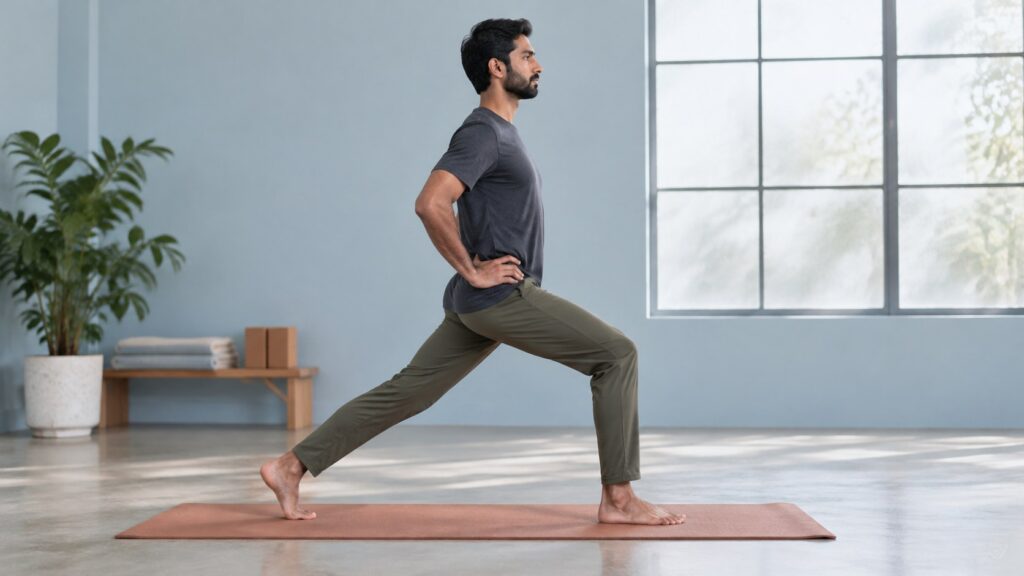
Warrior I and high Crescent Lunge can look almost identical above the waist: the front knee bends, the torso rises and the arms may reach overhead. The clearest difference is behind you. In Warrior I, the back heel rests down and the back foot turns diagonally outward. In high Crescent, the back heel lifts and the back toes point forward.
This comparison is about choosing and understanding a stance, not making one pose the winner. Neither a grounded heel nor a lifted heel automatically makes a lunge comfortable or appropriate for every body.
Start by checking which lunge the teacher means
Class names vary. Here, Warrior I means Virabhadrasana I with a grounded back heel. High Crescent Lunge means an upright lunge with the back heel raised and the back knee off the floor. A knee-down Low Lunge is another arrangement, not simply the same balance with a different arm position.
If you hear only “lunge” or “crescent,” ask whether the back knee or heel should be down. Looking at the arms alone will not answer that question. Keeping the hands at your hips or on a stable support can make it easier to pay attention to the feet.
What the grounded back heel changes
In Warrior I, the back foot turns out rather than pointing straight forward. The thigh and shin need to accommodate that direction. The heel gives another point of floor contact, but getting it down can ask more of the back ankle and calf.
If you must twist the back knee, collapse the foot or pull the pelvis around to keep that heel grounded, the stance needs attention. A shorter step or a different pose may be more useful than trying to press harder into the mat. The heel is part of the setup, not an achievement that overrides the rest of the leg.
What the lifted back heel changes
In high Crescent, the back forefoot supports the leg while the heel stays lifted. The toes generally point toward the front of the mat. That removes the requirement to ground a diagonal back heel, but it also changes the balance task.
You may find it easier to orient the pelvis forward in this arrangement. That does not make a long, deep lunge compulsory. Keep the stance modest, allow some softness at the back knee and use stable support if needed. More height at the heel is not a measure of a better pose.
Do not force the same pelvic position in both
Yoga International’s Warrior I guidance explains why a turned-out back foot and completely forward-facing pelvis can conflict. How much you can turn varies. Let the pelvis remain somewhat diagonal when that is what the back-leg arrangement allows.
In high Crescent, the forward-facing back foot may allow the pelvis to face more toward the front. Even then, avoid hauling the hips into position with your hands or compensating with a large lower-back arch. A comfortable torso and easy breathing matter more than an exact angle.
Teaching cues differ. If one source says “square the hips” and another allows an open angle, ask what the cue is meant to achieve in your actual stance. Do not try to obey both by turning the knee against a planted foot.
Width and length are different adjustments
Width is the side-to-side space between the feet. A wider base, like two tracks rather than a tightrope, can make the standing arrangement more manageable. Length is how far one foot steps behind the other. Shortening that distance can reduce the demand of the lunge.
Changing the width does not necessarily solve a stance that is too long, and shortening the stance does not automatically resolve a painful foot angle. Change one feature at a time, with the front knee following the general direction of the front toes. There is no universal step length or required ninety-degree bend.
A practical choice, not a difficulty ranking
- If the heel-down arrangement feels forced: ask your teacher whether a shorter Warrior I stance or a heel-lifted lunge better fits the lesson. Do not twist a planted back foot under load.
- If the heel-lifted version feels wobbly: use a clear wall or sturdy non-wheeled chair, reduce the stance or choose another movement. Warrior I is not automatically the answer if its foot position is uncomfortable.
- If the arms distract you: keep them lower. Both stances can be explored without an overhead reach.
- If either position hurts: stop rather than switching repeatedly between them to find a way through pain.
Both can involve substantial leg effort. The more useful choice is the version you can enter, support and leave with control, not whichever looks more demanding in a photograph.
Reset the feet rather than swivelling through the change
Moving from Warrior I to high Crescent changes the back-foot direction as well as the heel position. It is not just an arm transition. While learning, come out to a comfortable upright stance and arrange the feet again rather than rotating the knee over a heavily planted foot.
Let a qualified teacher show you an appropriate transition for a flowing class. Moving more slowly or taking an extra step is preferable to keeping pace with a sequence that leaves the feet behind.
When neither stance is the right experiment
This is general education, not medical advice. Knee, hip, ankle or foot symptoms, an injury, recent surgery, balance difficulties, dizziness, pregnancy and other relevant health conditions need individual guidance before practising standing lunges. A chair or wall changes support; it does not provide medical clearance.
Stop for pain, numbness, tingling, dizziness or restricted breathing. Do not repeatedly test a painful stance. You can choose a different practice with your teacher, including options from the beginner pose library. This comparison makes no claim to treat pain, correct a diagnosis or produce a particular health result.
Sources and further reading
- Yoga International: Five Things You Might Not Know About Warrior I, by Rachel Scott, for foot position, individual stance choices and avoiding forced pelvic squaring.
- Peloton: Warrior I, with Kristin McGee and physical therapist/yoga teacher Tara Salay, for the heel-down versus heel-up distinction and lower-arm options. Its fixed-angle and hips-square cues are not treated as universal requirements here.
- Yogi Flight School: Warrior and Crescent foot positions, for the need to change the base rather than only the arms.
- NCCIH: Yoga: What You Need To Know, for general safety and individual modifications.