Child’s Pose and Puppy Pose can both begin on hands and knees, and both may bring the forehead toward the mat. That resemblance hides a different task. In Child’s Pose, the hips move back toward the heels. In Puppy Pose, the hips stay roughly over the knees while the arms reach forward.
The choice is not simply which shape looks lower or easier. Consider three things separately: how much your knees bend, where your arms go and whether you actually want a stretch rather than a rest.
Compare the hips before the hands
Child’s Pose, or Balasana, folds the body back over bent legs. The hips travel toward the heels, although they do not have to touch them. The torso may rest on the thighs or on a bolster, with the head supported at a comfortable height.
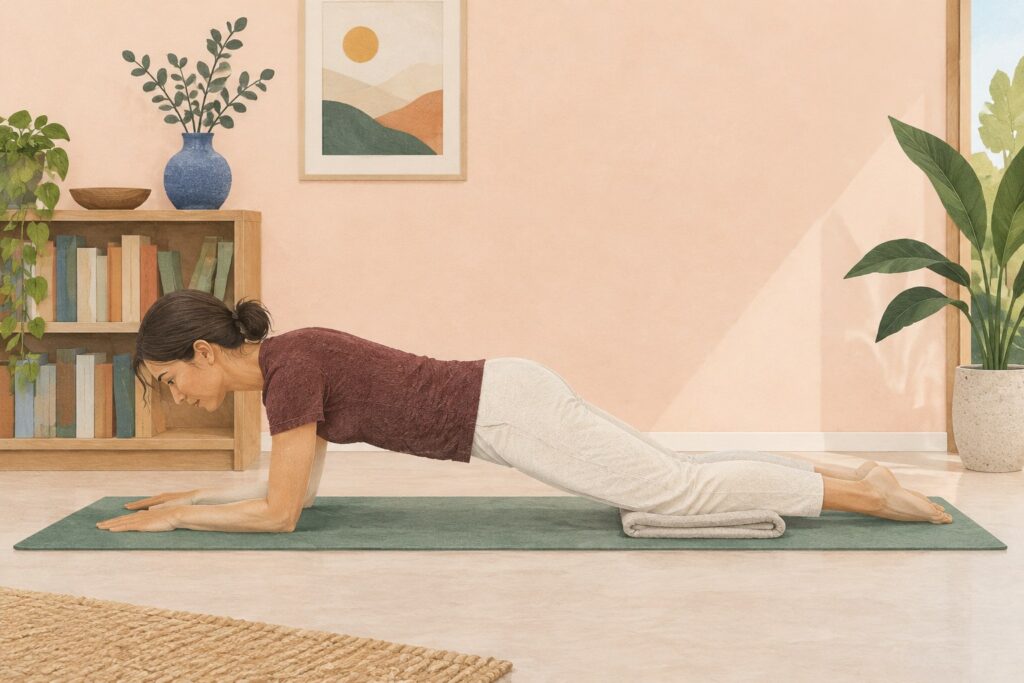
In Puppy Pose, commonly called Uttana Shishosana, the thighs stay more upright. The hands move forward and the chest lowers between the arms only as far as comfortable. Bringing the chest to the floor is not a requirement.
Our individual Child’s Pose and Puppy Pose guides cover their setups. Use this comparison to decide which task, if either, belongs in your practice today.
Arms forward do not automatically mean Puppy Pose
Child’s Pose can use arms alongside the legs or arms reaching forward. The forward-reaching variation is often called Extended Child’s Pose. It does not become Puppy Pose simply because the hands reach far away.
Look at the whole arrangement. Hips moving back over deeply folded knees suggest Child’s Pose. Hips remaining roughly above the knees, with the torso extending forward between the arms, suggest Puppy Pose. You do not need to chase a perfectly vertical line or a photograph’s exact angle to understand the difference.
If the goal is a break, check the shoulder demand
An arms-back Child’s Pose removes the overhead reach. A supported version may therefore make more sense for a quiet pause than a position in which you are still working to reach through the arms.
Puppy Pose keeps that forward arm reach as a main feature. Lowering the head does not remove the shoulder demand. If you want a break from overhead arm work, changing from one long-arm shape to another may not give you the break you intended.
Neither pose guarantees relaxation. Yoga anatomy teacher Andrew McGonigle points out in Yoga Journal that Child’s Pose is not restful for everyone, physically or emotionally. You may prefer sitting or another comfortable rest, even if the rest of the class folds forward.
A smaller knee bend does not remove kneeling pressure
Puppy Pose usually asks for less deep knee folding than hips-back Child’s Pose. Both floor versions still put the knees on the mat. That distinction matters: discomfort from bending a knee and discomfort from resting weight on it are not the same question.
Do not assume Puppy Pose is the answer to painful kneeling. Padding can change contact with a firm floor, but it does not make an injured joint ready for a pose. If kneeling hurts, leave both options out and ask about a non-kneeling position.
A chair-based rest described by McGonigle uses support on the lap rather than knees on the floor. That is a different arrangement to learn with guidance, not a reason to force a floor shape.
Head support is not permission to sink farther
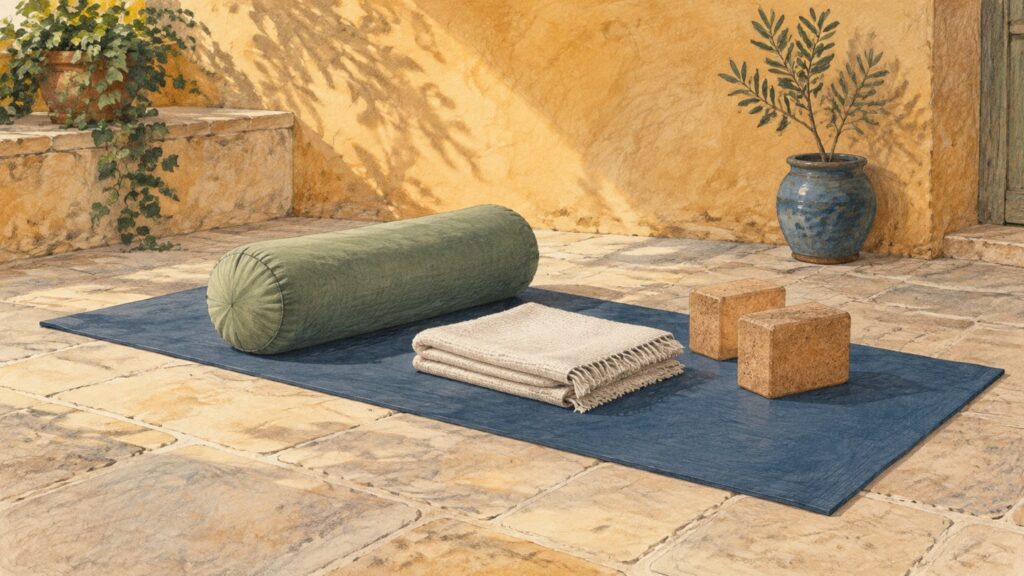
In either pose, a block, folded blanket or bolster may bring support closer to the forehead. The prop should meet you where your neck feels comfortable. It should not act as a lever for pressing the chest lower or forcing the hips backward.
For this comparison, leave chin-on-the-floor Puppy variations out. They change the neck position and add a task that is unnecessary for deciding between the basic shapes. A supported forehead or a different position is enough.
If the forehead cannot reach a stable support without strain, do not hold the head suspended while waiting for the body to loosen. Shorten the attempt and ask for another option.
Choose by purpose, not by a ranking
- You want less arm reaching: an arms-back, comfortably supported Child’s Pose may fit that purpose, if the folded knees and ankles are comfortable.
- You want to explore a forward arm reach: a modest Puppy Pose may fit, if kneeling and overhead shoulder movement are suitable for you.
- You want to avoid deep knee folding: notice the different knee positions, but do not substitute Puppy Pose automatically when there is pain or an injury.
- You need to avoid kneeling or feel uneasy face-down: choose neither. Ask about a seated, standing or other resting alternative.
These are purpose checks, not recommendations for treating a symptom. The useful answer can change from one session to the next.
Leave room for a separate exit
You do not have to finish Puppy Pose by moving into Child’s Pose. If the hips-back fold is the position you were avoiding, that compulsory finish would undo the point of choosing differently.
Leave a pose slowly with the support you need. From a comfortable Puppy position, bring the hands back in small steps and return to a manageable hands-and-knees position before choosing what comes next. From Child’s Pose, use the hands to help raise the torso without rushing. If either entry or exit is difficult, discuss it before trying the pose alone.
Safety before stillness
This is general education, not medical advice. Get individual advice for pregnancy, recent surgery, an injury, knee or ankle problems, shoulder or neck restrictions, or another relevant condition. Do not use a prop or the label “gentle” as proof that a position is suitable.
Stop for pain, pinching, tingling, numbness, dizziness or difficult breathing. There is no required hold time or breathing count, and you do not have to close your eyes. Resting elsewhere is a valid choice. Browse the yoga pose library for other shapes without treating either of these as compulsory.
Sources and further reading
- Yoga and Mindfulness for Teachers: Child’s Pose, curricular material describing the hips-back shape, arm options, support and the different hips-over-knees Puppy position.
- Yoga Journal: Four Ways to Practice Child’s Pose, by Andrew McGonigle, on individual comfort, bolsters and a chair-based alternative.
- Daytona Yoga With Krista: Child’s Pose vs Puppy Stretch, by Krista Oakes, for the hips-back versus hips-over-knees comparison. Individual responses are not assumed from the pose name.
- NCCIH: Yoga: What You Need To Know, for general yoga safety and the need for individual modifications.