Chair Pose and Garland Pose both bend the knees, but they are not simply shallow and deep versions of one fixed shape. Chair Pose usually keeps the hips higher, with the seat moving back. Garland Pose commonly uses a wider, turned-out stance and brings the pelvis much closer to the floor.
Choosing between them means considering stance, depth, support and the return to standing. A low squat is not a required destination, and doing Chair Pose comfortably does not establish that a deep Garland squat is suitable for you.
First, know which version the teacher means
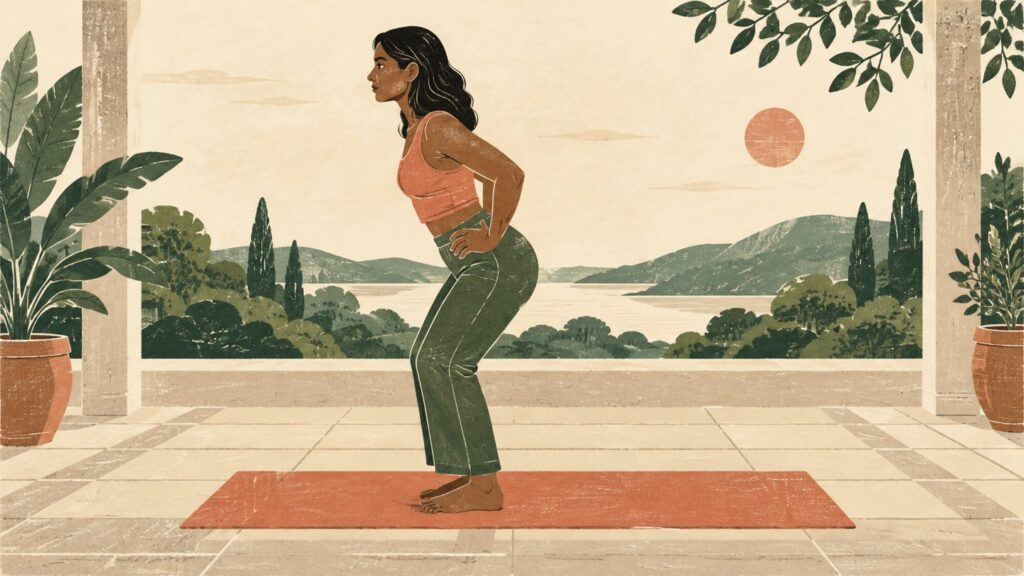
Chair Pose, or Utkatasana, resembles sitting back toward an imaginary chair. It is a standing, weight-bearing pose, not the same thing as seated chair yoga. The arms may lift, but keeping the hands on the hips can separate the leg task from an overhead reach.
Garland Pose, or Malasana, has variations across yoga traditions. Here it means the familiar wide-footed deep squat, with the knees opening in the direction of the toes. Other uses of the name may involve a narrower stance or a forward fold, so check the class instruction rather than relying only on the label.
Our Chair Pose and Garland Pose guides describe the individual shapes. This comparison explains why you might choose a different depth or support rather than treating one as a promotion from the other.
Depth and stance are separate choices
Chair Pose can use a modest knee bend. You do not have to lower the thighs to parallel with the floor or keep the feet touching. A small standing squat still asks the legs to support you.
In the common Garland shape, the pelvis lowers between the legs and the feet are often wider and more turned out. That changes the position of the hips as well as the amount of knee bend. Turning the feet farther out is not a universal fix, and forcing the knees apart with the elbows is unnecessary.
Do not copy one person’s stance and then use extra effort to make your knees fit it. Body proportions and joint movement differ. Find a comfortable arrangement with a teacher, or leave the pose out when there is pain or uncertainty.
Heels off the floor do not give you a diagnosis
It is common to hear that lifted heels in a squat always mean tight ankles. Bernie Clark’s Yoga International discussion explains that hip and knee movement, balance and body geometry also matter. The visible heel position alone cannot tell you which factor is responsible.
That is why comparing Chair and Garland should not become an ankle-flexibility test. A deeper squat is not necessarily easier to balance simply because the hips move closer to the floor. Nor does holding the heels down prove that the rest of the position is comfortable.
A stable heel support can be one option to discuss for Garland. It is support, not a promise that the heels will reach the floor after a certain number of weeks. Do not bounce, push through joint pressure or put a slippery stack beneath your feet to force a particular depth.
Support changes the task, not your worth
A higher squat with a stable hand support asks something different from sitting low on a firm prop. In the first, the legs continue to carry much of the body while the hands help you stay steady. In the second, a seat support can carry some weight beneath the pelvis.
Check the whole setup before moving: the support must not slide, tip or require you to reach so far that you lose balance. A prop that is comfortable once seated may still be awkward to get onto or leave. Avoid unstable book stacks or furniture that moves when you pull on it.
Neither unsupported Chair nor deep Garland is mandatory. A regular seated rest is an acceptable alternative when you do not want a standing hold or a low squat.
Think about the way back up before going down
The lower position is only part of the movement. Chair typically involves a shorter return to standing than a deep Garland squat. Before lowering farther, know whether you have the strength, balance and suitable support to return without rushing.
If you are already tired, a long squat hold followed by a difficult rise may not suit the purpose of your practice. Make the attempt shorter, stay higher or choose another position. Do not drop to the floor as a fallback if getting down and up is itself difficult.
Choose the task you actually want
- A brief standing leg task: a modest Chair Pose may fit without adding a deep squat or an overhead arm reach.
- An exploration of a lower, wider squat: Garland is a separate option to learn, with attention to the feet, knees, hip position and exit. It is not an automatic next step.
- A quiet rest: neither an unsupported standing squat nor an uncomfortable deep hold needs to serve as your resting position.
- A movement restriction or painful joint: do not choose from the photo alone. Get individual advice before testing the other squat as a substitute.
You do not need both poses in one session, and you do not need to remain longer to prove that the choice was worthwhile.
Safety applies at every depth
This is general education, not medical advice or a rehabilitation plan. Ask a qualified healthcare professional about suitable activity if you have knee, hip, ankle or back problems, a balance concern, recent surgery, pregnancy or another relevant condition. A yoga teacher can help with setup within that guidance.
Stop for pain, pinching, numbness, tingling, dizziness or difficult breathing. Keep breathing naturally rather than holding the breath to remain in the shape. There is no required hold time and no universal depth that makes a squat correct.
For a broader selection, explore the yoga pose library. Choose by the movement you want and can manage, not by how close your hips come to the floor.
Sources and further reading
- Yoga International: Why Your Heels Might Not Reach the Ground in Malasana, by Bernie Clark, for the limits of explaining squat shape by ankle flexibility alone.
- Yoga International: Utkatasana, by Zo Newell, used for the hips-back standing shape and arm options, not its organ-stimulation claims.
- Yoga Journal: Four Ways to Practice Malasana, by Andrew McGonigle, for the deep-squat shape and different heel, seat and chair supports.
- NCCIH: Yoga: What You Need To Know, for general safety, modifications and individual advice.