Fire Log Pose, or Agnistambhasana, is a seated position with the shins arranged roughly one above the other. It is also called Double Pigeon or Square Pose. In the familiar stacked version, the upper ankle sits above the lower knee and the upper knee sits above the lower ankle.
The shape asks for substantial outward movement at the hips. It is not ordinary cross-legged sitting, and the knees should never be pushed down to complete the stack. An upright supported preparation or a different pose may be the better choice.
Know which position you are being asked to make
In Easy Pose, the shins cross without needing to stack. In Pigeon Pose, one leg extends behind the body. Fire Log keeps both legs in front and places one bent leg above the other. Sharing the name “Pigeon” does not make the setups interchangeable.
There is no need to turn a comfortable cross-legged seat into Fire Log during meditation. The stack is a specific movement choice, not a more accomplished way to sit.
Do not use the knee as the route into the pose
This is general education, not medical advice. Ask your healthcare professional about suitable practice if you have hip, knee, ankle or back symptoms, an injury, recent surgery, pregnancy-related concerns, a health condition or a medical restriction. A qualified yoga teacher can help with the pose choice after those limits are clear.
Leave the pose out if arranging the legs causes knee pain, pinching, tingling, numbness or a feeling of joint pressure. Do not press down on a knee, pull the foot upward to force the stack, or ask another person to push the legs into place. A prop is not permission to continue through pain.
Start with an upright preparation
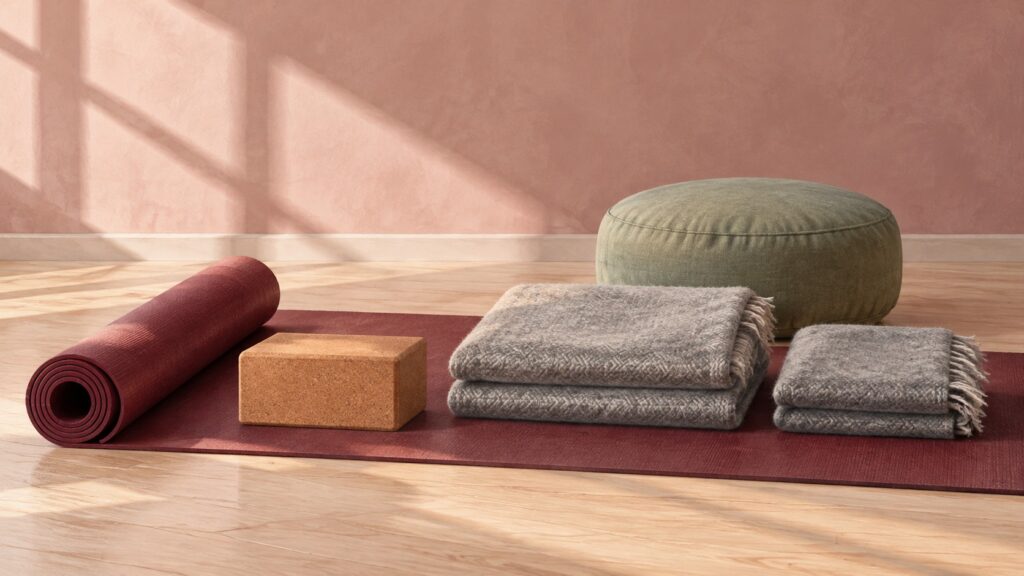
- Prepare the seat. Sit on a mat with the legs comfortably extended. A folded blanket under the sitting bones can provide a higher base if needed. Have supports within reach before moving the legs.
- Bend one leg. Bring the left shin across the front of the body, roughly parallel to the front edge of the mat. Choose a position you can make without pulling on the knee or ankle.
- Check before adding the second leg. If the first position already strains a joint, return to a simpler seat. Keep the torso upright rather than folding forward to compensate.
- Choose support for the upper foot. Instead of immediately placing the right ankle above the left knee, a supported variation rests the right foot or ankle on a stable block in front of the left shin. The exact height depends on a comfortable setup, not a prescribed angle.
- Support the upper knee if needed. A folded blanket or suitable stable support can fill the space beneath it. Do not use your hand to press the knee toward the support.
- Pause briefly. Keep the feet gently flexed without gripping the toes. Rest the hands lightly and breathe normally. Start with a few comfortable breaths, not a long stretch target.
This preparation does not need to become a perfect stack. If the props become awkward, unstable or too numerous to manage, come out and choose another position.
What changes in the stacked version?
In the full upright arrangement, the upper shin lies approximately above the lower shin, with the ankle and knee at opposite ends. The upper foot stays clear of being wedged or rolled underneath the thigh. A gap below the upper knee does not need to be closed.
Do not drag the ankle across the knee or press directly on the kneecap to place it. If the upper leg cannot be arranged without levering the knee or collapsing the torso, stay with a supported option or learn the setup with a teacher.
Matching a photograph is not the purpose. The guide to body proportions and yoga explains why the same cue can produce different shapes.
Leave the forward fold optional
This guide stays upright. Folding forward adds another movement and is not required to make Fire Log count. Do not use the weight of the torso to push a high knee down, and do not deepen the pose simply because you feel little stretch.
A quiet breath and a stable seat are more useful checks than how flat the shins look. Stop if you brace hard, hold the breath or need your hands to keep the legs trapped in position.
Choose a different shape when the stack does not suit you
Easy Pose is a simpler seated alternative. A reclining Figure Four stretch changes the support by placing the back on the floor. It is a different option, not a guarantee of comfort for every hip or knee.
You can also leave hip stretching out entirely. There is no compulsory range to reach and no need to “open” a joint through discomfort. When a health concern affects the choice, get individual advice rather than treating one internet alternative as universally safe.
Unstack slowly
Support the upper leg as you gently release it, then extend or reposition the legs without a sudden twist. Pause before changing sides. Set up the second side on its own terms instead of insisting on identical prop height or range.
If symptoms continue after leaving the pose, seek appropriate professional advice. For a different practice, use the yoga pose library without treating Fire Log as a required milestone.
Sources and further reading
- Yoga International: Double Pigeon variations and prop tips, for the naming, stacked arrangement, block-in-front option and alternative poses.
- Yoga Journal: Fire Log support options, for supporting the upper ankle and knee. This guide does not recommend staying in knee pain or pursuing its deeper variation.
- NCCIH: Yoga, effectiveness and safety, for general safety guidance. No treatment effect is claimed for this pose.