“Step your foot between your hands” can be one of the hardest instructions in a flowing yoga class. The foot may stop halfway, the knee may brush the chest, or the movement may feel rushed. You do not have to make the transition in one step.
This guide is about moving from Downward-Facing Dog into a lunge, not jumping both feet toward the hands. It offers a knee-down route first, then ways to make more room if you choose to practise the lifted-knee version.
The transition is its own movement skill
Being comfortable in Downward-Facing Dog and in a lunge does not automatically make moving between them easy. Stepping through asks you to support weight through the arms while bringing a bent leg forward under the torso. The amount of room available, your movement control and your body proportions can all affect it.
A short step is not proof that your hips are “too tight” or your core is “too weak.” One movement cannot diagnose the cause. The guide to body proportions explains why reach and clearance differ between people.
Check the starting and finishing positions first
This is general education, not medical advice. If you have an injury, pain, a health condition, recent surgery, pregnancy-related concerns or a medical restriction, ask your healthcare professional whether this kind of floor practice is suitable. A yoga teacher can help you choose a transition within those limits.
If Downward Dog itself hurts, do not use a step-through drill to try to fix it. If kneeling is painful, the knee-down route below may not suit you either. You can leave the transition out and ask for a standing or other individually suitable practice.
Stop for pain, pinching, numbness, tingling, dizziness or loss of control. Do not keep trying until fatigue makes the foot land by accident.
Start by lowering a knee
For many people, removing the need to balance on three points makes the movement more manageable. Try it slowly, outside the pace of a flowing class:
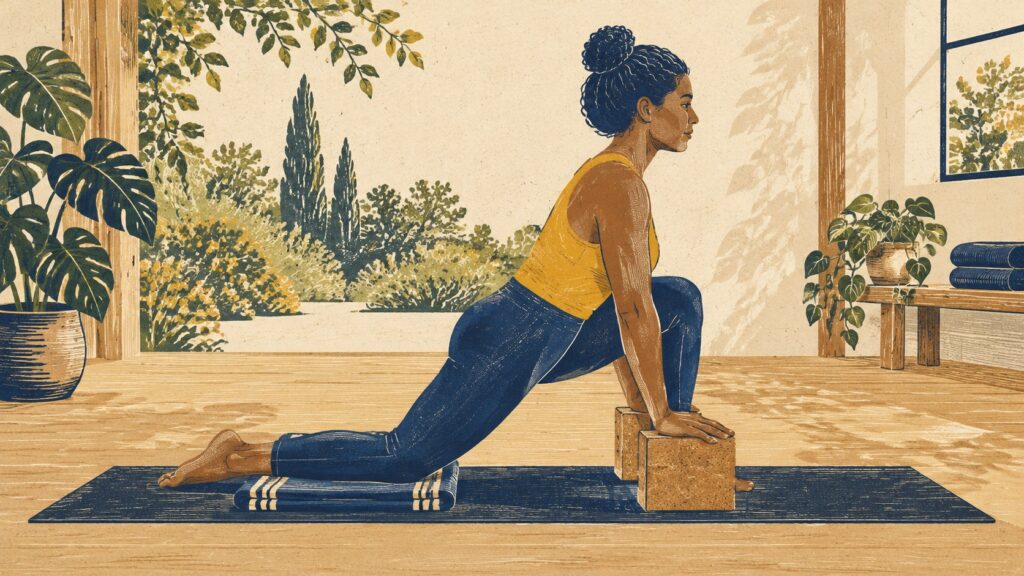
- Make space. Use a non-slip mat and clear the area in front of your hands. Have a folded blanket ready where your back knee will land if padding is useful.
- Come down with control. From a comfortable Downward Dog, lower both knees to the mat into hands and knees. Pause. You do not need to step while lowering.
- Keep one knee grounded. To bring the right foot forward, keep the left knee supported. Shift only as much as you can control through the hands and left knee.
- Bring the other foot forward. Move the right foot toward the space beside or between the hands. It can land wider than the hands if that gives your body room.
- Settle before adjusting. Keep support through the hands and back knee. Make small adjustments until the front foot rests flat and the position feels steady. Do not yank the foot or twist a planted knee.
- Choose what comes next. Stay supported or move into a comfortable low lunge. You are not required to lift the arms or deepen the stretch.
If stepping from hands and knees still feels awkward, stop there and ask a teacher to help you find a different route. Lowering the knee is a complete option, not a temporary failure you must graduate from.
Use blocks to create more clearance
Raising the hands can provide more space between the torso and floor. Begin with both hands on two sturdy yoga blocks set on their broad, low faces on a non-slip surface. Test that they do not slide or rock before using them for the transition.
Try the knee-down route with this higher hand support first. Keep both hands supported as the front foot moves forward. A taller block setting is not automatically better: if the blocks become unsteady, return to a lower setting or leave them out.
Do not stack loose books, cushions or multiple blocks for a moving, weight-bearing transition. If ordinary blocks do not give you a stable workable setup, get help rather than building an increasingly high platform.
If you keep the back knee lifted
Only explore this option when the starting pose and arm support are comfortable. From Downward Dog, bring the shoulders and hips somewhat forward as the bent leg comes toward the torso. Press into the hands so the upper body stays supported instead of collapsing toward the mat.
The moving knee can travel slightly toward the outside rather than having to squeeze straight through the centre. The foot may land outside the hand first. Once you are stable, you can lower the back knee and adjust the front foot. Do not force a straight path if a wider route is more manageable.
Movement teacher Jenni Rawlings and yoga teacher Dianne Bondy both describe using additional space during this transition, including blocks or a wider path. This does not mean every person needs the same hand width, knee path or stance length. Change one thing at a time and keep the movement easy to stop.
When the foot stops halfway
Pause rather than bouncing or swinging harder. Lower the back knee if comfortable and re-establish support. You can make a small foot adjustment once you are steady, or come out and set up the lunge separately.
A teacher may show you an assisted foot placement. Do not reach for the foot while balancing precariously on one hand, and do not drag a foot that is caught against the mat. Finding a dependable route matters more than avoiding all extra steps.
Practise the transition, not a speed test
Try one unhurried transition on each side and notice whether the support stays steady. Rest before you become tired. There is no required repetition count or deadline for making one clean step.
Breathe normally. If matching a teacher’s breath count makes you rush, take an extra breath or pause. In a Sun Salutation or another flow, you can rejoin the class after setting up instead of racing through the difficult part.
Tell the teacher before class if you want a knee-down option or more time. Choosing that route every time is valid. This transition is one way to connect poses, not a test of whether you belong in a yoga class.
Sources and further reading
- Jenni Rawlings: How to Step Forward From Down Dog, for clearance, body proportions, a wider knee path and blocks. This guide does not prescribe her wrist-lifting option for unsupervised beginners.
- Dianne Bondy for Yoga International: Stepping to Lunge From Down Dog, for shifting forward, making room, blocks and lowering the back knee.
- Heather Yoga: Ways of Transitioning to Low Lunge, for the hands-and-knees route with raised hand support.
- NCCIH: Yoga, effectiveness and safety, for general safety guidance, not evidence of a treatment effect from this transition.
For other practice choices, browse the yoga pose library.