Two people can follow the same yoga instruction and make different shapes. Arm length, leg length and torso length affect where the hands land, how far a foot needs to travel, and which support feels useful. Flexibility and strength matter too, but they are not the whole explanation.
This guide is about adapting reach and stance, not identifying a perfect body type. You do not need to measure your limbs, diagnose your anatomy from a photograph, or change your body to deserve a comfortable practice.
A hand touching the floor is not a universal benchmark
Consider a standing forward fold. The distance between the shoulders and the floor depends partly on the relationship between the legs, torso and arms. Touching the floor is therefore not a clean test of flexibility, experience or effort.
The same issue appears in a seated pose. One person’s hands may reach the floor beside the hips with bent elbows; another person may need to lean sideways to make the same contact. Copying the hand position can change the torso position even when both students are trying equally hard.
The useful question is not, “Why do I look different?” It is, “What is this part of the pose meant to do, and can I do that with a different contact point?”
Choose the purpose before the shape
Ask whether a hand is there to carry weight, offer light balance, connect to a foot, or simply rest. Those are different tasks. A hand that is only resting may not need to reach the floor at all. A hand carrying weight needs a stable support, not a fingertip stretch toward a surface that is too far away.
A teacher can help distinguish the purpose from a visual cue. Instructions such as “hands beside the feet” or “step between the hands” can be useful starting points without being fixed measurements for everyone.
Example 1: Bring support to your comfortable reach
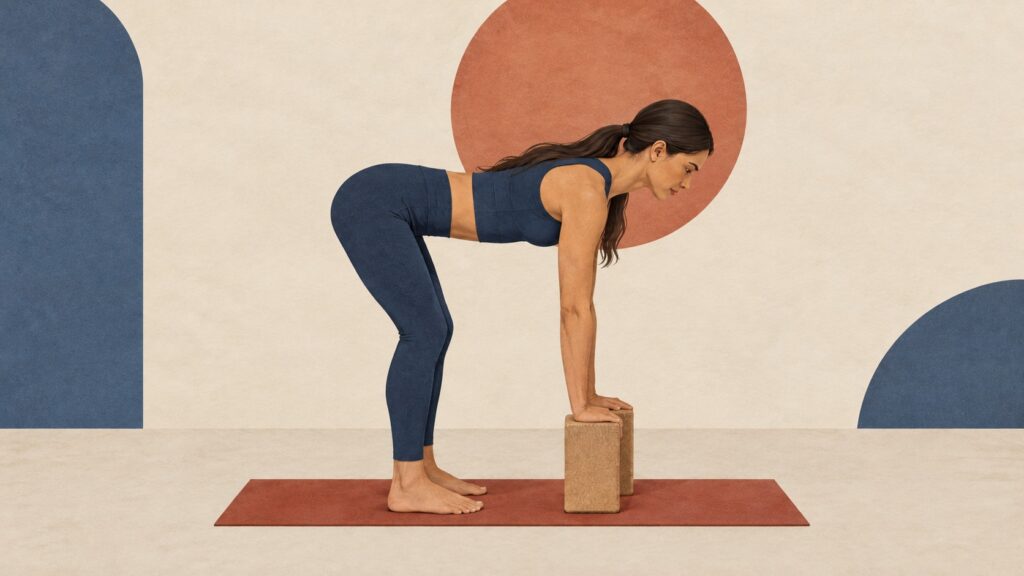
In a standing half forward bend, choose a height where you can support the hands without dragging the shoulders down or forcing the neck up. Depending on the version, the hands may rest on the thighs, shins or two stable blocks.
Do not assume that lowering the blocks is always progress. A useful height can remain useful as you gain experience. If the tall setting feels unstable, use a different contact point or ask about a stable higher support rather than balancing on a loose stack.
The separate yoga block guide covers placement and stability. Here, the decision is about the relationship between your reach and the task, not which block material to buy.
Example 2: Connect to a foot without chasing it
When a pose asks you to hold a foot, the distance is affected by more than hamstring flexibility. Reaching farther with the hand may also pull the shoulder forward or change the position of the torso.
A strap can bridge that distance. Use enough length that the connection does not become a strong pull. Keep the knee bent or the leg lower when that fits the pose and your comfort. Holding the toe is not automatically a better version than holding a strap.
See the yoga strap guide for basic handling. A strap extends reach; it does not prove that a joint should move farther.
Example 3: Treat stance cues as starting points
A stance described as “one leg length” or “arms wide over the feet” will not place everyone’s joints in the same relationship. Even people of the same overall height can have different limb proportions.
Begin with a manageable stance and adjust within the pose’s basic instructions. Check whether the feet remain grounded, the knees feel comfortable and the transition stays controlled. Do not keep widening the stance solely to place a hand beneath a shoulder or make a photograph look symmetrical.
If an adjustment changes the pose so much that you are unsure where the weight should go, come out and ask a qualified teacher. A simple support change is different from inventing a new loaded position.
Do not turn proportions into a diagnosis
A difficult reach does not prove that your arms are too short, your hips are shaped a particular way, or a movement will always be impossible. Range of motion, strength, balance, previous experience, fatigue and comfort can all affect the result.
Likewise, matching a photograph does not prove that a pose is comfortable or appropriate. Two people can make a similar outer shape with different amounts of effort. Avoid ranking bodies or assigning abilities from appearance.
A small adjustment process
- Identify the task. Is the priority support, balance, movement or rest?
- Change one thing. Try a different hand height, a longer strap or a modest stance change. Set up props before loading them.
- Check the result. Notice breathing, pressure, balance and whether you can leave the pose without rushing.
- Keep or discard the change. A modification is useful only if it helps this practice. You do not need to keep it because someone else recommends it.
Comfort is information, not a challenge
This is general education, not medical advice or an individual movement assessment. Get appropriate guidance if you have an injury, recent surgery, a health condition, pregnancy-related concerns or a medical restriction. Stop for pain, tingling, numbness, dizziness or difficulty breathing.
Do not force a joint to test whether the problem is flexibility or anatomy. Choose a different pose when needed. The yoga pose library offers options without requiring every body to take the same route.
Sources and further reading
- Bernie Clark: Proportions in Yoga, for examples of how relative limb and torso lengths affect the appearance of poses.
- Ananda: Helping Students Master the Asanas, Part 2, for practical examples of adapting hand support and reach. This guide does not use its energy or medical claims.
- NCCIH: Yoga, effectiveness and safety, for general safety guidance and the need for suitable modifications.