Standing Half Forward Bend, or Ardha Uttanasana, is the “half lift” you may hear called out between a forward fold and a step back in a yoga class. Instead of letting your head and torso hang toward your legs, you lift and lengthen your torso while keeping your hands supported. Bent knees, blocks or a sturdy chair can help you find a version that does not depend on reaching the floor.
This article is general education, not medical advice or a personal exercise plan. If you have an injury, a health condition, dizziness or pregnancy-related concerns, check with your doctor before starting or changing your practice. A qualified yoga teacher can help you choose an appropriate setup. Do not use a forward bend to work through pain.
What makes it a half lift?
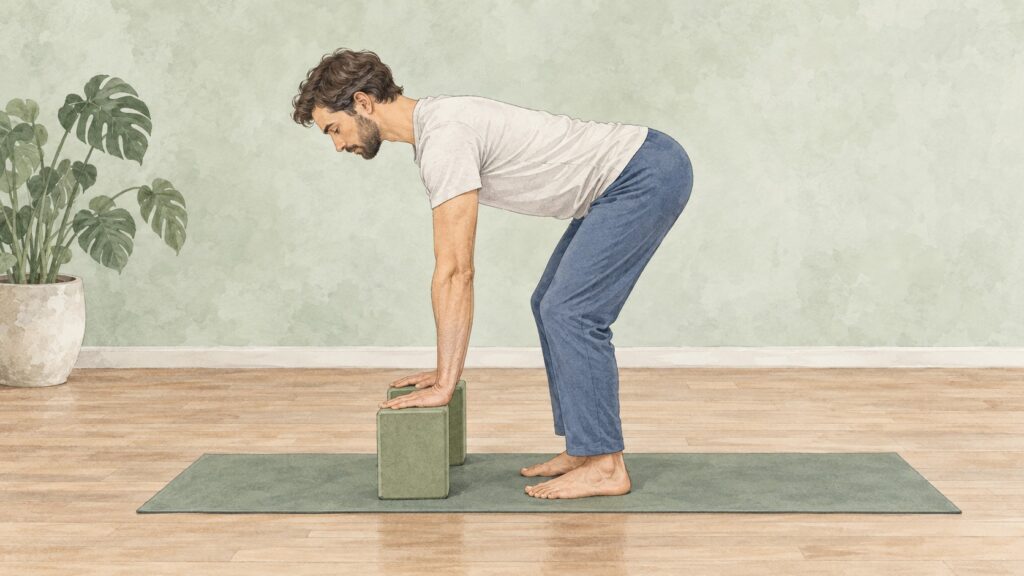
In Ardha Uttanasana, you hinge at the hips and lengthen the torso away from the thighs. Your head stays in line with the spine rather than hanging down as in a full standing fold. Your hands may rest on blocks, your shins or a chair, depending on your reach and the version being taught.
“Half” is a pose name, not an exact angle you need to measure. You can keep the torso higher if a lower position makes you strain. Your proportions and available movement affect where support belongs.
How is it different from a full forward fold?
Our Standing Forward Fold guide focuses on the fuller fold, with the torso closer to the legs and the head released. A half lift has a different task: creating length through the torso while your hands remain supported. You do not need to straighten the knees or flatten every natural spinal curve to do it.
The half lift also appears as a brief transition in a Sun Salutation. Learning it separately lets you adjust the support and understand the movement without keeping up with a flowing class.
Choose your support before bending
Yoga Journal shows half-lift variations with bent knees, blocks and a chair. Start with a height you can reach comfortably. Use two stable blocks, one for each hand, or a sturdy non-rolling chair that will not move or tip. Place props on a firm, nonslip surface and check them before putting weight through your hands.
You do not have to buy props to learn the idea, but a soft pillow or an unstable stack is not a reliable hand support. If you cannot find a steady setup, ask a teacher to help or leave the pose for another day.
A supported way to explore the pose
- Start standing. Place your feet a comfortable distance apart and keep your knees soft. Set the support in front of you so both hands can reach it without twisting.
- Make a small hip hinge. Tip forward from the hip creases, bending your knees as needed. Stop at a height where you can place your hands without forcing your back or reaching sharply.
- Lengthen forward. With your hands supported, let your chest move slightly away from your thighs. Think of making room from your hips toward the crown of your head, rather than lifting the chin.
- Keep your neck comfortable. Look down or slightly ahead without craning upward. Your gaze should follow the position of your torso. If you have a neck injury, seek individual advice rather than copying a forward-looking demonstration.
- Breathe normally. Keep the exploration brief. If you cannot breathe comfortably, raise the support, make the hinge smaller or return to standing.
- Return without rushing. Keep the knees soft, move back toward upright slowly and pause with both feet grounded. If a teacher is guiding you into a full fold instead, follow an option suited to your body rather than dropping your head suddenly.
The aim is a controlled movement you can enter and leave, not the lowest possible torso or the straightest possible legs. Stop for pain, dizziness, numbness or unusual symptoms.
Should my knees be straight?
No. Bent knees are an ordinary variation. They can change how much reach is required and let you find hand support without chasing the floor. Do not push the knees backward to make them look straight. If there is pulling or pain behind a knee or at the back of the thigh, come out and get appropriate advice rather than trying to stretch through it.
Where should my hands rest?
Yoga Journal includes hands on the shins or thighs as well as blocks and a chair. Adventure Yoga Online prefers hand support on the floor or props in its teaching approach. This is a useful reminder that teachers may choose different setups; one hand position is not a universal rule.
Choose a position that lets you breathe and keep control without pressing into a painful area. Avoid using the kneecaps as a place to push. If the hands slide, the shoulders tense or the back strains, change the height or ask a teacher to check your setup.
What if the floor feels far away?
Bring the support higher instead of pulling yourself deeper. You can use a chair variation or keep the torso more upright. A half lift is not a test of whether your fingertips can reach the mat. Long legs, shorter arms or a different comfortable range can all change the shape.
There is no requirement to stop using props as you gain experience. Support is a practical choice, not a lower grade of yoga.
Common mistakes to notice
- Looking sharply forward. Keep the head in line with the torso instead of lifting the chin to copy a photo.
- Reaching lower at any cost. Raise the hand support or bend the knees when reaching the floor causes strain.
- Forcing a rigidly flat back. Aim for comfortable length, not the removal of natural curves or a large backbend.
- Rushing the transition. Pause and adjust. You do not have to move on the same breath count as everyone else.
- Treating symptoms as a flexibility problem. Pain or dizziness is a reason to stop, not an invitation to work harder.
Is it a treatment for back pain?
No. This is a guide to a yoga shape, not a treatment programme. Research about yoga as a complete practice does not establish that a particular half lift is appropriate for your back condition. The National Center for Complementary and Integrative Health notes that people with injuries and health conditions may need modifications, and recommends qualified instruction.
If bending is uncomfortable or your clinician has given movement restrictions, follow that advice. A chair or block does not automatically make a forward bend suitable.
Where does it fit in a practice?
You can explore a small supported half lift as its own movement lesson or learn it as part of a teacher-led sequence. Keep the surrounding practice simple while you become familiar with entering and leaving it. Our beginner pose library explains the broader starting points without requiring a difficult sequence.
The bottom line
Ardha Uttanasana is a supported lengthening of the torso, not a demand to touch the floor. Let your knees bend, choose a useful hand height and keep your neck comfortable. A smaller hinge you can control is enough.
Sources
- Yoga Journal: Standing Half Forward Bend. Pose description, bent-knee, block and chair variations, and neck cautions.
- Adventure Yoga Online: Ardha Uttanasana. A contrasting teaching approach to hand support and pose modifications. This article does not adopt its individual therapeutic or broad benefit claims.
- NCCIH: Yoga Effectiveness and Safety. General safety, individual modifications and qualified instruction.
Featured image: original illustration of a supported half-lift variation, not a photograph or an individual assessment.