Head-to-Knee Pose, or Janu Sirsasana, is a seated forward bend with one leg extended and the other knee bent out to the side. The name can make it sound like your forehead must reach your knee. It does not. A small forward lean, a comfortable bent knee and an easy breath are a better starting point than trying to copy a deep fold.
This guide focuses on the one-leg setup, especially the support under the bent leg. For the two-leg version, see our seated forward bend guide. This is general education, not medical advice. If you have knee, hip or back pain, an injury, osteoporosis, recent surgery, pregnancy-related concerns or another health condition, ask your healthcare professional whether this movement is appropriate before trying it.
What makes Janu Sirsasana different?
In a two-leg seated forward bend, both legs extend in front of you. In Head-to-Knee Pose, one knee bends and the thigh opens to the side. That changes the position of the hips and creates a separate question: can the bent leg rest comfortably while you sit and lean forward?
The bent knee is not something to press down. If the leg cannot settle without discomfort, support it, adjust the angle or choose a different pose. Being able to reach the straight-leg foot does not mean the bent leg is comfortable.
Set out support before you begin
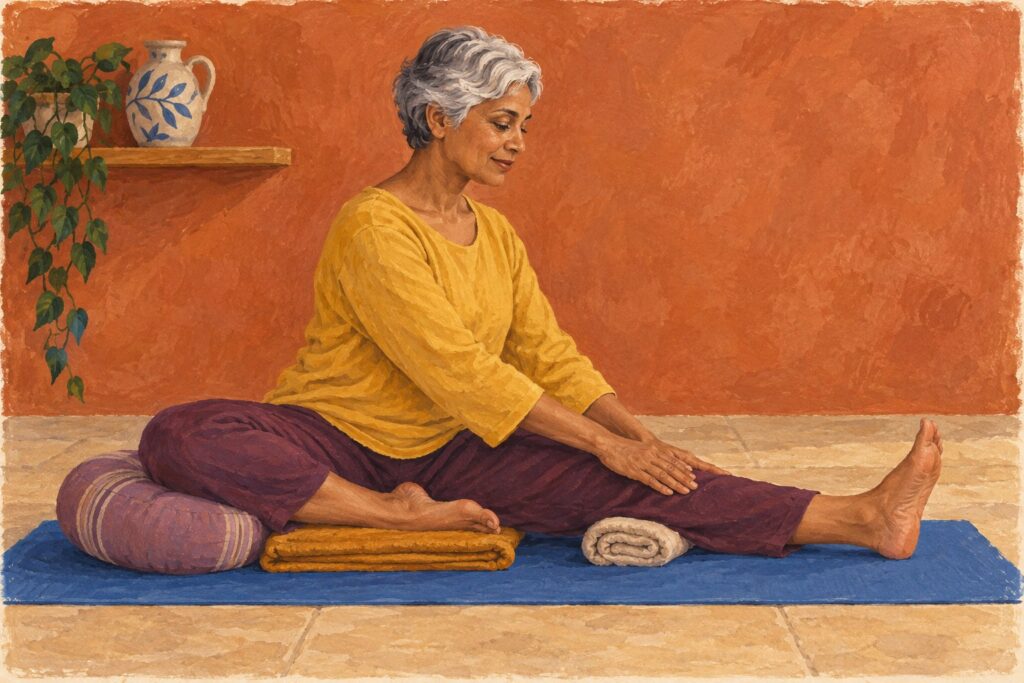
Use a firm, level surface with enough room for both legs. Keep a folded blanket for your seat, a cushion or folded blanket for the outer bent thigh, and a small towel roll for beneath the extended knee. Supports should stay in place without wobbling or slipping.
You do not need a strap to begin. Your hands can stay on the floor or your leg. Removing the expectation of holding the foot often makes it easier to notice the setup rather than the distance.
Start with the seat and legs
- Sit with both legs in front of you. Raise your hips on a folded blanket if that helps you sit upright without straining.
- Leave the right leg extended, with a small bend at the knee if needed. A towel roll beneath that knee is an option, not a demand to straighten it.
- Bend the left knee and let the thigh open only as far as feels comfortable. Bring the left sole toward the inner right thigh without pulling the foot into position.
- Support the left outer thigh and knee with a cushion or folded blanket if the leg otherwise hangs or feels strained. Do not use your hand to push the knee down.
- Pause upright. Check both the knee and hip before adding a fold. If this seated shape is uncomfortable, come out rather than moving farther.
Add a small forward hinge
Turn your chest gently toward the extended right leg without wrenching the hips or forcing a twist. Lengthen through the torso and lean a little from the hip creases. Rest your hands lightly on the right thigh or shin, or on the floor where you can reach without collapsing.
Keep the head in line with the spine instead of dropping it toward the knee. Stop where breathing stays comfortable and the movement feels unforced. Staying nearly upright is a valid choice. The front of the body does not need to lie on the leg.
Pause for a few easy breaths rather than a fixed endurance target. Then use light hand support to sit upright slowly. Bring the bent leg back toward the centre with care and extend it before changing sides. Do not rush the knee through the transition.
Check the bent knee before the depth of the fold
The bent-leg position asks for movement at the hip. A knee that stays high is not an invitation to press harder. Yoga Journal’s teaching guidance recommends supporting the outer thigh and reducing the angle between the legs when the bent-knee position is uncomfortable. Persistent pain is a reason to leave the pose.
Support is not a way to make pain acceptable. If you feel pinching at the inner knee, a sharp sensation, instability or increasing discomfort, stop. Do not pull the ankle, force the heel closer or ask someone to press the knee toward the floor. A teacher can help with the general setup; symptoms or an existing injury need advice from a qualified healthcare professional.
If the extended leg feels too demanding
Keep a soft bend in that knee and make the fold smaller. Raising the seat may make the upright starting position easier. A towel beneath the knee can give the leg a place to rest, particularly if you tend to press the knee backward.
A gentle stretch and pain are different experiences. You do not need to wait for discomfort to become severe before changing the pose. Tingling, numbness, sharp pain or a feeling that you must brace and hold your breath are reasons to come out, not signs of progress.
Should you use a strap?
A strap can extend the reach of your hands, but it should not become a handle for pulling the torso down. If a qualified teacher has shown you the setup, hold the strap lightly, keep the elbows soft and leave enough slack to stay upright or make only a small hinge. Let it go easily when returning.
For a first attempt, hands resting on the leg may be simpler. The pose is still Head-to-Knee Pose even when your hands do not reach the toes and your head is nowhere near the knee.
Do both sides need to look the same?
No. Notice each side separately and choose support for that side. You might need a higher cushion beneath one bent leg or a smaller lean on the other. Do not force the less comfortable side to match a picture or the shape you made on the first side.
Keep your attention on the quality of the movement rather than measuring how far you reach. New pain or a marked change in comfort is worth checking with a healthcare professional, particularly after an injury.
Head-to-Knee, Revolved Head-to-Knee and Half Butterfly
These names can appear near each other in classes, but the instructions are not interchangeable. This guide describes a modest forward bend toward the extended leg. Revolved Head-to-Knee adds a side-bending and rotational element and needs its own teaching.
Half Butterfly is a name often used for a Yin Yoga shape with a different approach to effort and holding time. Do not automatically turn a brief, active Janu Sirsasana practice into a long passive hold. The same broad outline does not mean the same method or suitability.
What can you reasonably expect?
Janu Sirsasana offers a way to explore a one-leg forward bend and notice how the two sides feel. You may notice a stretch along the back of the extended leg or prefer the quiet pace of a brief seated pose. Those experiences vary.
This article does not claim that one pose treats back pain, anxiety, digestive problems or another medical condition. Research about yoga programmes cannot be used to promise a particular health outcome from a single posture. Keep any clinical questions separate from the goal of learning the shape.
Where it fits in a practice
Try the setup after comfortable movement rather than rushing into the deepest fold at the start. Keep the first attempt brief. After each side, sit upright and let both legs rest. There is no need to add a demanding backbend to compensate for the fold.
If floor sitting does not work for you, skip this shape. A teacher can help you choose a different seated or chair-based movement rather than trying to reproduce every detail. Our beginner pose library is a place to compare other options.
Questions that come up in class
Must my forehead touch my knee?
No. The name is not a range-of-motion requirement. Keep the torso long and choose a small fold you can leave comfortably.
Can I push the bent knee down?
No. Support the leg instead. If the knee hurts despite changing the setup, stop and get advice rather than applying more force.
Is a straight extended knee compulsory?
No. A soft bend and a small support beneath the knee are useful options. Avoid forcing the back of the knee toward the floor.
Is this the same as a seated forward fold?
It belongs to the forward-fold family, but the one-bent-leg setup changes the hip and knee demands. Start with that setup rather than treating it as a deeper version of the two-leg fold.
Sources and further reading
- Yoga Journal: Head-to-Knee Pose, used for the pose distinction, supported seat and knee options, and avoiding forceful pulling.
- Yoga Journal: Modifications for knee discomfort, used for the bent-thigh support and reduced-angle options, not as medical clearance.
- National Center for Complementary and Integrative Health: Yoga, effectiveness and safety, used for general safety and the need for individual modifications with health conditions.