Dancer Pose, or Natarajasana, combines standing on one leg with a backbend and a reach behind the body. The familiar photograph may show a high lifted foot and an overhead grip, but those are not requirements for exploring its simpler actions.
This guide starts with wall support and a small movement. The deeper, overhead-grip version is a teacher-led learning task, not the next step you must attempt at home.
Separate balance, reach and backbending
Three different tasks meet in Dancer: standing on one leg, reaching back toward the other foot, and moving that thigh behind you as the chest stays lifted. Difficulty with any one part can change the whole pose.
Do not pull harder on the foot to solve a balance problem. Do not arch the lower back farther to compensate for a difficult shoulder reach. Wall support can reduce the balance demand, but it does not remove the need for comfortable knees, shoulders and back.
Warrior III also uses a one-leg balance, but its lifted leg is extended and its main task is a forward hinge. Dancer bends the lifted knee and adds the reach and backbend. They are different choices, not levels of the same pose.
Decide whether to try it today
This is general education, not medical advice. Ask your healthcare professional about suitable movement if you have pain, an injury, a health condition, recent surgery, pregnancy-related concerns, dizziness, balance problems or a medical restriction. A qualified teacher can help with pose selection within those limits.
Skip Dancer if bending the knee, reaching behind or standing on one leg causes discomfort. Stop for joint pain, back pinching, tingling, numbness, dizziness or a sense that you may fall. A wall is support, not permission to push through symptoms.
Prepare without making a pose checklist
Begin after comfortable general movement, not by grabbing a cold foot and pulling it upward. Choose familiar, easy movements for the shoulders, hips and legs. A supported low lunge or Tree Pose may be useful choices if they already suit you.
You do not have to perform Camel, Bow or another deep backbend first. If the basic actions are unfamiliar or hard to control, learn them with a teacher before combining them in Dancer.
Start facing a wall
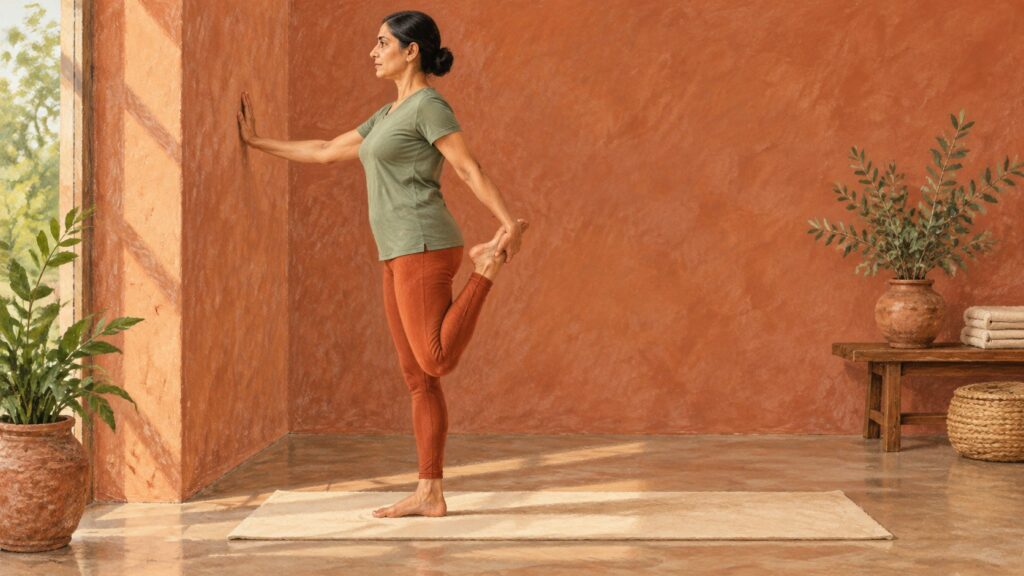
- Set up the support. Stand facing a clear wall, close enough to rest the left hand on it without leaning or reaching far. Use a stable, non-slip surface under the standing foot.
- Shift weight slowly. Keep the gaze on a steady point and move weight into the left foot. Keep the standing knee comfortably active rather than forcing it backward.
- Bend the other knee. Bring the right heel behind you only as far as comfortable. Keep the torso mostly upright. You can stop here without catching the foot.
- Check the reach. If the foot is comfortably within reach, hold the right foot or ankle gently with the right hand. Do not twist the shoulder or yank the heel toward the buttock.
- Explore a small movement. If steady, let the right thigh move a little backward as the foot presses gently into the hand. Keep the chest comfortably lifted. A small forward inclination is enough; avoid dropping the chest and hauling the leg upward.
- Stay brief. Take a few natural breaths only while the position remains controlled. Keep the left hand on the wall throughout.
The bent knee can point generally downward and back without being forced into a perfect line. If it swings far outward or the pelvis twists as you try to lift higher, reduce the movement. The height of the heel is not a score.
If you cannot reach the foot
You can keep the hand free and practise only the supported knee bend. That is a preparation, not a failed Dancer. Do not hop around trying to catch the ankle.
A yoga strap can extend reach, but managing it while standing on one leg adds another task. Have a teacher show you a stable setup with one hand remaining on the wall. The strap should connect the hand and foot without becoming a tool for pulling the leg higher.
This article does not teach threading the strap over the shoulder, walking the hands toward the foot or changing to an overhead grip. More reach is not always a better choice for the shoulder or back.
What wall support changes, and what it does not
The wall gives the forward hand a dependable contact point. Keep enough space that the elbow can bend as the torso moves slightly. Do not push the wall away or stand so far back that your supporting hand becomes a long reach.
A sturdy chair may be another support if it cannot slide or tip under the direction of pressure. Use the support that is genuinely stable in your room, not whichever looks more like a class photograph.
Alternatives need their own comfort checks
Yoga Journal describes side-lying and chair-based versions that separate some of Dancer’s actions from standing balance. They are different setups, not automatically suitable for every knee, hip or shoulder.
If standing balance is not appropriate, ask a teacher about a comfortable supported alternative. If bending the knee or reaching behind is the problem, removing balance alone does not solve it. You can leave the pose out rather than chase a version with the same name.
Exit before balance runs out
Reduce the backward press, bring the torso upright and gently release the foot without letting it spring away. Lower the foot to the floor while keeping the other hand on the wall. Pause with both feet grounded before deciding whether to change sides.
Set up each side on its own terms. You do not need identical reach, height or duration. End the practice if fatigue, pain or unsteadiness appears, and seek appropriate professional advice for symptoms that persist.
Dancer is optional. Use the yoga pose library to choose another movement without treating the overhead version as a milestone.
Sources and further reading
- Yoga Journal: Andrew McGonigle, Dancer Pose variations, for wall, chair and side-lying options.
- Yoga Journal: Dancer Pose, for distinguishing the balance and backbend and for wall support. This article does not adopt its advanced progression or health-benefit claims.
- Liforme: Ann Pizer, Dancer Pose, for the simpler hand-behind variation and controlled return. The overhead-grip progression is not taught here.
- NCCIH: Yoga, effectiveness and safety, for general safety context, not a treatment claim for this pose.