Bharadvaja’s Twist, or Bharadvajasana I, is a seated rotation usually shown with both knees bent and the feet resting beside one hip. The torso turns away from the feet while staying upright. A chair variation lets you explore the turn without arranging the legs on the floor.
The unusual seat is an important part of the floor version. Do not force the ankles or knees into it just to practise a twist. This guide keeps the arms unbound and the rotation modest.
How the seat differs from other twists
In Bharadvajasana I, both bent legs rest to one side rather than one foot crossing over the opposite thigh. That makes the base different from the familiar crossed-leg or Half Lord of the Fishes setup discussed in our seated spinal twist guide.
Bharadvajasana II is another variation involving a different leg arrangement, including a half-Lotus position. It is not taught here. The name also appears in supported reclining variations, which should not be confused with this upright seat.
Choose the seat before adding rotation
This is general education, not medical advice. Ask your healthcare professional about appropriate movement if you have pain, an injury, a spinal or joint condition, recent surgery, pregnancy-related concerns or a medical restriction. A qualified yoga teacher can help choose support within those limits.
The floor setup bends both knees and places the ankles in an unfamiliar position. If that is uncomfortable, use a chair if suitable or leave the pose out. Extra blankets are not a reason to continue through pain. Stop for pinching, numbness, tingling, dizziness or strain in the back, neck or joints.
A chair option without forced leverage
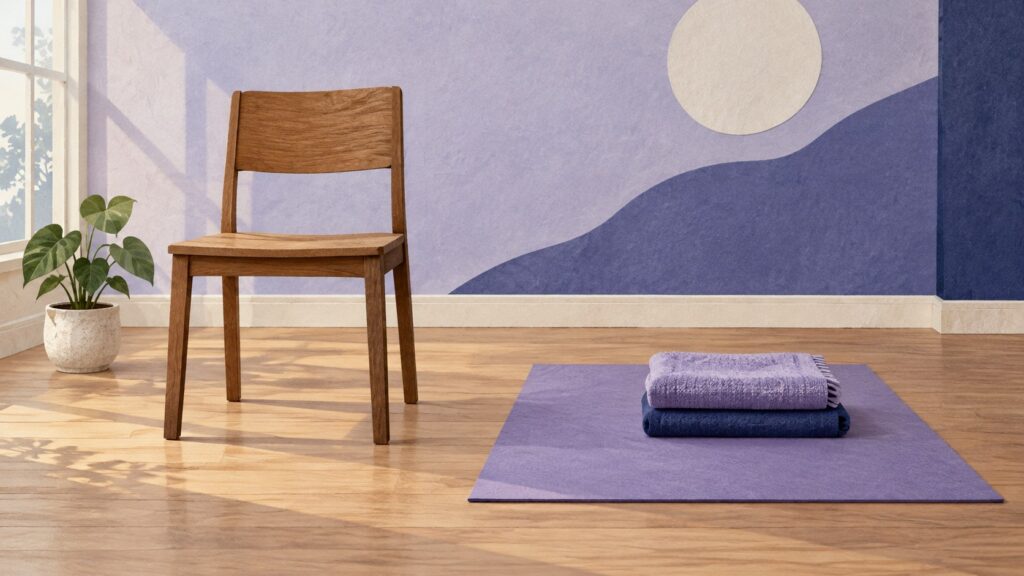
- Choose a stable chair. Use an armless chair without wheels that cannot slide or tip. Sit sideways with the backrest to your right, keeping enough of the seat beneath you to feel secure.
- Support both feet. Place the feet comfortably apart and flat on the floor. If they do not reach, use a firm stable foot support rather than leaving them dangling.
- Begin upright. Let the torso lengthen comfortably above the pelvis. Keep both sides of the seat supported instead of leaning toward the backrest.
- Turn a little. Rotate the chest toward the backrest. Rest the hands lightly on it if they reach easily. Do not pull with one hand and push with the other to crank the torso around.
- Keep the neck easy. Let the head follow only as far as comfortable. The chin does not need to reach the shoulder.
- Return slowly. Take a few natural breaths, then unwind to your starting position. Reposition the whole seat to practise the other direction rather than twisting against an awkward chair edge.
Jivana Heyman’s guidance for accessible twists describes the hands as stabilising contact, not a way to force depth. That is the approach used here. You can keep the hands on the thighs if reaching the backrest makes the movement harder.
Arrange the floor seat without a twist first
If floor sitting and knee bending are comfortable, begin seated with the legs forward and supports nearby. Bend both knees and bring the feet toward the outside of the left hip. The left ankle may rest in the arch of the right foot, but do not wedge the feet or force the knees down to copy a picture.
Notice whether the torso tips strongly to the right. A folded blanket beneath the right sitting bone can raise that side of the seat while leaving room for the left side to settle. Adjust the height before turning. The aim is an upright, supported base, not a perfect arrangement of the shins.
If you need a hand to hold the torso upright, cannot place the legs without strain or feel pressure in an ankle, return to the chair option. You do not have to solve the floor seat today.
Add a small turn away from the feet
With the feet to the left, turn the chest gently to the right. The right hand can rest behind the right hip, on the mat or a stable support within easy reach. Let the left hand rest lightly on the right thigh or knee without pulling it.
Keep both sides of the torso comfortably long. If the supporting hand makes you lean back or sideways, change its position or reduce the turn. Do not press the knee downward or use the arms to pin the pelvis while forcing the chest farther around.
Keep breathing normally. An exhale is not an instruction to twist deeper every time. Stay briefly and unwind before the position becomes tiring or difficult to leave.
Let the neck be part of the choice
A large head turn can make a small torso movement look deeper than it is. Keep the gaze in a comfortable direction, even if that means the head turns less than the chest.
Do not force the chin around or lift it to look behind you. If neck tension appears, reduce the movement or leave the twist. Repeated symptoms are a reason for individual advice rather than a more detailed set of internet alignment cues.
Leave the bind and deeper variation out
Some versions place one arm behind the back to hold the opposite upper arm, while the other hand reaches beneath a knee. That adds shoulder movement and can increase leverage. It is optional and is not taught in this guide.
Likewise, a supported twist with the torso lowered onto a bolster is a different position. A prop-supported shape is not automatically suitable for pregnancy, a back condition or another medical concern. Get guidance for the actual variation you intend to try.
Unwind before moving the legs
Return the chest toward the front first. Then use the hands for support as you gently reposition or extend the legs. Pause before setting up the second side. Each side may need a different blanket height or range.
This pose is a movement choice, not a treatment for back pain, digestion or other symptoms. Choose another seated position from the yoga pose library if the seat or turn does not suit you.
Sources and further reading
- Yoga Journal: Bharadvaja’s Twist, for naming, floor-seat arrangement, blanket support and chair options. Treatment and digestion claims are not adopted.
- Yoga Journal: Marla Apt, Bharadvaja’s Twist variations, for staged chair and blanket-supported learning. This guide does not adopt its bind, deeper leverage or general pregnancy-safety claim.
- Yoga International: Jivana Heyman, Making Twisting Poses Accessible, for chair support without pulling deeper.
- NCCIH: Yoga, effectiveness and safety, for general safety context.