Standing Hand-to-Big-Toe Pose, or Utthita Hasta Padangusthasana, combines a one-leg balance with a lifted-leg stretch. A strap can bridge the distance between hand and foot, but it does not remove the balance challenge. Keeping the lifted knee bent and using a wall are valid ways to begin.
This introduction stays with the leg in front of the body. It does not add the side-opening variation, a forward fold over the lifted leg or an unsupported endurance hold.
What makes the standing version different?
In the reclining hand-to-big-toe pose, the floor supports the torso. Here, one foot carries your weight while you stay upright. The work is therefore about managing balance and reach together, rather than simply copying a lying stretch while standing.
If you want to explore the back of the leg without a standing balance, choose the reclining version instead, provided lying on your back is comfortable and appropriate for you. Neither version is a required step toward the other.
Set up support before lifting the foot
Use a level, nonslip surface beside a clear wall. Keep the hand nearest the wall available for support and leave space in front of the other leg. A chair is another option only if it is sturdy, cannot slide or tip and has no wheels. Move loose straps and other trip hazards out of the standing area.
Begin standing with both feet down. Look toward a still point in front of you. Keep breathing normally. Shift a little weight onto the leg nearer the support, then test whether you can lift the other heel without leaning heavily or gripping the toes of the standing foot.
Start with a bent-knee balance
- Place one hand on the wall. Slowly lift the opposite knee a small amount, keeping it comfortably bent. The knee does not have to reach hip height.
- Keep the standing knee active without pushing it backward into a locked position. Let the standing foot remain grounded.
- Stay upright rather than leaning back to raise the knee. Keep your gaze steady and your shoulders relaxed.
- Pause for one or two easy breaths, then lower the foot slowly. Try the other side after a pause.
This can be the whole practice. If you need both hands for support, cannot lower the foot with control or feel unsteady, leave out the foot hold and strap.
Add a strap only when the setup is manageable
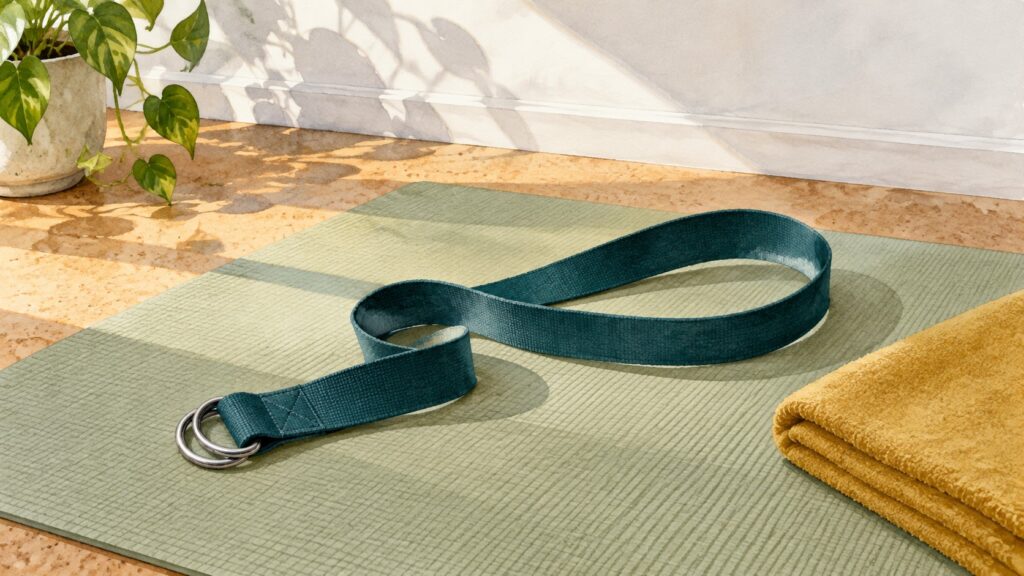
With one hand still on the support and the lifted knee bent, place the middle of a long yoga strap around the ball of the lifted foot. Hold the two ends in the free hand. Keep the strap flat rather than wrapped tightly around your hand, and keep loose ends clear of the standing foot.
If arranging the strap makes you lose balance, put the foot down. Ask a qualified teacher to help with the setup rather than hopping or bending awkwardly to catch the foot.
From the bent-knee position, let the lifted heel move forward a little as you gradually open that knee. Stop well before the movement pulls your torso forward, hikes the hip or strains the back of the leg. Keep enough strap length for the shoulders and elbow to stay comfortable. Do not haul the foot upward with your arm.
The leg may stay low and noticeably bent. A straight knee and a high heel are not requirements. The strap changes your reach, not the amount of range your body needs to provide.
Come out before the balance becomes a struggle
Bend the lifted knee again, bring the foot closer and lower it slowly. Release the strap without leaving it under either foot. Stand on both feet for a moment before changing sides. A brief, controlled attempt is more useful than staying until you wobble or hold your breath.
- If the back rounds: bend the lifted knee more, lengthen the strap or return to the knee-lift preparation.
- If the standing knee locks: lower the foot, reset with a softer knee and make the next attempt shorter.
- If the support hand is working very hard: reduce the lift or keep both feet down. The wall is support, not something to pull against.
- If either side feels different: use a different range on each side. Matching the height is unnecessary.
When to skip it or get individual guidance
Stop for pain, tingling, numbness or dizziness. Do not try to stretch through these sensations. Current injuries involving the back, hips, legs, ankles or shoulders, recent surgery, significant balance difficulties and pregnancy call for individual advice before attempting this standing balance. Support does not make every pose suitable for every person.
This is general education, not treatment or a test of flexibility. For a broader starting point, use our guide to yoga poses for beginners and choose movements that fit your current needs.
Sources and further reading
- Everyday Yoga: Standing Hand to Big Toe Pose, for the front-leg setup, bent-knee option and strap adaptation.
- Adventure Yoga: Utthita Hasta Padangusthasana, for support choices and the distinction between standing and reclining practice.
- NCCIH: Yoga: What You Need To Know, for general safety and individual modifications.