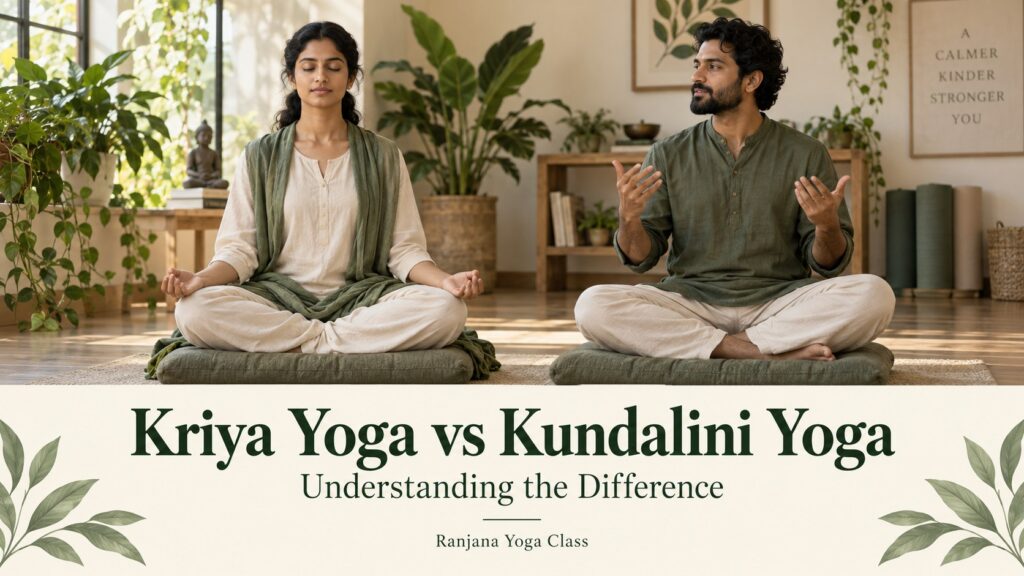
Kriya Yoga and Kundalini Yoga are not interchangeable names. In the Yogananda tradition, Kriya Yoga is a meditation path with preparation and formal instruction; in Kundalini Yoga classes, a kriya can mean a particular sequence of movement, breathing, sound and attention. The shared word explains much of the confusion, but it does not make the practices identical.
This comparison separates the different meanings, explains what to ask a teacher and offers a cautious starting point. It does not teach an advanced breathing technique or promise a spiritual experience. If you have a health condition or are pregnant, discuss suitable practice with your health care professional and instructor.
Kriya Yoga vs Kundalini Yoga at a glance
| Question | Kriya Yoga in the Yogananda tradition | Kundalini Yoga in the 3HO teaching context |
|---|---|---|
| What does the name describe? | A meditation path, including a specific advanced pranayama technique. | A practice context in which kriyas combine physical or meditative elements. |
| What might practice include? | Preparation, concentration, meditation and instructed techniques. | Postures, breath, sound, eye focus and meditation, depending on the set. |
| How is it learned? | Through a lineage’s preparation and teaching process. | Through instruction in a particular class or sequence. |
| Does the name establish safety? | No. The actual technique and the person’s needs matter. | No. Intensity and adaptations matter more than the label. |
These columns describe two named teaching contexts, not every teacher who uses either term. Ask what a particular course contains before deciding that its label tells you enough.
What does Kriya Yoga mean?
Kriya Yoga has more than one established meaning. A useful explanation starts by identifying which source or tradition is being discussed.
In Yoga Sutra 2.1, the term refers to tapas, svadhyaya and Ishvara pranidhana. These are commonly discussed as disciplined effort, self-study and dedication or surrender to Ishvara. Translators differ in their wording, especially for religious and philosophical terms. This is a framework for practice and conduct, not simply the name of a breathing exercise.
In the teaching of Paramahansa Yogananda’s Self-Realization Fellowship, Kriya Yoga also names a meditation path and a specific advanced pranayama technique. The organisation describes preparatory concentration and meditation practices before students apply for instruction in that technique. Its own explanation of the Kriya Yoga path is a primary source for how that tradition presents itself.
Neither meaning cancels the other. When someone says they practise Kriya Yoga, the useful follow-up is, “Which tradition and which part of the practice do you mean?” Our Kriya Yoga beginner guide provides related background.
What does kriya mean in Kundalini Yoga?
In the Kundalini Yoga context described by 3HO, a kriya is a specified practice or sequence. It may combine postures with breath, sound and focused attention. Some sets are more physically active; others are more meditative.
3HO’s explanation of kriya describes the term as covering both yoga sets and meditations. That is why a class advertisement might mention a “Kundalini kriya” without referring to the Kriya Yoga meditation path described above.
A single shared Sanskrit word does not establish that the same exercise is being taught. Think of the difference between a general word for an action and the name of a particular system. Context does the work.
3HO also makes claims about the intended effects of its practices. Its page is useful for understanding its terminology, but a tradition’s description is not independent clinical proof that a sequence treats a disease, changes hormone levels or produces a predictable health result. This distinction matters when comparing classes.
Are the two practices completely separate?
They can share vocabulary and themes, including breath, concentration, meditation and spiritual development. Shared themes do not make their methods or learning processes identical.
It is also misleading to say that one is always a quiet, short practice and the other is always a vigorous, long class. The SRF path includes preparatory exercises as well as meditation. A Kundalini Yoga kriya can be meditative rather than a demanding posture sequence. Session length alone cannot tell you which tradition you are looking at.
For a related distinction, our Kriya Yoga vs pranayama comparison explains why a broad practice category and a named path should not be treated as synonyms. Our Kriya Yoga vs Raja Yoga guide explores another pair of overlapping terms.
Are kundalini and chakras medical facts?
In this context, kundalini, prana and chakras belong to traditional spiritual explanations. They should not be presented as established anatomical structures or as proof of a medical mechanism.
A teacher may use this language to describe the meaning or purpose of a practice. You can respect that explanation while keeping it separate from claims about blood pressure, hormones, lung function or mental illness. Those claims need relevant health research.
Be especially careful when a bodily sensation is given a dramatic interpretation. Feeling warmth, tingling, emotion or light-headedness does not by itself prove a spiritual awakening. It also does not establish that you should continue an uncomfortable exercise. Stop when you feel unwell and seek appropriate help rather than trying to force an interpretation.
Which is better for a beginner?
There is no single best label for every beginner. Start by comparing the actual instruction, intensity and support. A course that explains its preparation, welcomes questions and offers suitable modifications is easier to evaluate than one promising rapid awakening or guaranteed transformation.
If you are drawn to the Yogananda tradition, read its introduction and learning process before treating a general breathing tutorial as formal Kriya instruction. If you are considering a Kundalini Yoga class, ask whether it includes rapid breathing, breath retention, demanding postures or prolonged concentration exercises.
You do not have to begin with an advanced technique in either setting. Our meditation for beginners guide can help you understand basic seated practice. Reading about pranayama for beginners can also help you recognise the difference between ordinary breathing awareness and more demanding breath regulation.
The goal of an introductory session is understanding what you are doing and being able to stop or adapt it. Intensity is not a measure of your sincerity.
Do you need a teacher or initiation?
Learning arrangements depend on the tradition. Self-Realization Fellowship describes preparation followed by an application for initiation into its advanced Kriya technique. It also offers introductory meditation information separately. An open beginner meditation exercise and formal instruction in the advanced technique are not the same thing.
For Kundalini Yoga, ask about the teacher’s training and experience, the content of the class and how individual needs are handled. A certificate does not remove the need to ask practical questions.
Be wary of a page claiming to reveal every lineage’s complete method in a few steps. A good overview can explain terms and help you choose a learning route without claiming to replace instruction. Our discussion of Kriya Yoga at home without a guru is further reading, not evidence that any advanced method is safe to self-teach.
What should you ask before joining a class?
- Which tradition or teaching approach does this course follow?
- What happens in a typical introductory session?
- Does it include forceful breathing, breath holds or strenuous postures?
- Can I keep my breathing natural and rest when needed?
- How do you adapt practice for pregnancy, injuries or health conditions?
- What preparation is expected before advanced instruction?
- What should I do if practice increases distress or makes me feel unwell?
Specific answers are more useful than impressive language. You should not have to hide a limitation or continue because the group is continuing. If a teacher cannot explain an exercise or dismisses concerns, it is reasonable to choose another learning setting.
What does research say about safety?
The National Center for Complementary and Integrative Health’s yoga review says yoga is generally considered safe for healthy people when performed properly with qualified guidance, but injuries can occur. It specifically advises beginners to avoid forceful breathing and extreme practices.
Pregnant people, older adults and people with health conditions may need modifications and should discuss their needs with a health care professional and instructor. A general yoga safety finding does not establish that every named kriya or intensive breath practice is appropriate for everyone.
NCCIH’s separate meditation and mindfulness review notes that safety research is limited and negative experiences, including anxiety and depression, have been reported. Quiet practice is not automatically risk-free.
Stop if an exercise causes dizziness, pain, marked distress or a feeling that you cannot breathe comfortably. Do not describe those symptoms as a required stage of progress. Seek medical help for severe or persistent symptoms, and do not replace prescribed care with yoga or meditation. Our Kriya Yoga safety guide offers related reading.
Can you combine the two?
You can be interested in both, but interest is not a reason to combine unfamiliar techniques yourself. Different methods may come with different instructions and preparation. Ask your instructor before mixing breath patterns, holds or advanced practices.
A simpler first step is to learn one approach clearly. Notice whether you can follow the instructions comfortably and whether support is available when questions arise. There is no need to add several techniques at once or chase an unusual experience.
For the broader ethical and philosophical setting, our guide to the eight limbs of yoga looks beyond exercise names. Disciplined learning and respect for your limits matter more than collecting methods.
Frequently asked questions
Is Kriya Yoga the same as Kundalini Yoga?
No. The names can share vocabulary, but they do not identify an interchangeable practice. Check the tradition and the specific technique being taught.
What is a Kundalini kriya?
In the 3HO context, it is a specified yoga set or meditation that may combine postures, breath, sound and attention. It is not automatically the advanced Kriya technique taught in the Yogananda tradition.
Is one safer than the other?
The label alone cannot establish safety. Intensity, instruction, preparation and your health needs matter. Beginners should avoid forceful breathing and seek qualified guidance.
Do you need initiation for Kriya Yoga?
It depends on what the name refers to. Self-Realization Fellowship describes a preparation and initiation process for its advanced technique. The term in Yoga Sutra 2.1 has a different philosophical context.
Does kundalini language prove a health benefit?
No. Spiritual explanations and clinical evidence answer different questions. A claim about treating illness needs relevant health research, not only traditional terminology.
The bottom line
Ask what the practice contains, not only what it is called. Kriya Yoga can refer to a philosophical framework or a meditation tradition; a kriya in Kundalini Yoga can refer to a particular set. Understand the context, choose clear instruction and keep safety ahead of intensity.