Yoga may help some people with high blood pressure, but the research does not establish one safe routine for every beginner. It belongs alongside prescribed care, not in place of it. Before choosing poses or breathing exercises, it helps to separate what researchers found from what a general article can reasonably recommend.
This guide explains that evidence and the questions to take to your health care professional and yoga teacher. It is general education, not an individual treatment plan.
Can yoga lower blood pressure?
Research suggests it may, particularly when yoga is compared with usual care or a waiting list. That is different from showing that yoga works better than another exercise programme, or that it will lower your own readings by a particular amount.
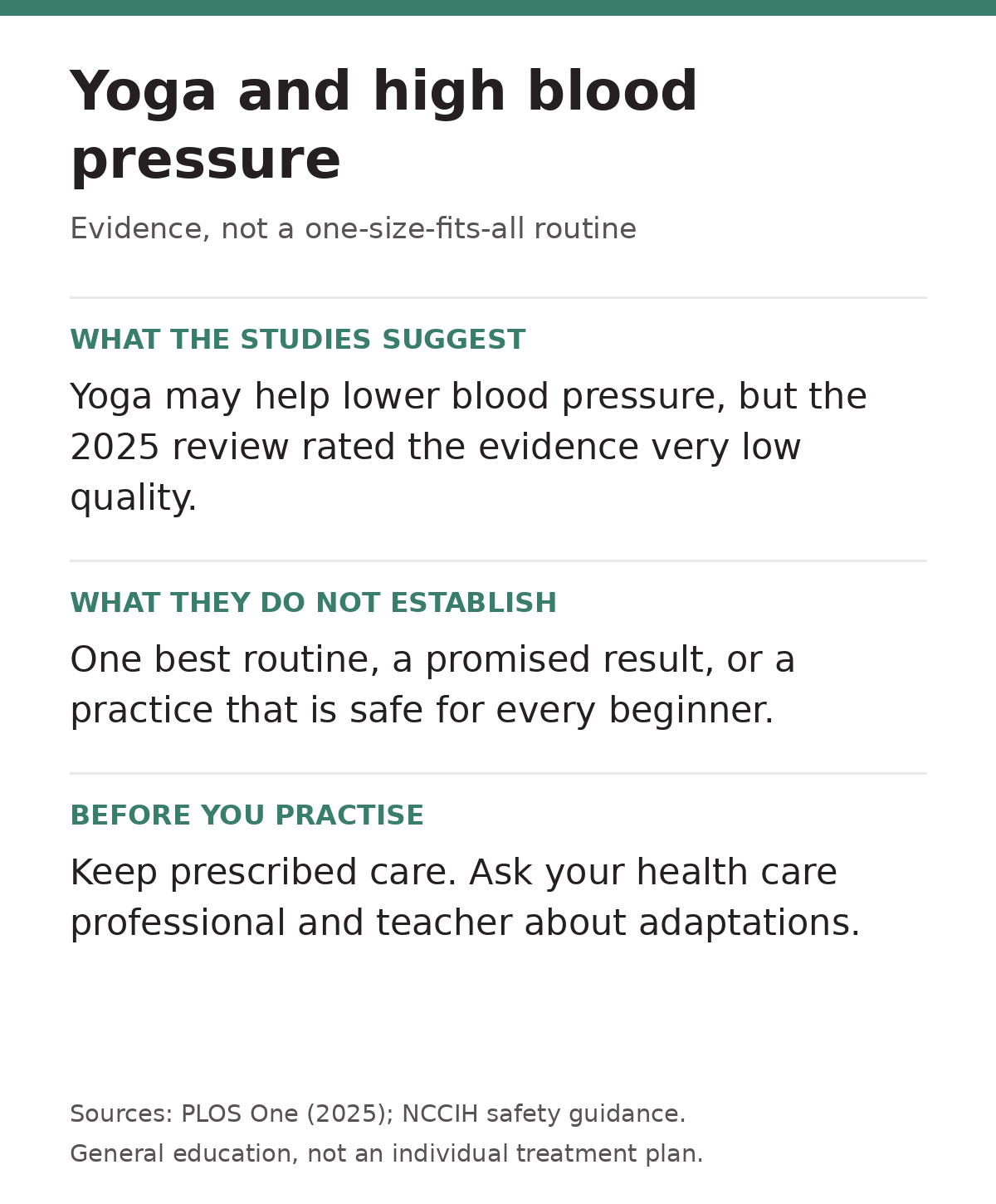
A 2025 systematic review in PLOS One combined 30 randomized trials involving 2,283 adults with prehypertension or hypertension. The researchers rated the evidence very low quality. This means there is substantial uncertainty about the size of any benefit, despite some encouraging average results.
Compared with usual care or a waiting list, yoga was associated with average reductions of about 8 mmHg in systolic pressure, the upper number, and 5 mmHg in diastolic pressure, the lower number. Those figures describe differences between study groups. They are not a promised result for someone beginning yoga at home.
The comparison with active programmes was less convincing. Across five trials with 306 participants, the average systolic difference favoured yoga by about 4 mmHg, but its confidence interval ranged from a reduction of 10.76 to an increase of 2.44 mmHg. Because that range includes no difference, the analysis did not establish a clear systolic advantage over the active comparisons. The average diastolic difference was smaller, about 1.9 mmHg, with very low quality evidence.
The practical point is that the comparison matters. A benefit over doing no additional programme does not automatically mean yoga is the best form of activity for blood pressure.
What did the older 2019 review actually find?
A 2019 review in Mayo Clinic Proceedings included 49 controlled trials with 3,517 adults. Its abstract reports overall average reductions of 5.0 mmHg systolic and 3.9 mmHg diastolic compared with nonexercise, nondiet control groups.
You may also encounter figures of 11/6 mmHg for programmes that included breathing and meditation or relaxation, versus 6/3 mmHg for programmes without those elements. These were conditional estimates from the review’s statistical modelling, not the overall pooled result and not a direct randomized test of adding breathing or relaxation to an otherwise identical programme.
It would therefore be misleading to say that breathing and rest were proved to cause a particular extra drop. The 2025 review also states that it could not determine how much of any effect came from postures, breathing or meditation.
Why this is not a nine-step treatment routine
The trials used different yoga programmes, durations, teaching arrangements and comparison groups. Most measured blood pressure in a clinic rather than with 24-hour monitoring. Results varied considerably between studies, and only a minority reported safety data.
Those limits matter when turning research into advice. A review of varied programmes does not validate a particular sequence of Cat-Cow, supported poses and breathing exercises, a fixed inhalation-to-exhalation ratio, or a set number of minutes for every person with hypertension. Nor does calling a pose gentle establish that it is suitable for your circumstances.
For that reason, this guide does not prescribe a blood-pressure-lowering sequence or a timetable for results. A programme needs to fit your health, current readings, other conditions and any advice you have already received.
What should you check before your first class?
The National Center for Complementary and Integrative Health, or NCCIH, advises people with high blood pressure to discuss complementary approaches with their health care professional and instructor. Some yoga poses may need to be changed or avoided. It also warns against replacing prescribed treatment with an unproven practice.
Useful questions for your health care professional include:
- Are there activities or positions I should avoid or adapt?
- Does my current blood pressure or another health condition affect whether I should start now?
- What should I do if I feel unwell during activity?
- How should I continue monitoring my readings and reviewing my treatment?
Tell the teacher that you have high blood pressure and share the relevant restrictions you have been given. Ask about their training, experience with adaptations, and whether you can pause or use a different position. A class description such as gentle or beginner does not replace that conversation. Our guide to choosing a yoga class can help with general class questions, but it is not a medical assessment.
Are there practices beginners should avoid?
NCCIH’s yoga safety guidance advises beginners to avoid extreme practices such as headstands, shoulder stands, lotus position and forceful breathing. It also notes that hot yoga has risks related to overheating and dehydration. People with health conditions, including severe high blood pressure, may need individual modifications.
The American Heart Association’s activity guidance recommends starting gradually and breathing regularly during activity. Holding your breath can raise blood pressure. That is not a reason to force long breaths or impose a difficult breathing count. A specific breathing practice still needs to be appropriate for you.
Do not assume an online pose demonstration has been assessed for your medical situation. If you are unsure whether a practice fits your restrictions, ask before attempting it.
Does yoga replace walking, monitoring or medicine?
No. Keep following the treatment plan agreed with your health care professional. Do not stop or change blood pressure medicine because you have started yoga or because one reading looks better.
The American Heart Association includes regular aerobic activity in blood pressure management and gives a general goal of at least 150 minutes of moderate-intensity aerobic activity per week. It also advises people with cardiovascular disease or other pre-existing conditions to check with their health care professional. Your own activity plan may need to be adapted. Do not assume a quiet yoga session automatically provides the same activity as brisk walking or another aerobic exercise.
Yoga can be one part of a broader plan if it suits you. It is not a substitute for monitoring, medication when prescribed, or the other changes your health care team recommends.
When should you seek medical help instead of practising?
Do not try to deal with a dangerously high reading by doing breathing exercises or waiting for yoga to calm you down. Follow your health care professional’s urgent-care instructions.
The American Heart Association’s explanation of very high readings describes readings above 180 systolic and/or 120 diastolic in non-pregnant adults as requiring prompt attention. If a very high reading comes with symptoms such as chest pain, shortness of breath, weakness, a change in vision or difficulty speaking, seek emergency medical help through your local emergency service. Do not wait for the reading to fall on its own.
Without those symptoms, the AHA advises repeating a reading in that very high range after at least one minute and contacting a health care professional as soon as possible if it remains high. Pregnancy needs separate medical guidance; these numbers are not a universal threshold for everyone.
For an ordinary first step, bring your questions to your health care professional, then choose a teacher who can work within the advice you receive. The evidence leaves room for yoga as an addition to care. It does not support a blanket promise that one routine is safe or effective for every beginner.
Sources
- Geiger C and colleagues (2025). A systematic review and meta-analysis of yoga for arterial hypertension. PLOS One.
- Wu Y and colleagues (2019). Yoga as Antihypertensive Lifestyle Therapy: A Systematic Review and Meta-analysis. Mayo Clinic Proceedings. Numerical findings here were checked against the PubMed abstract.
- NCCIH. Hypertension (High Blood Pressure), updated July 2018; and Yoga: Effectiveness and Safety. Used for general care and safety context, not as proof of an exact routine.
- American Heart Association. Getting Active to Control High Blood Pressure and urgent-reading guidance, both reviewed 14 August 2025; plus The lowdown on high blood pressure, 28 May 2026.