You may have seen pictures of yoga students resting on bolsters, looping straps around their feet, or stacking foam blocks under their hands, and wondered what kind of yoga needs so much equipment. That is Iyengar yoga, one of the most beginner-friendly styles ever created. It slows everything down, breaks each pose into small clear steps, and uses props to make every shape fit your body instead of forcing your body to fit the shape. This guide explains what Iyengar yoga is, why teachers love it for new students, and how to start a simple practice at home.
What is Iyengar yoga?
Iyengar yoga is a style of yoga named after its founder, B.K.S. Iyengar, an Indian teacher who spent decades studying how poses work in real bodies. His big idea was simple: alignment matters more than depth. In an Iyengar class, you do fewer poses than in a flow class, but you study each one carefully. Where should your feet point? Is your knee tracking over your ankle? Is your spine long? Teachers give precise instructions and expect you to notice small details.
The style is built on three pillars. The first is alignment, meaning the careful placement of bones and joints in every pose. The second is sequencing, meaning poses are taught in a deliberate order so the body opens safely. The third is timing, meaning poses are held long enough for you to actually feel and adjust them, sometimes a minute or more. If you are completely new to yoga, our yoga for beginners guide covers the basic ideas before you pick a style.
How is Iyengar different from other styles?
Beginners often hear style names thrown around without explanation, so here is a plain comparison:
- Iyengar vs vinyasa: Vinyasa flows quickly from pose to pose with the breath. Iyengar stops in each pose, holds it, and refines it. Vinyasa builds heat; Iyengar builds precision.
- Iyengar vs hatha: Hatha yoga is the broad parent category of physical yoga, usually taught as gentle held poses. Iyengar is technically a type of hatha, but with far more detailed instruction and systematic use of props.
- Iyengar vs yin: Yin yoga also holds poses for minutes, but the goal is deep, relaxed stretching of connective tissue. Iyengar holds are active: muscles stay engaged and alignment keeps being adjusted.
- Iyengar vs power yoga: Power yoga is fast and fitness-focused. Iyengar is slow and technique-focused. They sit at opposite ends of the speed scale.
Why does Iyengar yoga use so many props?
B.K.S. Iyengar believed that nobody should be locked out of a pose because of a stiff body, an injury, or simple genetics. Props are his solution. A block brings the floor closer to your hand in a standing pose. A strap extends your reach in a forward bend. A bolster supports your back in a restorative shape. Blankets cushion knees and lift hips so the spine can stay long.
This matters for beginners because props remove the two biggest reasons new students quit: feeling pain and feeling inadequate. When the pose is adjusted to your body, you can relax and actually learn it. Over time, many students need fewer props, but there is no shame in using them forever. Even advanced Iyengar teachers practice with props daily. If you want to set up a small home kit, our guides to yoga blocks, yoga straps, and bolsters and blankets explain what to buy and what household items work instead.
Is Iyengar yoga good for beginners?
Yes, and many teachers consider it the single best starting point. Here is why. First, the pace is slow, so you are never left behind wondering what everyone else is doing. Second, instructions are extremely specific, which teaches you body awareness you will carry into every other style. Third, props make every pose accessible on day one, whatever your flexibility or fitness.
It is also a thoughtful choice if you are stiff, older, returning from a long break, or simply cautious. Iyengar teachers train for years and learn to modify poses for many common limitations. That said, always tell a teacher about any health condition before class, and read the safety notes below.
What does a beginner Iyengar class look like?
A typical beginner class runs 60 to 90 minutes and covers only five to ten poses. It often starts with a few quiet minutes sitting or lying down, then moves into standing poses, which are the foundation of Iyengar teaching. You might spend ten full minutes on mountain pose and triangle pose, adjusting feet, legs, and arms step by step. The class usually ends with a supported relaxation pose.
Do not expect music, heat, or flowing sequences. Expect clear words, demonstrations, and teachers who walk around and gently adjust students. Many students are surprised by how much effort a “simple” standing pose takes when you do it with full attention.
What are the benefits of Iyengar yoga?
Research on yoga generally suggests regular practice may support flexibility, balance, strength, and stress management, and Iyengar yoga has been studied in small trials for back and knee discomfort, with some promising results. But it is honest to say that evidence is still limited, and yoga is not a medical treatment. What students most often report after a few months is practical: they stand taller, move with less stiffness, understand their own posture habits, and feel calmer after class. If you live with back pain, see our overview of yoga for back pain and speak with your doctor before starting.
Are there any downsides or risks?
Iyengar yoga is low impact, but it is not risk free. Long held standing poses can tire the legs, and pushing for “perfect” alignment can strain a joint if you force it. A few honest cautions:
- Move into every pose slowly and back off from any sharp or pinching pain, especially in knees, hips, and the lower back.
- Tell the teacher about injuries, pregnancy, blood pressure issues, or eye conditions before class, since some poses need modification.
- The detail-heavy style can feel slow or picky if you want a sweaty workout. That is a preference, not a flaw, but it is worth knowing before you sign up.
How do I start Iyengar yoga at home?
You need very little: a mat with decent grip, two blocks or thick books, a strap or belt, and a couple of firm blankets. Clear a wall space if you can, because Iyengar practice often uses the wall for feedback and balance. Our mat guide and home practice guide walk through the setup in detail.
Begin with two or three short sessions a week, 15 to 30 minutes each. Consistency matters more than length, as explained in how often should you do yoga. Learn each pose slowly, and keep a simple note of what felt easy or confusing so you can revisit it.
A simple 15-minute beginner Iyengar sequence
Try this short sequence at home. Move slowly, hold each pose for 5 to 10 calm breaths, and rest whenever you need to.
- Mountain pose (Tadasana), 2 minutes: Stand with feet hip-width apart. Spread your toes, press down through all four corners of each foot, and grow tall through the crown of your head. This is the blueprint for every standing pose.
- Arms overhead stretch, 1 minute: From mountain pose, interlace your fingers and reach your arms up, palms to the ceiling. Keep ribs soft.
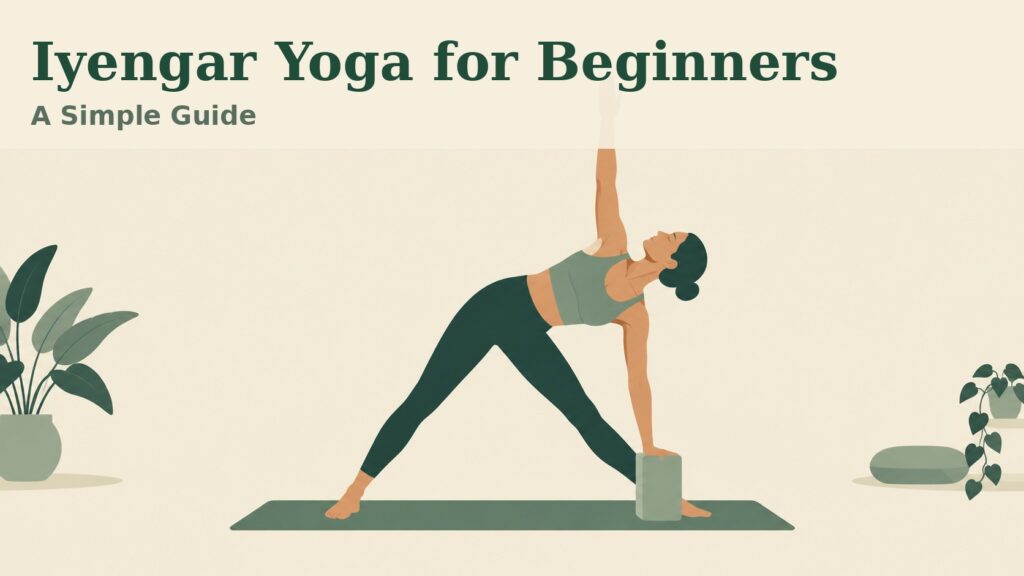
- Triangle pose (Trikonasana) with a block, 2 minutes each side: Step feet wide, turn the right foot out, and hinge sideways, placing your right hand on a block. Keep both legs firm and your chest open. Repeat on the left.
- Standing forward bend with hands on blocks, 2 minutes: Feet hip-width, hinge forward from the hips with a long spine, hands resting on blocks at any height. Bend knees as much as you need.
- Bridge pose with support, 3 minutes: Lie on your back, knees bent, and lift your hips. Slide a block or firm cushion under your sacrum and rest your weight on it. Let the front body open.
- Legs up the wall, 3 to 4 minutes: Sit sideways near a wall, swing your legs up, and rest your back on the floor. Stay and breathe quietly.
Common beginner mistakes to avoid
The most frequent mistake is chasing depth: rounding the spine to reach the floor in a forward bend, or dumping into the front knee in triangle pose. Height is not the goal; length is. The second mistake is skipping props out of pride, which usually makes the pose harder and less useful. The third is holding the breath during long holds. If you cannot breathe steadily, ease out of the pose a little. Finally, do not practice through pain. Muscular effort is fine; joint pain is a stop signal.
Frequently asked questions
Is Iyengar yoga too slow if I want exercise?
It is slow in pace but not in effort. Holding standing poses with full attention is genuinely tiring, and many students are surprised by how worked their legs feel. If you want continuous movement and sweat, vinyasa or power yoga will suit you better, and you can practice both styles side by side.
How many times a week should a beginner practice Iyengar yoga?
Two or three sessions a week is a realistic start. Short, regular practice teaches the body far more than one long session every few weeks.
Do I need to buy all the props before my first class?
No. Studios provide everything, and at home a belt, two thick books, and firm blankets cover most beginner needs. Buy a mat first, then add blocks and a strap when you know you enjoy the practice.
Can Iyengar yoga help with posture?
Many students say their posture awareness improves because the style trains you to notice alignment in detail. It is not a guaranteed fix, but the habit of noticing how you stand and sit tends to follow you off the mat.
Is Iyengar yoga suitable if I have an old injury?
Often yes, because teachers are trained to adapt poses and props can reduce load on sensitive joints. Still, check with your doctor first, tell your teacher about the injury before class, and skip anything that reproduces your symptoms.