
You sit through a long drive or a full workday, stand up, and a dull pull runs from your lower back down one leg. Many people look for sciatica yoga stretches at that moment, hoping for something calm and easy to try at home. This guide shows slow, low-impact options, how to size them to your body, and when to check in with a professional first, so you can practice with confidence at your own pace.
This article is general education about movement and is not medical advice. If you have pain, numbness, or any health condition, talk with your doctor before you try these stretches.
What are sciatica yoga stretches?
They are slow, supported stretches that people use to ease tension around the lower back, hips, and the backs of the legs. Sciatica describes pain that travels along the sciatic nerve, from the low back through the buttock and down a leg. Yoga stretches for it are kept small and calm, and they are chosen to feel comfortable rather than intense.
Where does this guide fit in the bigger picture?
This is a beginner support guide, and it sits beside our main pillar guide, Yoga for Sciatica for Beginners. If you want the full overview, read Yoga for Sciatica for Beginners first, then come back here for the stretch-by-stretch detail. Think of this page as the practice sheet and the pillar as the big map.
Why do people try sciatica yoga poses?
Many people try them because slow movement can feel kinder than lying still all day. Sitting for hours can leave the hips and back feeling tight, and that tightness is often what people want to soften. Sciatica yoga poses give you a quiet, structured way to move without rushing or pushing.
Is it safe to start on your own?
It is usually reasonable to start small, but check with your doctor first if you have any pain that runs down a leg. A doctor can tell you what is going on and whether movement fits your situation today. Once you have the okay, begin with short sessions and keep every stretch well inside your comfort zone.
Is yoga a treatment for sciatica?
No, yoga is not a treatment for sciatica or any medical condition. These stretches are a way to move with care and attention, not a replacement for medical advice or care. If your symptoms are strong, spreading, or not going away, a healthcare professional is the right person to guide you.
How do you get ready to practice?
Pick a quiet spot, wear loose clothes, and give yourself about ten unhurried minutes. A mat or a firm carpet works well. Keep a pillow, a folded towel, and a belt or scarf nearby so you can adjust any stretch. Set aside your phone so the time feels like yours.
What is the golden rule for pace?
Move slowly and stop at the first sign of sharp, shooting, or tingling feelings. A stretch should feel like a mild pull, never a jolt. If something feels wrong, ease out of it, rest, and try a smaller version or skip it for the day. Skipping is a smart choice, not a failure.
How does breathing change the practice?
Slow, steady breathing helps you stay relaxed while you hold each stretch. Breathe in through your nose for a count of four, and out for a count of six. A longer exhale tends to signal calm to the body. If you want a simple practice for this, try belly breathing for beginners before you move into the first stretch.
Step 1: How do you do a knee-to-chest stretch?
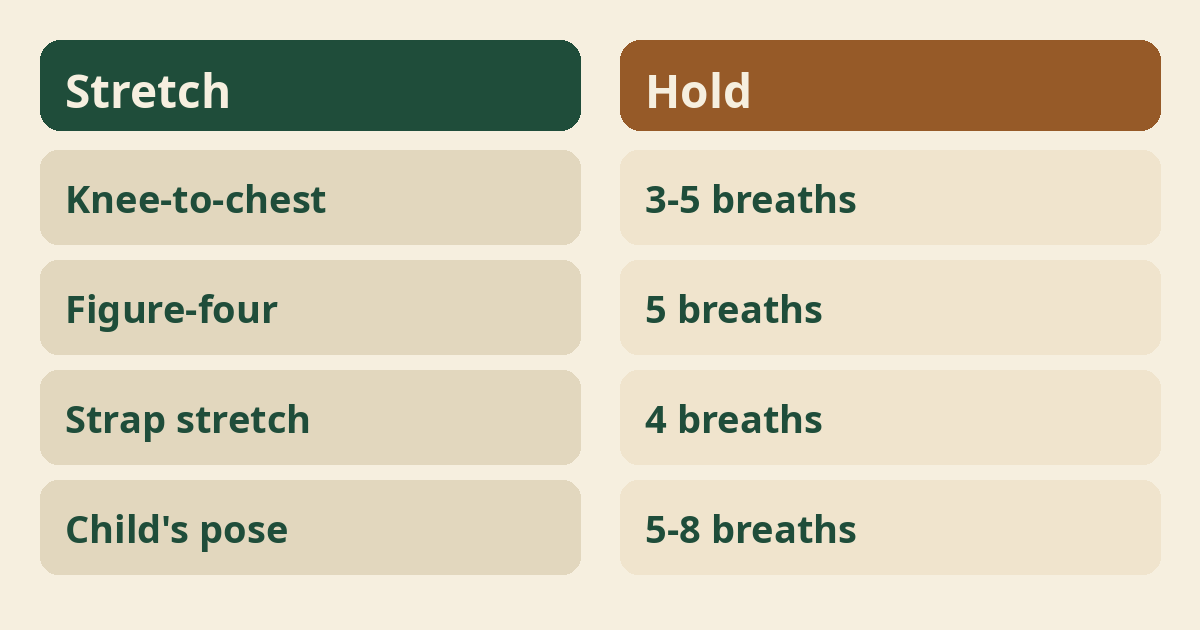
Lie on your back and hug one knee toward your chest while the other foot stays on the floor. Keep your head resting down and your shoulders loose. Hold for three to five slow breaths, then switch sides. If pulling the knee in feels too strong, hold behind the thigh instead of the shin.
Step 2: How do you do a supine figure-four stretch?
Lie on your back, cross one ankle over the opposite knee, and let the legs rest in a loose triangle. Keep both feet relaxed. If you want more feeling in the hip, draw the lower thigh slightly closer. Stay for five slow breaths, then change sides. Skip this one if it brings on any leg sensations.
Step 3: How do you do a reclined hamstring stretch with a strap?
Lie on your back, loop a belt around one foot, and lift that leg only as high as feels comfortable. The knee can stay bent as much as you like. The goal is a light stretch behind the leg, not a straight line. Hold for four breaths, then lower slowly and repeat on the other side.
Step 4: How do you do a seated forward bend on a chair?
Sit near the front of a chair, place your feet flat, and lean forward from the hips with a long spine. Rest your hands on your thighs or let your arms hang. Go only as far as feels easy. Stay for a few breaths, then roll up slowly. A chair keeps the move small and steady for new practitioners.
Step 5: How do you do a gentle spinal twist on your back?
Lie down, let both knees fall to one side, and keep your shoulders resting on the floor. Place a pillow under the knees if the twist feels strong. Hold for four slow breaths, then bring the knees back to center and switch sides. Keep the twist small and avoid forcing the floor.
Step 6: How do you use cat and cow for the lower back?
Move on hands and knees, arching and rounding your spine in a slow, small wave with your breath. Keep the motion modest and stay curious about how it feels. If you want more help with form, see cat-cow pose for beginners for a step-by-step walk-through. Do six slow rounds and then rest.
Step 7: How do you rest in child’s pose?
Sit back toward your heels with your arms forward and your forehead down, using a pillow to fill any gap. Widen the knees if your belly needs room. This pose is a quiet place to finish. A guide to child’s pose for beginners can show you easy ways to adjust the shape.
How long should each stretch be held?
A hold of three to five slow breaths is a good starting point for most beginners. You can build toward longer holds over time if they feel fine. Shorter is perfectly fine too. The point is steady, relaxed attention, so let the breath, not the clock, set your pace.
How long should a whole session last?
Ten to fifteen minutes is plenty when you are new to this. A short, calm session you actually enjoy beats a long one you dread. If you feel tired or sore afterward, trim it next time. You can always add a stretch later once your body feels at ease.
How often can you practice?
Many beginners start with three or four short sessions a week and see how they feel. Rest days matter too, and listening to your body is more useful than sticking to a plan. For a bigger look at pacing, read how often you should do yoga and find a rhythm that suits your week.
Which props make these stretches easier?
A strap, a folded blanket, a pillow, and a chair can make nearly every stretch more comfortable. Props let you meet your body where it is today. A towel can stand in for a strap, and a firm pillow works in place of a block. Our yoga props for beginners guide covers simple low-cost choices.
What are common mistakes to avoid?
The most common mistakes are pushing too far, holding the breath, and rushing between stretches. Bouncing, forcing a stretch to feel stronger, and comparing yourself to others tend to add strain. Move slowly, breathe out through the hard parts, and see every day as a fresh start with a different body.
Which stretches should you skip?
Skip any stretch that brings sharp pain, numbness, tingling, or weakness in your leg. Deep forward folds and big twists can feel too strong when you are sore. Choose smaller versions or leave them out. If you are unsure, ask a qualified teacher or your doctor to point out options that fit you.
Who should be extra careful?
People with ongoing pain, recent injury, pregnancy, or a medical condition should speak with their doctor before starting. Anyone who has had surgery, notices changes in strength, or has trouble with bladder or bowel control should seek medical help promptly rather than stretch. Pregnant readers can look at prenatal yoga vs regular yoga for context before asking their care team.
When should you see a professional?
See a professional if pain is strong, spreading, getting worse, or has lasted a while. A clinician can look at the cause and suggest what is right for you. Yoga can sit next to that guidance as a calm daily habit. Never delay care in order to keep practicing at home.
What benefits do people notice?
Many people find these stretches leave them feeling looser, calmer, and more aware of how they sit and move. Results vary from person to person, and nothing is guaranteed. Reliable background reading on yoga and back discomfort is available from National Center for Complementary and Integrative Health. Take any good feeling as a pleasant bonus rather than a promise.
Can yoga help with a stiff back in general?
A stiff back can often feel more comfortable after slow, supported movement, though experiences differ. If you have a bad back and are not sure where to begin, read about whether you can do yoga with a bad back and use it as a companion to this page.
Why do the hips matter so much?
Tight hips can leave the lower back feeling like it is doing extra work, so many routines include hip stretches. Small, easy hip openers can make sitting and walking feel a bit freer for some people. Read yoga for hips for beginners for more low-pressure ideas.
Can you stretch at your desk?
Yes, a few quiet stretches in a chair can break up long sitting spells. Stand up, take a slow breath, and do a small seated forward bend or a few shoulder rolls. Our yoga at your desk for beginners guide has more office-friendly ideas.
How do you stay consistent without pressure?
Link your practice to something you already do, such as after your morning coffee or before bed. A fixed cue makes the habit easier to keep. Keep it short, forgive missed days, and notice small wins like an easier breath or a more relaxed jaw instead of chasing big changes.
How can you progress over time?
Progress means a little more comfort, a slightly longer hold, or an extra round, never forcing a deeper shape. After a few weeks of steady practice, you might add a few more breaths to each hold or try a floor pose without a prop. Keep everything optional, and step back whenever your body asks for it.
What mindset helps most?
A patient, kind attitude toward your body helps more than any perfect shape. Some days will feel easier than others, and that is normal. Let the practice be a quiet check-in, not a test. Notice how you feel, thank yourself for showing up, and leave the rest alone.
Should you learn from a teacher?
A qualified teacher can watch your form and suggest changes that fit your body. Look for someone who works with beginners or people with back concerns, and tell them about your situation before class. Many teachers offer private sessions or online classes with clear, slow guidance.
Do you need to be flexible to try this?
No, these stretches are built around ease, and props make them reachable for stiff bodies. Flexibility tends to come slowly with regular practice, if at all. What matters more is comfort and care. Bend your knees, use a strap, and take smaller ranges until the stretch feels right.
What should you do after your session?
Rest quietly for a minute, drink some water, and notice how your body feels. Lie on your back with your knees bent and breathe normally. If you feel any new pain or odd sensations, stop practicing and speak with your doctor. If you feel fine, make a note of what felt best.
What is a simple weekly plan to begin with?
Try two or three of the stretches above on three days a week, and rest on the other days. Start with knee-to-chest, the supine figure-four, and child’s pose. Add the strap stretch in week two if it feels fine. Keep the total time short, and adjust whenever your body feels different.
Where to read next
For a calm, beginner-friendly start, Ranjana Sinha’s Begin Where You Are is written for people who want simple steps. Our guide to starting a home yoga practice adds a gentle routine you can follow at home.
Frequently asked questions
What is the easiest sciatica yoga pose for a total beginner?
Many beginners start with a knee-to-chest stretch because it is small, supported, and easy to adjust.
Is it okay to feel a mild pull in the back of the leg?
A mild, easy pull is common in stretching, but sharp, burning, or tingling feelings are a sign to stop.
Can I do these stretches when pain is flaring up?
It is best to ask your doctor first, and rest is often a sensible choice when things feel sore.
Do I need special gear to begin?
No, a towel, a pillow, and a chair are enough to get started at home.
When might I notice a difference?
Experiences vary a lot, so it is better to watch for small changes in comfort than to expect fast results.
The bottom line
Go slowly, stay curious, and let comfort lead every stretch.

