Side lying relaxation is a resting yoga position where you lie on one side and use support to stay comfortable without holding a stretch. It can be an option when lying flat on your back does not feel pleasant. The aim is simple: settle your body, leave your breathing alone, and spend a few quiet minutes without needing to perform. This guide explains how to arrange pillows, check your comfort, and leave the position slowly, with no pressure to feel a particular result.
This guide offers general education and is not medical advice. Check with your doctor before trying it if you are pregnant, have a medical condition, are recovering from surgery, or have unexplained pain or breathing difficulties.
What is side lying relaxation?
Side lying relaxation is supported rest rather than an active yoga stretch. You lie on your side with your head, arms, and legs arranged so that little effort is needed. There is no required depth, angle, or final shape. A position that looks different from someone else’s can still be suitable for your own comfort.
Why do people choose it?
People choose this position because side lying can feel more comfortable than lying face up. Some prefer the sense of having a pillow in front of them, while others simply dislike resting on their back. You do not need to compare the two positions or prove that one is better. Choose according to your needs and any medical advice.
How do you start?
Start by choosing a stable resting place and placing your supports within reach. A mat on the floor works for people who can get down and up comfortably. A firm bed may be easier if floor access is difficult, provided you can move safely. Leave space around your body and avoid practicing close to an unprotected edge.
Step 1: Lower yourself gently
Lower yourself onto your side slowly instead of dropping your weight onto one shoulder. If starting on the floor, use your hands for support and move through a seated position that feels manageable. There is no need to copy a fixed entry sequence. If getting down or up is uncertain, ask for help rather than practicing alone.
Step 2: Support your head
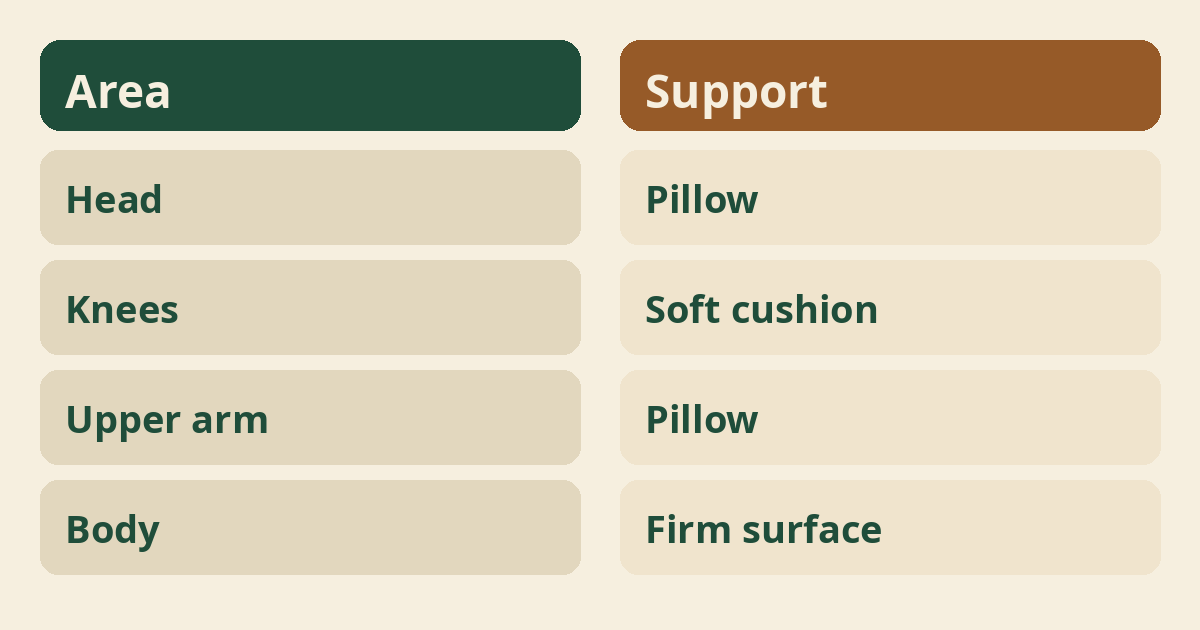
Put a pillow beneath your head so your neck feels comfortably supported. Your head should not hang toward the mat or be pushed sharply upward. Adjust the pillow before settling, and keep your nose facing roughly forward rather than twisting toward the ceiling. The useful height depends on your shoulders, resting surface, and how much the pillow compresses.
Step 3: Arrange your legs
Bend your knees a little and support them without pulling them tightly toward your chest. Try a pillow between your knees and, if helpful, between your ankles as well. Let the upper leg rest rather than dragging it forward into a twist. If your hips feel crowded, move the knees slightly farther from your torso and check again.
Step 4: Rest your arms
Place your lower arm where it is not trapped beneath your body. It can rest forward on the surface, with the elbow bent if that feels comfortable. Rest the upper hand on a pillow or hug a cushion loosely. Avoid reaching so far that your chest rolls forward and your shoulder begins doing the work of holding you up.
Step 5: Check the whole position
Check your comfort before treating the position as a place to rest. Notice your neck, lower shoulder, waist, hips, and knees one area at a time. Make small changes now rather than waiting for discomfort to grow. You should be able to breathe normally and move a hand or foot without feeling wedged between your supports.
Which props are useful?
Ordinary pillows and a folded blanket are often enough for a short practice. One pillow can support your head and another can separate your legs. A further cushion may give your upper arm somewhere to rest, but more equipment is not always more comfortable. See yoga props for beginners for ways to choose support without buying a full set.
Can the lower shoulder feel squeezed?
Pressure on the lower shoulder means the position needs changing, not enduring. Move the lower arm forward, check the head pillow, and try a small change in how your torso rests. If pressure remains, leave the position or choose another resting shape. Persistent shoulder discomfort is a reason to seek medical guidance, not to add longer practice time.
What should your neck feel like?
Your neck should feel supported without being forced into a stretch. A pillow that is too low or too high can make resting harder, even if the rest of the position feels pleasant. Adjust it gently and avoid testing your neck by pulling your head around. For separate gentle movement ideas, explore yoga for neck and shoulders only within your comfort.
How should you breathe?
Let your breathing stay quiet and natural rather than following a demanding breathing pattern. You do not need to take the biggest breath possible or hold your breath between cycles. Notice the movement of your ribs without trying to control it. If you want a separate introduction, belly breathing for beginners explains gentle breathing awareness without making it a test.
Should you count your breaths?
Counting is optional and should make resting simpler rather than more demanding. You might count a few comfortable breaths and then let the numbers go. If counting makes you monitor every inhale, return to noticing the support beneath you instead. Losing count is not a mistake, and you do not need to restart the practice when your attention wanders.
How long should you stay?
Start with about two to five minutes and leave earlier whenever you need to. That is a practical starting point, not a medical dose or a target you must reach. A short rest with good support is more useful than staying longer while uncomfortable. Keep a gentle timer nearby if checking the clock would otherwise interrupt you repeatedly.
How often can you practice?
Practice as often as it fits comfortably into your routine and any medical guidance you have received. You might use it after a yoga class or during an occasional quiet break. Daily practice is not a requirement, and missing a day does not undo anything. How often should you do yoga offers a broader way to think about a manageable routine.
What benefits might people notice?
Many people find supported rest gives them a pleasant pause, but results vary. You may feel less rushed afterward or simply appreciate a few minutes without moving. This position alone should not be credited with the broader effects sometimes discussed for yoga, and it cannot promise better sleep or relief from symptoms. National Center for Complementary and Integrative Health Keep expectations modest and judge the experience by your comfort.
Is this a treatment?
Side lying relaxation is not a treatment for pain, anxiety, sleep problems, or any medical condition. Feeling comfortable in a position does not tell you what is causing a symptom. If you are seeking help for a health concern, talk with your doctor first and follow the care they recommend. A restful break can remain a personal preference without becoming a medical claim.
Who should be careful?
People with health concerns should check with their doctor before trying or changing a resting position. This includes recent surgery, injuries, pregnancy, ongoing joint pain, and problems that affect breathing or safe movement. Ask whether there are positions or movements you should avoid. Advice specific to your situation matters more than a general yoga description or a photograph of a pose.
What if you are pregnant?
Ask your maternity care team which resting positions are suitable for your pregnancy. Do not assume this general guide replaces advice about your stage of pregnancy, symptoms, or complications. A teacher with prenatal training can help arrange support within that advice. Prenatal yoga versus regular yoga explains why an ordinary class and pregnancy-specific guidance are not interchangeable.
What if you have back pain?
Get medical advice before using side lying relaxation to address back pain. A pillow arrangement that feels comfortable for one person may not suit another, and comfort does not establish that a position is appropriate for an injury. Avoid trying to force your spine into a shape described as correct. Read can you do yoga with a bad back as general education, not a diagnosis.
What symptoms mean you should stop?
Stop if you notice pain, numbness, tingling, dizziness, or difficulty breathing. Change position carefully rather than waiting for the feeling to pass while staying still. New, severe, or persistent symptoms need medical attention, and severe breathing difficulty or chest pain needs urgent help. Do not assume a symptom is a normal part of learning to relax.
Which side should you choose?
Choose the side that feels comfortable unless your doctor has given you different instructions. There is no general requirement to start on the left or to spend equal time on both sides. If one side brings discomfort, do not use the other side as proof that the problem is harmless. Ask for advice when the difference is persistent or unexplained.
Do you need to switch sides?
Switching sides is optional rather than a task needed to complete the practice. If you want to switch, pause the timer and move with support instead of rolling quickly through a stack of pillows. Rebuild the head and leg support on the second side. You may also finish after resting on just one side if that suits you.
What are common mistakes?
Common mistakes include too little support, cramped limbs, and staying still despite discomfort. Another is treating complete stillness as the goal and refusing to make a useful adjustment. Rest should not depend on holding your body rigidly in place. If you keep shifting, check the setup first rather than judging yourself for failing to relax.
Can you curl into a tight ball?
A gentle bend in your knees is enough; you do not need a tightly curled position. Pulling your legs close can crowd your belly or encourage your upper body to round more than feels pleasant. Give your limbs space and check whether breathing feels easy. There is no benefit to making the position smaller simply because a curled shape looks restful.
Should you close your eyes?
Close your eyes only if doing so feels comfortable and safe. A soft gaze toward the floor or a fixed point is another option. Some people feel more settled when they can see the room, especially in an unfamiliar class. You can change your choice partway through without needing to explain it or begin again.
What if your mind stays busy?
A busy mind does not mean the practice has failed. You can notice a thought and return to the feel of the pillow beneath your head. There is no need to push thoughts away or make your mind blank. If quiet rest feels unpleasant, shorten the practice or choose an activity that feels more comfortable for you.
Can you use music or a recording?
Soft music or a short recording is optional, not part of the position itself. Keep the volume low enough that you remain aware of your surroundings. Choose something that does not demand strict breath timing or pressure you to stay still. Silence is equally valid, and you can turn the recording off if it becomes distracting.
Where does it fit in a yoga session?
Side lying relaxation can be a resting option at the end of a gentle session. Finish active movement before arranging your pillows so you do not have to hurry into the position. Tell your teacher if lying on your back is uncomfortable and ask about alternatives. A class plan should leave room for safe adjustments rather than requiring everyone to rest identically.
Can it be a break from desk work?
It can be a quiet break if you have a suitable space and can move safely. You do not need to lie down to take a useful pause during work, especially when the room or clothing makes it impractical. A seated break may fit better. Yoga at your desk for beginners offers another starting point without needing floor access.
How should you finish?
Finish by opening your eyes, moving your limbs gently, and getting up without rushing. Move the upper pillow aside before trying to push yourself up. Use your hands and a stable support if needed, then pause in sitting before standing. If floor transfers are difficult, arrange help or use a resting surface that you can enter and leave safely.
How can beginners progress?
Progress means learning what makes rest comfortable, not holding the position for longer. You might become quicker at choosing a pillow height or more willing to adjust before discomfort builds. Extend your time only if you want to and remain comfortable. You do not need fewer props, deeper breathing, or an impressive session length to show improvement.
When can a teacher help?
A qualified yoga teacher can help you arrange props and find a manageable resting option. Explain what feels uncomfortable and share any movement limits your doctor has provided. The teacher should respect your choice to move, keep your eyes open, or stop. For a broader introduction, yoga for stress relief for beginners keeps the focus on gentle practice rather than guaranteed outcomes.
What mindset helps?
Approach the position as an invitation to pause rather than a demand to feel calm. Some days you may enjoy it, and other days a short walk or seated rest may suit you better. Notice the experience without scoring it as good or bad. The useful skill is responding to your needs, including deciding that this position is not right today.
Where to read next
For a calm, beginner-friendly start, Ranjana Sinha’s Begin Where You Are is written for people who want simple steps. Our guide to starting a home yoga practice adds a gentle routine you can follow at home.
Frequently asked questions
Can I use a normal pillow?
Yes, use a normal pillow if its height and firmness let your head rest comfortably.
Must my knees touch?
No, a pillow between your knees can help you rest without pressing them together.
Is falling asleep the goal?
No, this is a brief resting practice, and staying awake or feeling alert is equally acceptable.
Can I skip breathing exercises?
Yes, natural breathing is enough, and you do not need a separate breathing technique.
What if I cannot get onto the floor?
Use a safe accessible resting surface or ask a qualified teacher about an alternative that fits your movement needs.
The bottom line
Use support, stay within your comfort, and let a short pause be enough.