
Pranayama is the practice of regulating the breath. Kriya yoga is a wider path of practices, and in many modern traditions it includes specific breath techniques, concentration and meditation. So pranayama is often one part of Kriya, while Kriya is more than breathing. This guide explains the difference in plain words, how the two overlap, and which one a beginner can start with.
This is general education, not medical advice. If you have a heart, lung or blood pressure condition, are pregnant, or feel unsure, speak with your doctor before trying any breathing practice.
What is pranayama?
Pranayama is the yogic practice of guiding the breath on purpose, usually through slower, deeper or paced breathing. The word joins “prana” (life energy, often linked to breath) and “ayama” (extending or regulating). It is the fourth limb of the eight-limbed path described in the Yoga Sutras. If you want the full map, see our guide to the eight limbs of yoga.
Common examples are deep belly breathing, alternate nostril breathing and humming breath. Most are simple enough to learn from a book or a good class. Our pranayama for beginners guide walks through the gentle ones.
What is Kriya yoga?
Kriya yoga is a set of yoga practices aimed at settling the mind, often combining breath work, focus and meditation. The word “kriya” means action or practice. In the Yoga Sutras, “kriya yoga” is described as three habits: self-discipline, self-study and surrender to something larger than yourself. In the twentieth century, several teachers used the name for particular techniques passed on in a set order, often with a teacher. Our Kriya yoga for beginners article explains the meaning and the first steps.
Because the name is used in more than one way, two people can say “Kriya” and mean different things. One means the three habits from the Sutras. Another means a lineage with its own techniques. It helps to ask which one is meant.
What is the main difference between Kriya yoga and pranayama?
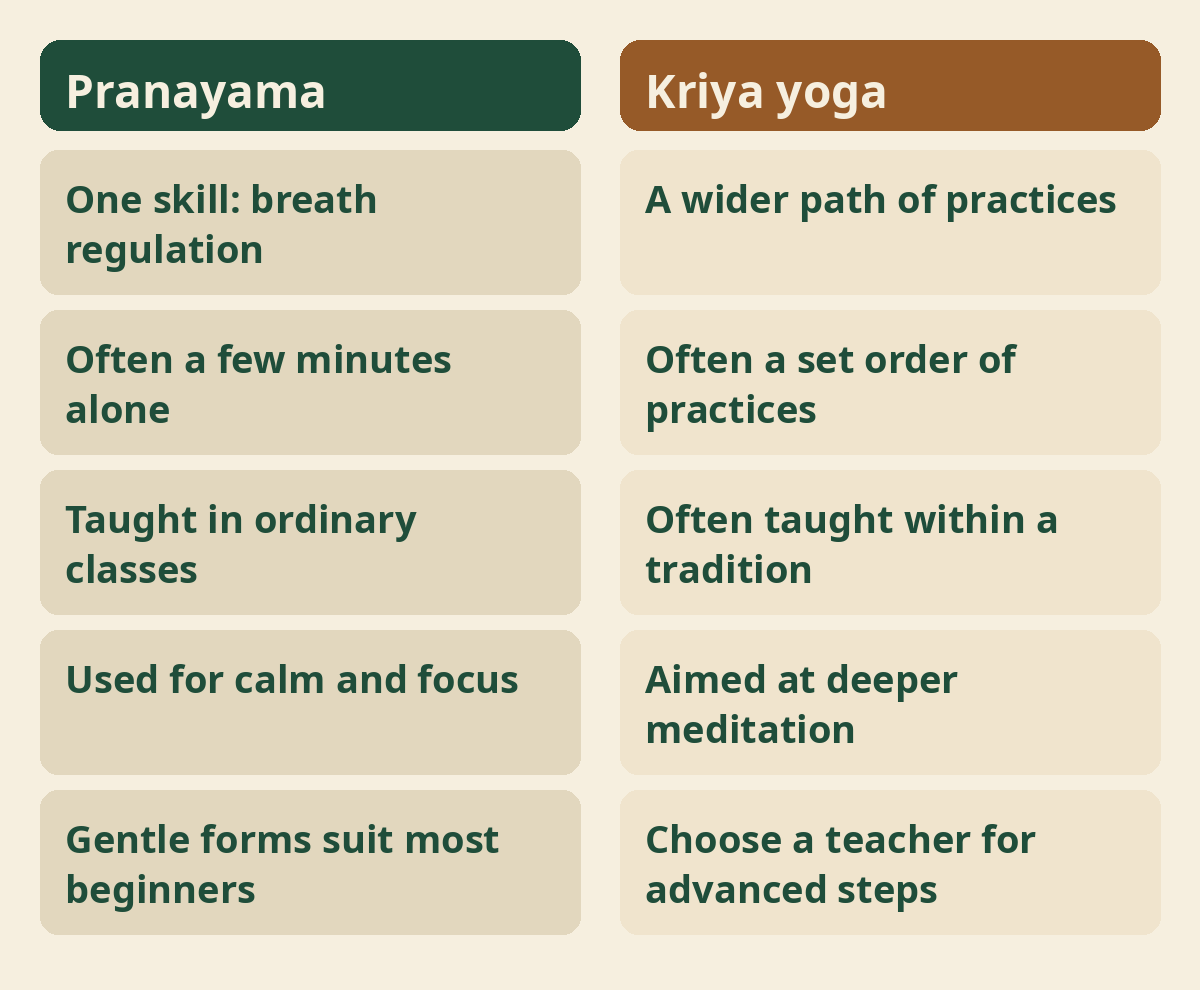
The main difference is scope. Pranayama is a single skill, breath regulation. Kriya yoga is a broader system that can include pranayama along with other practices. Think of pranayama as one tool, and Kriya as a toolbox that sometimes contains it.
- Focus. Pranayama works on the breath. Kriya also works on attention, discipline and meditation.
- Structure. Pranayama can be practised on its own for a few minutes. Kriya traditions often present practices in an order.
- Teaching. Pranayama is widely taught in ordinary classes. Specific Kriya techniques are often taught by a teacher within a tradition.
- Goal. Pranayama is often used for calm and focus. Kriya is usually described as a path toward deeper meditation.
Do Kriya yoga and pranayama overlap?
Yes. Many Kriya practices use breath control, so they overlap with pranayama. If a Kriya technique asks you to pace or watch your breath, that part is a form of pranayama. The overlap is the reason the two are often confused.
The difference shows up in what surrounds the breath. In pranayama, the breath is the practice. In Kriya, the breath is usually a way to prepare the mind for concentration and meditation that follow.
Which is better for a beginner?
For most beginners, simple pranayama is the easier and gentler place to start. It needs no initiation, only a few quiet minutes, and you can stop at any time. Start with natural, unforced breathing, and add pauses or speed only if a qualified teacher suggests it.
Kriya practices can come later if you feel drawn to them. Before you begin, read our guide on whether Kriya yoga is safe for beginners, because strong breathing techniques are not right for everyone.
How to practise a gentle breath exercise as a beginner
- Sit on a chair or cushion with your spine tall and shoulders loose.
- Close your eyes or soften your gaze.
- Breathe in through the nose for a count of four, without strain.
- Breathe out slowly for a count of four to six.
- Repeat for five to ten rounds, then breathe naturally for a minute.
- Stop if you feel dizzy, tense or anxious, and return to normal breathing.
Is breath practice proven to help?
Research on breathing practices is still developing. The National Center for Complementary and Integrative Health notes that yoga is generally low risk for healthy people who practise sensibly, and that results vary from person to person. Treat breath practice as a way to feel calmer and more focused, not as a treatment for any condition.
How do the two feel different in practice?
Pranayama usually feels like a short, focused breathing exercise, while Kriya practice tends to feel like a longer session that moves from breath to stillness. A pranayama round might last a few minutes and end with you simply sitting for a moment. A Kriya-style session, in traditions that teach it, may include preparation, several techniques and a period of silent meditation.
That longer shape is why Kriya asks more of your time and patience. It is also why it helps to build a base first. If sitting quietly for ten minutes still feels hard, work on that before adding anything complicated. Our guide to common obstacles to meditation can help with restlessness and a wandering mind.
What do the old texts say?
The Yoga Sutras name pranayama as one of eight limbs and describe kriya yoga as a separate set of three habits. That is a useful point, because it shows the two ideas were never identical. Pranayama sits inside the eight-limbed path as a breath practice. Kriya yoga, in the Sutras, is about the attitude and discipline you bring to practice.
Later teachers blended these ideas and gave “Kriya yoga” a more technical meaning in some lineages. You do not need to settle which meaning is correct. You only need to know which one your teacher or book is using, so you can judge what is being asked of you.
How can you tell which one you are being taught?
Ask what the practice is, how long it takes, and what the first step is. If the answer is “slow your breath and watch it for five minutes”, that is simple pranayama. If the answer involves a fixed sequence, initiation or a promise of rapid inner change, treat it as a specific tradition and ask more questions before you commit.
- Is the teacher open about what is taught, and why?
- Can you stop or skip a step if it feels wrong?
- Are health conditions taken seriously, with advice to check with a doctor?
- Is there pressure to pay, join or keep secrets?
A good teacher welcomes these questions. If you feel rushed or shamed for asking, step back.
Can you combine them in a daily routine?
Yes. A simple routine can use a few minutes of gentle pranayama as a warm-up for sitting meditation. For example, breathe slowly for five rounds, then sit quietly and watch the breath for a few minutes. That is not a formal Kriya sequence, but it uses the same idea: breath first, then attention. Keep it short and steady. Our morning meditation guide shows an easy way to fit it into the day.
Who should wait before trying breath practice?
People with heart, lung or blood pressure conditions, pregnant women and anyone who feels unwell should speak with a doctor before breath practice. People who tend toward panic or anxiety may also find strong breathing uncomfortable. In these cases, plain natural breathing and a short walk or gentle stretching are kinder choices. Skipping a technique is never a failure. Your comfort comes first, and the practice will still be there when you feel ready.
Common myths
- “Kriya and pranayama are the same thing.” They overlap, but Kriya is broader.
- “More breath control is better.” Gentle, steady practice is safer and usually more useful.
- “You need a guru to breathe deeply.” Simple breath awareness needs no initiation. Specific advanced techniques are another matter.
Where to go next
If you want a calm daily routine, our guides to starting a home yoga practice and how long to meditate are good companions. For a gentle written start, Ranjana’s book Begin Where You Are offers a beginner’s guide to yoga at home.
Frequently asked questions
Is pranayama part of Kriya yoga?
Often, yes. Many Kriya traditions include breath techniques, so pranayama can be one part of Kriya practice.
Can I practise pranayama without learning Kriya?
Yes. Pranayama is taught widely on its own, and gentle forms are suitable for most healthy adults.
Is Kriya yoga harder than pranayama?
Usually, yes. Kriya often asks for more time, a set order of practices and sometimes a teacher. Simple pranayama can be learned in a few minutes.
Do I need a teacher for Kriya?
Some traditions teach specific techniques only through a teacher. General breathing and meditation can be learned without one.
Which is safer for beginners?
Gentle, unforced pranayama is the lower-risk starting point. Avoid forced breathing or long breath holds without guidance.
How long should a beginner practise?
Five to ten minutes is enough. Add time slowly and stop if you feel unwell.
The bottom line
Pranayama is breath regulation. Kriya yoga is a wider path that often includes it. Start with gentle breathing, stay curious, and build up slowly.

