
Yoga breathing counts are a simple way to follow the length of an inhale and an exhale without forcing either one. For beginners, the safest starting point is noticing your usual breath, then adding a soft mental count only if breathing stays easy. You do not need long breaths, breath holds, or a special rhythm to begin. This guide explains how to choose a comfortable count, try a short practice, and recognize when counting is making breathing harder rather than easier.
This article provides general education and is not medical advice or a personal breathing plan. Check with your doctor before changing your breathing if you have a health condition, are pregnant, have unexplained symptoms, or have been advised to limit breath exercises.
What are yoga breathing counts?
Yoga breathing counts use numbers to give your attention a simple rhythm while you breathe. You might silently count during an inhale, then start again during the exhale. The numbers describe your chosen pace, not a standard that your lungs must meet, and ordinary breathing is always an acceptable alternative.
Why do people count their breaths?
People count breaths to make a quiet practice easier to follow. A small task can give a wandering mind somewhere to return without needing to empty it. Counting is optional, though, and the practice has missed its purpose if keeping track leaves you tense, distracted, or short of air.
What does a three-three count mean?
A three-three count means inhaling for three comfortable beats and exhaling for three comfortable beats. There is no breath hold between those parts in this guide. Think of the numbers as labels for a rhythm rather than instructions to drag out a breath beyond its natural ending.
Are counts the same as seconds?
Counts do not have to match exact seconds. A soft mental beat is enough for this beginner exercise, and it need not follow a clock. Keep its pace fairly steady within a round, but avoid treating small timing differences as mistakes that need fixing during the next breath.
How should you start?
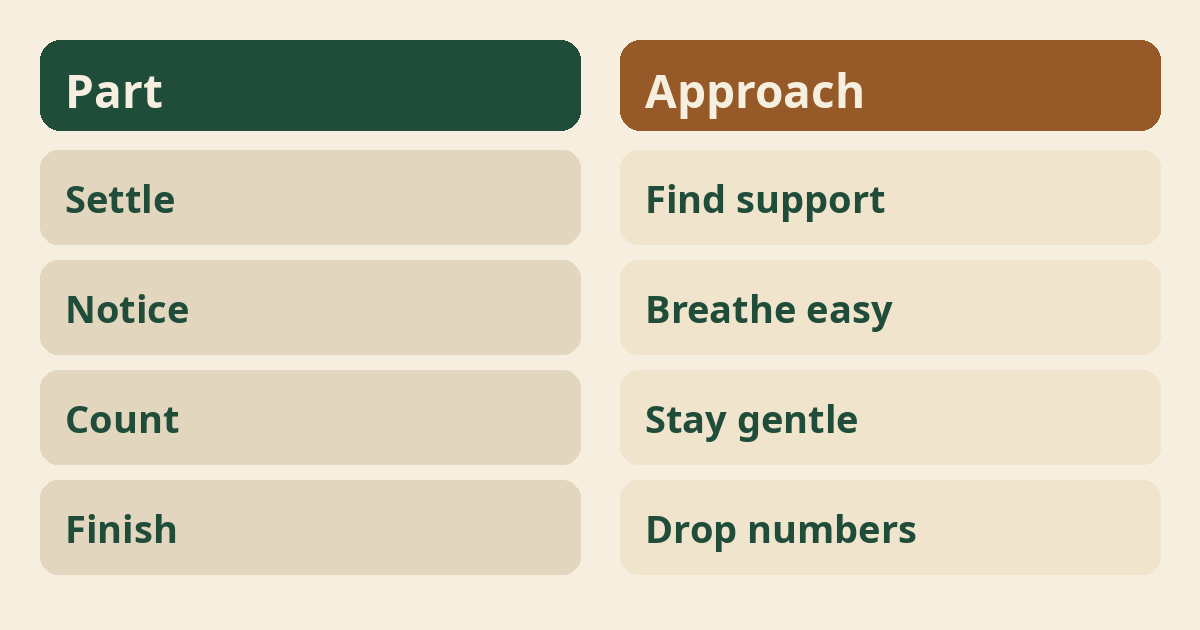
Start by watching your ordinary breathing before choosing any numbers. Sit somewhere that feels settled and notice several easy breaths without changing them. If your breath already feels uncomfortable, leave the counting exercise aside rather than using a longer count to try to correct the feeling on your own.
Step one: Find support
Choose a supported position that lets you breathe without bracing. A chair with your feet resting on the floor is a useful option, and your hands can rest on your thighs. Explore yoga at your desk for other simple ways to make a seated practice fit your day.
Step two: Notice the breath
Notice where breathing moves your body without pushing that movement. Your ribs, abdomen, or both may move gently, and you do not need to make that movement large. The belly breathing guide offers a separate introduction, but a visibly rising belly is not a requirement for counting.
Step three: Add a small count
Add a short count that fits the breath you already have. Try two easy beats in and two easy beats out only if that feels natural. If even that rhythm asks for effort, drop the numbers and keep observing; choosing not to count is a useful adjustment, not a failed attempt.
Step four: Keep the turns easy
Let the inhale become an exhale without deliberately holding your breath. Avoid adding a pause just because a diagram or another person’s practice includes one. If a natural brief transition happens, leave it alone rather than clamping your throat, keeping your chest full, or waiting for the next number.
Step five: Release the count
Finish the counted breaths by returning to your usual breathing. Try just a few comfortable rounds before letting the numbers go and checking how you feel. There is no need to take a final giant breath, empty your lungs, or complete a set if your body is asking you to stop.
Should you breathe through your nose?
Gentle nose breathing is an option when your nose feels clear and breathing stays comfortable. Do not force air through congestion or seal your mouth to meet a yoga rule. If nose breathing is difficult, leave the counting practice aside or breathe normally in the way that is comfortable for you.
How deep should the breath be?
Keep the breath comfortable rather than trying to make every inhale deep. Avoid repeatedly filling your lungs to their limit, raising your shoulders, or pulling in air to satisfy a number. A quiet, modest breath is enough for this exercise, and discomfort is a reason to release the rhythm rather than strengthen it.
What is an equal count?
An equal count gives the inhale and exhale the same number of gentle beats. Two in and two out may suit one person, while another prefers ordinary uncounted breathing. Equal numbers are only an attention tool; they do not prove that your breathing is correct, balanced, or better than it was before.
Should the exhale be longer?
A longer exhale is optional, not the next requirement for every beginner. Start with an easy rhythm and avoid changing it if that already takes attention. If you later explore a slightly longer exhale with a qualified teacher, keep it relaxed and never squeeze out air or delay inhaling when you need to breathe.
Do beginners need breath holds?
Beginners do not need breath holds to practice counting. Some yoga methods use retention, but those methods are outside this simple exercise and need their own guidance. Avoid copying hold patterns from videos, especially if you have a health condition, are pregnant, or have not discussed the practice with your doctor.
How long should a practice last?
A brief practice is enough to learn whether counting suits you. Begin with several ordinary breaths and just a few counted rounds, then stop while it still feels easy. You do not need to fill a full session, and a timer should never persuade you to continue through discomfort or a need for air.
How often can you practice?
Practice only as often as it remains comfortable and useful in your day. A short attempt on some days may be more manageable than a strict daily target that becomes another task. The guide to how often to do yoga can help you think about a flexible routine without turning missed days into a problem.
What benefits might people notice?
Many people find gentle breath counting offers a simple focus or a quiet pause, but results vary. Some enjoy the structure, while others feel better leaving their breathing alone. For broader background on yoga and safety, see National Center for Complementary and Integrative Health; this small exercise should not be presented as a guaranteed way to change sleep, mood, or health.
Is this a treatment?
Yoga breathing counts are not a treatment or a substitute for medical care. Do not use a counting pattern to manage unexplained breathlessness, chest pain, faintness, or a worsening health condition yourself. Follow your clinician’s advice and prescribed care, even when a breathing practice seems pleasant or someone else reports a strong personal benefit.
Who should check with a doctor first?
Get medical guidance first if a condition or symptom could make changing your breathing unsuitable. This includes heart or lung conditions, fainting episodes, pregnancy, and discomfort linked to breath-focused exercises. Ask whether gentle counting without holds is appropriate for you, and follow any personal limits rather than choosing a pattern from a general article.
What if you become dizzy?
Stop counting and let your breathing return to normal if you feel dizzy, tingly, strained, or short of air. Stay safely supported and do not restart to prove you can finish. Seek medical advice for new, recurring, or persistent symptoms, and get urgent help for severe breathing difficulty, chest pain, or fainting.
What if counting makes you anxious?
Stop focusing on the breath if counting increases anxiety or makes you feel trapped. Open your eyes and notice ordinary details around you, such as the chair supporting you or objects in the room. You can choose a different activity entirely; breath awareness is not a skill you have to push through distress to acquire.
Which mistakes are common?
Common mistakes include chasing larger numbers, taking oversized breaths, and continuing after comfort has gone. Another is turning every small timing change into something to correct immediately. Use comfort as your main guide, and avoid judging a session by whether each inhale and exhale matched perfectly from beginning to end.
What props do you need?
You do not need special equipment for yoga breathing counts. A stable chair or a cushion that supports an easy sitting position is usually enough for a simple attempt. If you are choosing support, yoga props for beginners explains basic options without making a purchase part of the practice.
Can you count during yoga poses?
Learn the counting exercise separately before combining it with movement. Following a number while balancing or stretching can distract you from comfort and make you hold your breath without noticing. When exploring mountain pose, let breathing stay natural instead of trying to fit both your posture and breath into a strict rhythm.
Should you count aloud?
Silent counting is usually simpler because speaking changes the breath you are observing. You can think the numbers softly or use your fingers to track completed rounds rather than timing each phase. Neither approach needs to be exact, and losing your place is a reason to restart gently rather than take a corrective breath.
What if you lose the count?
Losing the count is ordinary and does not spoil the practice. Return to one on the next comfortable inhale, or spend a few breaths without numbers. The useful part is noticing and returning without a struggle, not remembering an unbroken sequence or proving how closely you can control your attention.
Can you practice before bed?
You can try a short practice before bed if it feels easy, but sleep is not a promised result. Sit comfortably and stop if tracking numbers makes you more alert or frustrated. Keep any care plan for ongoing sleep difficulties, and avoid using longer counts as a way to force yourself into sleep.
Can you practice at work?
A quiet break at work can be enough space for a few comfortable counted breaths. Choose a moment when you are not driving, operating equipment, or doing anything that needs your full attention. Let your eyes remain open if useful, and return to your task without expecting the exercise to remove every source of pressure.
How do you progress?
Progress means the practice feels easier to choose and adjust, not that your count keeps rising. You might become quicker at noticing tension or more willing to stop when counting is unhelpful. There is no fixed ladder from two to larger numbers, and staying with a small count is a complete option.
When can a teacher help?
A qualified yoga teacher can help you understand a method and adapt the way it is introduced. Explain any relevant medical guidance before the session and ask for an option without holds or strain. A teacher should welcome questions and comfortable limits, while decisions about symptoms and medical suitability belong with your healthcare professional.
What mindset supports this practice?
Approach breathing counts with curiosity rather than a performance target. Notice whether the numbers simplify your attention or make the experience harder, then adjust accordingly. If your broader aim is a quieter pause, yoga for stress relief offers other ideas, without making breath control the only route worth exploring.
How do you choose a useful pattern?
Choose the smallest, simplest pattern that leaves you breathing comfortably, or choose no pattern at all. Do not copy another person’s count because they seem experienced or relaxed. Your useful practice might be a few equal breaths today and ordinary observation another day, with neither choice needing to become a permanent rule.
Where to read next
For a calm, beginner-friendly start, Ranjana Sinha’s Begin Where You Are is written for people who want simple steps. Our guide to starting a home yoga practice adds a gentle routine you can follow at home.
Frequently asked questions
What is a beginner yoga breathing count?
A short equal count, such as two easy beats in and two out, is one optional starting point if it fits your usual breath.
Must I hold my breath between counts?
No, this beginner practice uses no deliberate breath holds.
Is a higher count better?
No, a higher count is not a measure of progress and should never take priority over comfortable breathing.
Can breath counting replace prescribed care?
No, keep following your clinician’s advice and do not replace prescribed care with yoga breathing counts.
What if no count feels comfortable?
Leave the numbers aside, breathe normally, and seek medical guidance if breathing itself feels difficult or symptoms recur.
The bottom line
Let yoga breathing counts support a comfortable moment of attention, and leave the numbers behind whenever ordinary breathing feels better.

