
When someone dependent on opioids stops taking them, the first days are the hardest. Withdrawal brings sweating, restlessness, anxiety, pain and broken sleep, and it is the moment when people most often drop out of treatment and relapse. Standard care relies on medicines such as buprenorphine, which ease the symptoms but, as researchers have pointed out, do not fully calm the overactive stress response that comes with withdrawal.
A randomized clinical trial published in JAMA Psychiatry in January 2026 tested a simple question: if you add a short, gentle, supervised yoga program to standard medical care during those first two weeks, do people stabilize faster? The answer, in this one trial, was yes – and by a wide margin. Here is what the study found, and just as important, what it did not find.
What the study actually was
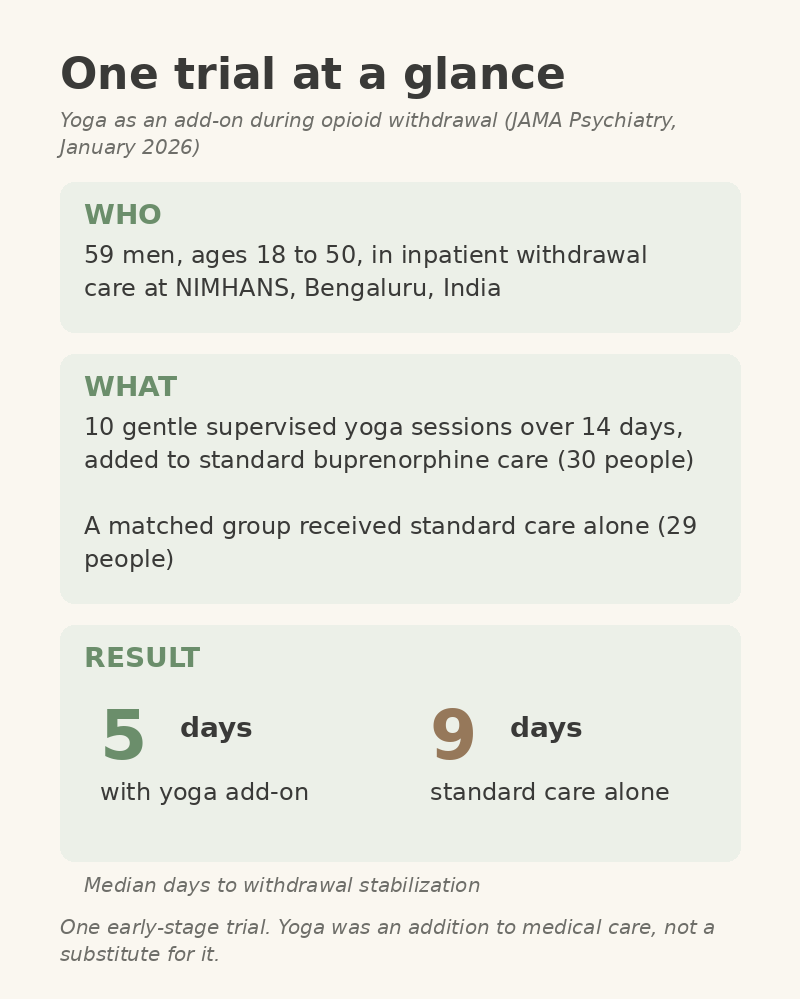
This was a two-arm randomized clinical trial run at the Centre for Addiction Medicine at NIMHANS, a tertiary hospital in Bengaluru, India, between April 2023 and March 2024. The researchers screened 68 adults admitted to the inpatient ward with opioid use disorder and randomized 59 of them: 30 to a yoga add-on group and 29 to standard care alone.
All participants were men, with an average age of about 26. Everyone entering the trial had mild to moderate withdrawal symptoms (scores of 4 to 24 on the Clinical Opiate Withdrawal Scale, or COWS, a standard checklist clinicians use to rate withdrawal). People with severe withdrawal, serious neurological or psychiatric conditions, or recent yoga training were not included. About 80% of participants were dependent on tapentadol, a prescription opioid whose misuse has risen sharply in India; most of the rest used heroin or other synthetic opioids.
Everyone in both groups received the same standard medical care: buprenorphine, with the dose adjusted daily by the treating psychiatrist according to withdrawal severity. The only difference was the yoga program. The yoga group received ten supervised 45-minute sessions over 14 days, taught by a certified yoga therapist, in a yoga hall or at the bedside. The program was a validated module designed specifically for withdrawal, with five parts: relaxation practices, gentle postures done mindfully, sectional breathing exercises, slow pranayama, and guided relaxation with affirmations (a short form of yoga nidra). More than 90% of the yoga group completed at least eight of the ten sessions.
The trial was registered in India’s clinical trials registry (CTRI/2023/04/051302). The people assessing outcomes and the statistician analyzing the data did not know who was in which group, and the researchers checked this afterwards: assessors’ guesses about group assignment were no better than a coin flip.
The main result: stabilization in half the time
The trial had two primary outcomes. The first was time to withdrawal stabilization, defined as the day a participant’s COWS score fell below 4 – minimal or no withdrawal – and stayed there.
Participants doing yoga stabilized at 4.4 times the rate of those on standard care alone (hazard ratio 4.40, 95% confidence interval 2.40 to 8.07). In plain terms, the median time to stabilization was 5 days in the yoga group versus 9 days in the control group. Crucially, this was not because one group got more medicine: the total buprenorphine dose did not differ significantly between the groups, and the analysis statistically accounted for it anyway.
The second primary outcome was heart rate variability (HRV), a measure of how flexibly the nervous system shifts between its “fight or flight” and “rest and digest” modes. Withdrawal is a state of sympathetic overdrive – racing heart, sweating, agitation – with the calming parasympathetic branch suppressed. By day 15, the yoga group showed significantly better HRV than controls across all three measures examined, with large effect sizes, indicating a real shift toward parasympathetic balance rather than a statistical wobble.
A mediation analysis added an interesting mechanistic detail: the rise in parasympathetic activity statistically explained about 23% of yoga’s effect on faster stabilization. The rest of the benefit came through other paths – likely including the anxiety, sleep and pain improvements described below. To be clear about the null results here: mediation through the other HRV measures (low-frequency power and the LF/HF ratio) was not significant. The parasympathetic pathway was the specific one that held up.
What else improved
Three secondary outcomes favored the yoga group:
- Anxiety. Scores on the Hamilton Anxiety Rating Scale fell far more in the yoga group, with a large effect size (comparable, the authors note, to what anti-anxiety medications achieve). This matters because anxiety during early recovery is a known driver of craving and relapse.
- Sleep. Time to fall asleep dropped by about 61 minutes more in the yoga group than in controls – a statistically significant but more modest effect. Sleep is a recurring theme in yoga research; see our earlier note on a trial of yoga for mood, sleep and memory.
- Pain. Average pain over 24 hours improved significantly more in the yoga group, again with a modest effect size.
There was also a finding worth understanding if you practice breathing techniques. During the pranayama sessions, participants’ breathing slowed from about 21 breaths per minute to about 12, but their stress response briefly rose rather than fell during the practice, before rebounding into deeper calm afterwards. The researchers describe this as a kind of “autonomic stress test”: in people new to breathwork, slow deliberate breathing takes effort, and the effort shows. By day 15, resting measurements showed the calmer pattern had carried over into daily life. If you have ever tried breathwork and found it effortful at first, this study says that is normal and expected, and the settling effect builds with repetition.
The part about harms and limits
This study needs careful reading before anyone draws big conclusions.
The published article does not report a formal tally of side effects. An earlier feasibility study of the same yoga module described it as safe, and the practices involved are gentle, but readers should know that this trial paper does not give the kind of adverse-event accounting we reported in our note on the knee osteoarthritis yoga trial. Four participants left the trial after randomization – one from the yoga group and three from the control group.
The other limits are substantial:
- All men. Every participant was male, reflecting who was admitted to that ward. Whether the same benefit holds for women is simply unknown.
- One hospital, one ward. A single-center inpatient trial at a leading research institute may not transfer to ordinary clinics, let alone to community or home settings.
- No active control. The control group received standard care but no equivalent extra attention. Some of the benefit could come from having a caring therapist visit daily rather than from yoga itself. The objective HRV changes argue against a pure placebo effect, but they cannot rule out an attention effect entirely.
- Two weeks only. The trial says nothing about long-term abstinence, relapse rates, or what happens after discharge. Faster stabilization is meaningful – it is the window where dropout and relapse peak – but it is not the same as recovery.
- Mostly one opioid. Four out of five participants were dependent on tapentadol. Withdrawal from fentanyl or methadone may behave differently, and the authors say replication in those populations is needed.
- Small and early-stage. Fifty-nine participants is enough to detect a large effect, and the effect here was large – but one early-stage trial is not proof. It is a strong signal that larger, multi-site trials are worth doing, which is exactly what the authors call for.
What this means in practice
If you or someone you love is facing opioid dependence, the message of this trial is not “do yoga instead of treatment.” Everyone in the trial received full medical care, and the yoga was an addition to it, supervised by professionals inside a hospital. Opioid withdrawal can be dangerous and should be managed with medical support; nobody should stop or reduce prescribed medication based on a yoga article, including this one.
What the trial does suggest is that the body’s stress regulation – the racing, agitated, sleepless state that medicine only partly reaches – can be worked with directly, and that simple breathing, gentle movement and relaxation practices, taught patiently by someone qualified, may help that system settle measurably faster. For yoga teachers and therapists, it is a reminder that the gentlest parts of practice – relaxation, slow breathing, guided rest – are sometimes the most clinically powerful, and that working with people in withdrawal is specialized work done alongside medical teams, not in ordinary studio classes.
For the rest of us, it is one more careful piece of evidence that yoga’s effects on the nervous system are real enough to measure on an electrocardiogram – while also being a reminder that honest evidence comes wrapped in limits: one center, one gender, two weeks, and one early-stage trial.
What this study does not mean
It does not show that yoga treats opioid addiction, only that it sped up short-term withdrawal stabilization alongside medication in one inpatient trial. It does not mean any yoga class is suitable during withdrawal – the program was designed, gentle and supervised. It does not prove the benefit came from yoga itself rather than the extra daily attention. And it says nothing about long-term recovery, which is the outcome that ultimately matters most.
Frequently asked questions
Can yoga replace medication for opioid withdrawal?
No. In this trial, yoga was added to standard buprenorphine treatment, not substituted for it, and both groups received full medical care. Withdrawal should be medically supervised; never stop or change prescribed medication without your doctor.
Is it safe to practice yoga during withdrawal?
The program studied was gentle – relaxation, easy postures, slow breathing – taught by a certified therapist inside a hospital, and an earlier study of the same module found it feasible and safe. This trial’s paper does not report a formal side-effect tally. Intense or vigorous practice during acute withdrawal would be a different and untested matter.
What kind of yoga was studied?
Ten supervised 45-minute sessions over two weeks: relaxation practices, gentle mindful postures, sectional breathing, slow pranayama and short guided relaxation (yoga nidra). Not a flow class, not hot yoga, and not self-directed practice.
Do these results apply to everyone with opioid dependence?
Not yet. The trial involved 59 men at one Indian hospital, mostly dependent on tapentadol, followed for two weeks. The authors call for larger multi-site trials that include women, other opioids such as fentanyl, and longer follow-up before the findings can be generalized.
Sources
- Mahadevan J, Nagendra RP, Jasti N, et al. Yoga for Opioid Withdrawal and Autonomic Regulation: A Randomized Clinical Trial. JAMA Psychiatry, published online 7 January 2026. doi:10.1001/jamapsychiatry.2025.3863 (full text read 27 November 2026)
- Harvard Gazette coverage of the trial (checked 27 November 2026)
- Trial registration: Clinical Trials Registry – India, CTRI/2023/04/051302