Yoga and calisthenics can both involve supporting your own body weight. A still photograph of a plank-like position may look familiar in either setting. That does not mean the two practices have the same purpose or that one is simply an easier version of the other.
Calisthenics usually means bodyweight exercise organised around strength, muscular endurance and movement skills. Yoga is a broader practice rooted in Indian philosophy, with contemporary classes often combining postures, breathing practices and meditation.
The useful choice depends on what you want to learn, how the class is taught and whether the work suits your current abilities. This is a comparison of approaches, not a workout plan or medical advice.
What counts as calisthenics?
Exercise researchers writing in The Conversation describe calisthenics as training that uses bodyweight exercises to build strength. Familiar examples include push-ups, bodyweight squats and chin-ups. These examples describe the category, not a starting routine for every reader.
Some sessions use repeated movements, while others focus on controlled holds or learning a particular skill. Faster circuits may add a substantial cardiovascular demand. A slow strength session can feel quite different from a jumping circuit, even when both carry the same label.
Calisthenics is not limited to the difficult skills shown in social-media clips. A beginner class should offer a suitable entry point rather than assume that everyone can already lift or support their full body weight.
What does yoga include?
NCCIH describes yoga as an ancient, complex practice with spiritual roots. Many contemporary classes emphasise postures, breathing techniques and meditation, but styles vary from gentle to physically demanding.
That variation matters when comparing exercise. A supported rest class and a vigorous movement class are not interchangeable. Yoga should not automatically be described as passive stretching, easy exercise or a recovery session.
A yoga teacher may also discuss attention, the experience of movement or ideas beyond physical conditioning. Ask what the particular class includes, especially if you want to explore the wider practice rather than only exercise.
Yoga and calisthenics compared
| Question | Yoga | Calisthenics |
|---|---|---|
| Main frame | A broad practice tradition | Bodyweight exercise |
| Common focus | Poses, breath, attention | Strength, endurance, skills |
| Session style | Depends on the yoga style | Depends on the training goal |
| Equipment | Mat and optional supports | May include bars or supports |
| Progress | Not only deeper poses | A planned change in demand |
These are common emphases, not strict boundaries. Yoga can involve demanding bodyweight work, and calisthenics can require attention, balance and controlled breathing.
Shared movements do not make them identical
A professional education article in Strength & Conditioning Journal groups calisthenics and physical yoga practice under the wider heading of bodyweight training. This is a useful way to understand the overlap without reducing yoga to a fitness method.
The same-looking position can sit inside different lessons. One teacher may use it to explore attention and a steady transition; another may use it as part of a measured strength progression.
Neither context makes the movement automatically safer or more effective. You still need an appropriate version, clear instruction and a way to stop or change it when necessary.
If your main goal is strength
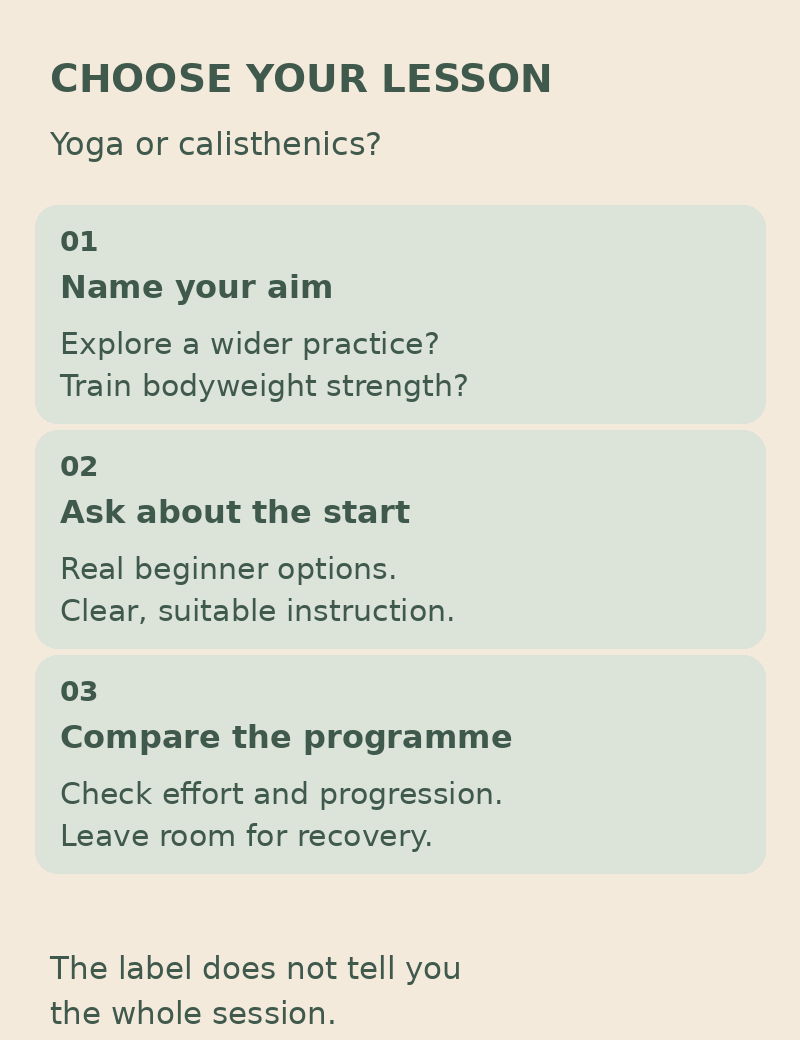
A calisthenics programme can make strength training its central organising goal. Ask how it covers different movement demands, what starting options are available and how the coach decides when to increase the challenge.
The American Heart Association’s scientific statement includes bodyweight exercises among resistance-training methods. It also explains the role of gradual progression. This supports bodyweight training as a legitimate method, not proof that every calisthenics class is a complete programme.
Some yoga postures can contribute to muscle strengthening too. The CDC includes some yoga postures and bodyweight exercises among its examples. It does not say that every yoga session provides the same strengthening stimulus or works every major muscle group.
If strength is your main goal, compare the actual programme rather than deciding from a class photograph or how tired you feel afterward.
Why bodyweight does not always mean easy
Your body weight may be more resistance than you can comfortably manage in a particular movement. Spencer Hospital’s education article notes that bodyweight work can feel too difficult for a novice even when an experienced exerciser finds another version easy.
Changing the challenge is not always as simple as adding a small weight to a machine. The Conversation’s researchers point out that the step between bodyweight variations can be large.
Ask a coach how they bridge that gap. You should not have to jump from a manageable version to an advanced skill because there are no intermediate options. Difficulty is something to plan, not a test of determination.
Progress is not the same in every class
In calisthenics, progress may be tracked through a better-controlled movement or a planned change in repetitions, support or difficulty. A qualified coach can choose an appropriate measure without making every session a maximum-effort test.
Yoga progress need not mean a deeper shape or a harder balance. It may mean learning to notice unnecessary effort, using support confidently or understanding the practice more clearly.
If you enjoy measurable training targets, say so. If performance tracking makes a class feel less useful to you, say that too. These preferences can help you choose teaching that you will want to return to.
What about flexibility and cardio?
Do not assume that yoga supplies all flexibility work or that calisthenics supplies all cardiovascular exercise. Both labels cover sessions with very different content and effort.
The CDC distinguishes aerobic activity from muscle-strengthening activity and recommends a mix for adults. A class counts toward a particular goal because of what you do and how hard you work, not because its name sounds active.
Likewise, a difficult strength hold is not automatically a substitute for sustained aerobic activity. If you are building a general activity plan, consider the full week rather than expecting one class to cover every need.
Equipment and the place you practise
Many calisthenics movements need little equipment, but some use bars, rings or other supports. A yoga class may use a mat, blocks, a strap or a chair. Neither practice always means buying nothing.
Ask what the venue provides and what you need to bring. At home, clear space and suitable equipment matter more than copying an attractive setup from a video.
Do not improvise a pulling station from furniture or assume a doorframe or railing can hold you. Ask for instruction and use equipment designed and installed for the intended purpose.
Can you combine them?
Yes, but the names alone do not create a balanced plan. A demanding yoga class can add another substantial physical load alongside calisthenics. It is not automatically a rest day.
Tell your teacher or coach what else you do. Consider overlapping effort and leave room for recovery rather than adding a session simply because it has a different label.
Our guide to yoga alongside strength training discusses keeping your main programme and individual guidance in view. You do not need to adopt both practices to make a worthwhile start.
What the evidence does and does not decide
The sources here explain yoga, bodyweight training and general activity principles. They are not a set of direct trials proving yoga or calisthenics superior for every outcome.
The older Strength & Conditioning Journal article and Spencer Hospital article offer practical education, not a head-to-head clinical trial. The American Heart Association statement concerns resistance training broadly, not one branded class.
Be cautious of claims that one practice guarantees a particular body shape, faster fat loss, freedom from injury or a cure for pain. A useful comparison names a goal and examines the actual programme.
Starting with appropriate support
Look for a qualified instructor who welcomes questions and offers realistic beginner options. Tell them about relevant health conditions, injuries and clinician-given limits before class.
If you are pregnant, have a health condition, recent surgery, ongoing pain or uncertainty about what exercise is suitable, discuss your needs with your clinician first. A general class is not individual rehabilitation.
Do not force range or hold your breath to complete a movement. Stop for pain, dizziness, numbness or symptoms that concern you. Seek appropriate medical advice rather than using another repetition or pose to test the problem.
Common questions
Is yoga a form of calisthenics?
Some physical yoga work overlaps with bodyweight exercise, but yoga has a wider practice context. The terms are not interchangeable.
Do I need advanced skills to start calisthenics?
No. Ask for a genuine beginner class with options matched to your current ability. Advanced skills are not an entry requirement.
Which should I choose first?
Choose yoga if the practice and teaching interest you. Choose calisthenics if a suitable bodyweight strength programme matches your goal. Ask about the actual session before joining.
The useful choice
You do not have to choose a permanent team. Start with a clear aim, suitable teaching and work you can learn without pressure. Yoga and calisthenics can overlap, complement each other or serve different interests. Their value depends on the session you actually do.
Sources and further reading
- NCCIH: yoga, evidence and safety
- The Conversation: exercise researchers explain calisthenics
- CDC: aerobic and muscle-strengthening activity
- American Heart Association: scientific statement on resistance training
- Strength & Conditioning Journal: bodyweight training education
- Spencer Hospital: advantages and limits of bodyweight training