
Purna Yoga is the name Aadil Palkhivala and Savitri use for a system that brings posture practice, meditation, philosophy and daily habits together. Its official materials translate “purna” as “complete.” The word describes the scope of the teaching, not a promise that one class meets every physical or emotional need.
The method has a particular background: Palkhivala’s study with B.K.S. Iyengar, the spiritual influence of Sri Aurobindo and The Mother, and Savitri’s Heartfull Meditation. Understanding those connections is more useful than assuming that Purna is simply another name for slow stretching.
This is an overview of the named method, not a home sequence, meditation initiation or nutrition plan. It explains the main ideas and helps you check what an actual lesson offers.
First, make sure you have the right Purna Yoga
“Complete yoga” is a broad expression. The official Purna Yoga website identifies Aadil Palkhivala and Savitri as the founders of the system discussed here. Look for their names, the four-part framework or a clear explanation of the teacher’s training when comparing classes.
Sri Aurobindo’s teaching is also associated with the names Integral Yoga and Purna Yoga. Palkhivala describes his own system as inspired by Sri Aurobindo’s wider vision. That connection does not make every school using those words the same organization or give them the same class format.
There is another distinction worth keeping clear: Swami Satchidananda’s Integral Yoga is a separate tradition. Our guide to Satchidananda’s Integral Yoga addresses that system. A shared word should lead you to check the source, not combine unrelated class descriptions.
The four parts of the method
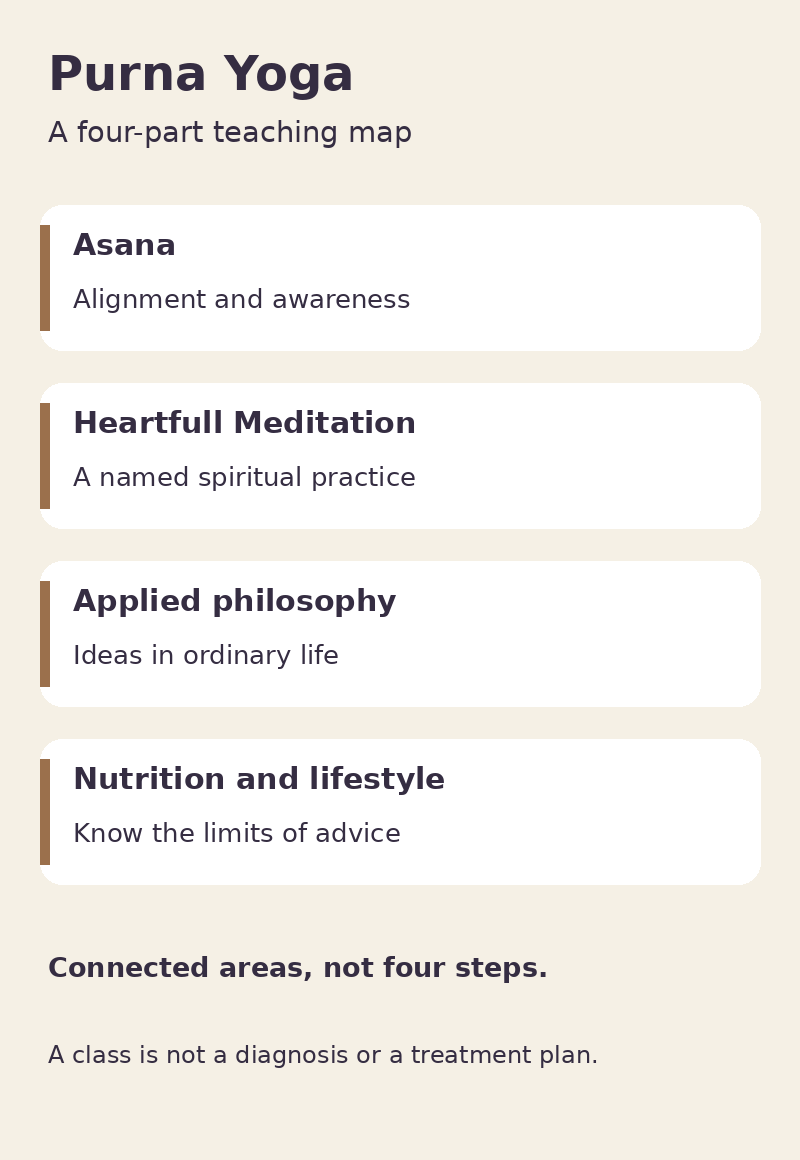
The official website calls its main areas the “Four Petals”: safety and alignment-based asana, Heartfull Meditation and lifestyle, applied philosophy, and nutrition and lifestyle. They describe connected areas of learning rather than four exercises performed in order.
In practical terms, the map tells you why a teacher might discuss attention, choices or ordinary habits alongside physical movement. It does not tell you how many minutes a particular class spends on each area. A posture lesson and a meditation workshop may emphasize different parts.
| Area | Question for a teacher |
|---|---|
| Alignment-based asana | Which positions, supports and alternatives will this class use? |
| Heartfull Meditation | What does the practice involve, and can I listen before joining in? |
| Applied philosophy | Which source or idea are we discussing, and what is belief rather than evidence? |
| Nutrition and lifestyle | Is this general education, or advice that needs a qualified health professional? |
What does alignment mean here?
Alive & Shine Center, the founders’ teaching center, describes Purna asana in terms of alignment and awareness. Palkhivala’s Yoga Journal account also explains the influence of his long study with Iyengar. Careful attention to how a posture is arranged is therefore part of the method’s stated approach.
That is an intention, not proof that one arrangement prevents injury in every body. Ask how a teacher changes a position for someone who cannot comfortably use the floor, bear weight through the hands or remain standing for long. A detailed instruction should make your choices clearer, not require you to force a joint into a photograph’s shape.
Before attending, check the class level and equipment. Ask whether blocks, a chair or other supports are used and supplied, and whether there is time to learn transitions. Do not infer intensity from the word “alignment”: a held posture can still involve effort.
How does Heartfull Meditation fit in?
The official Purna Yoga materials credit Savitri with creating Heartfull Meditation. They present it as a heart-focused spiritual practice connected with the method’s wider view of life. It is a named approach, not a generic label for every meditation that mentions kindness or the heart.
Ask what the session actually includes: guided attention, imagery, movement, spoken words or time in silence. You can also ask whether the teacher explains the spiritual language before using it. Understanding a practice does not require accepting its beliefs as scientific facts.
This article does not reproduce the techniques. A general introduction cannot establish which meditation format suits an individual. If an exercise causes distress, you can stop and discuss an alternative rather than treating discomfort as a test of commitment.
Philosophy beyond the mat
In his Yoga Journal interview, Palkhivala connects yoga with integrity, relationships, kindness and the way people act in ordinary life. That helps explain why applied philosophy has its own place in the framework rather than appearing only as an opening quotation.
A useful first question is which teaching the class is applying. Is the teacher discussing a text, offering a personal interpretation or asking students to reflect on a practical choice? Keeping those categories visible makes it easier to learn without mistaking an opinion for a rule everyone must follow.
You do not need to overhaul your private life after one lesson. Ask questions, take time to consider an idea and keep decisions about your relationships, money and health with you. Respect for a teacher does not remove ordinary boundaries.
Nutrition teaching needs a clear boundary
Nutrition and lifestyle appear explicitly in the official framework and college description. That tells you these subjects may be discussed; it does not establish that a particular diet treats a symptom or that every posture teacher is qualified to give individual nutrition advice.
Some older accounts of the method include strong claims about food and illness. This guide does not turn those anecdotes into recommendations. Do not remove whole food groups, use supplements or change prescribed care simply because a yoga article or teacher suggests it.
Ask whether a discussion concerns general habits or a personal medical need. Questions about persistent symptoms, allergies, medication or a restrictive diet belong with an appropriately qualified healthcare professional. You can be interested in the method without buying a nutrition programme.
What does “complete” not establish?
A wide teaching framework is not clinical evidence. Official descriptions use language about healing, energy and transformation. Those expressions need to remain separate from a claim that an ordinary Purna Yoga class diagnoses, prevents or treats a condition.
NCCIH notes that yoga studies use varied practices, making results difficult to compare. Findings about yoga generally should not be presented as proof for this particular combination of postures, meditation and lifestyle teaching. A systematic review of yoga safety also called for better reporting of adverse events.
Nor does a focus on safety mean risk-free practice. NCCIH advises beginners to avoid extreme practices such as headstands, shoulder stands and forceful breathing. You do not need to attempt advanced postures, locks or intense breathwork to understand the four-part framework.
Choosing a first class
Start with the class description, not the broadest claim on a website. Ask what you will physically do, which parts of the framework are included, what training the teacher has in this method, and whether you can pause or leave out an activity.
If you are pregnant, have an injury or live with a health condition, discuss the planned activity with your healthcare professional and instructor. NCCIH notes that needs such as balance difficulties, glaucoma and lumbar spine disease may require changes. A general class description cannot settle individual suitability.
Purna Yoga may interest you if you want to learn how one named tradition connects movement with meditation and daily life. The useful starting point is a clear account of that tradition and a lesson with real choices, not a promise that “complete” means everyone needs the same thing.
Sources
- Purna Yoga: founders, background and four petals
- Alive & Shine Center: its description of Purna Yoga asana
- Purna Yoga College: the scope of its teaching
- Yoga Journal: Palkhivala’s account of the system
- Yoga Journal: interview on Purna Yoga and ordinary life
- NCCIH: yoga evidence and safety
- Cramer and colleagues: review of yoga safety reporting