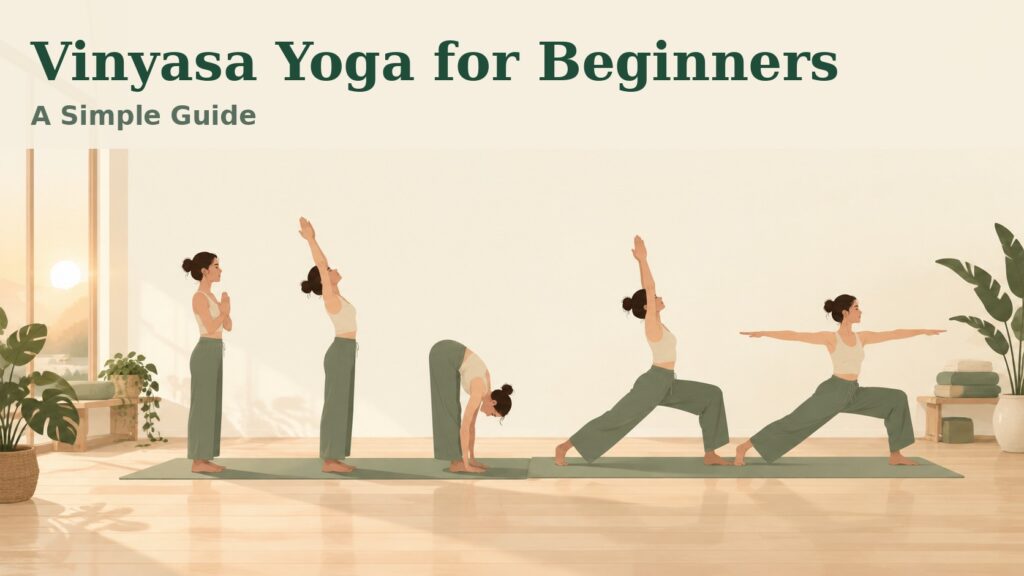
A yoga class and a mobility class can both include slow movements, floor work and time spent exploring how your joints move. Looking at a photograph may not tell you which class you are seeing. The more useful difference is what the teacher is asking you to learn.
Yoga is a broad practice rooted in Indian philosophy. Mobility training usually describes exercise aimed at developing movement you can use and control. These are overlapping categories, not opposing teams.
This guide helps you read a class description and ask useful questions. It does not prescribe a routine or claim that either label guarantees better joints, less pain or protection from injury.
What yoga includes
NCCIH describes yoga as an ancient, complex practice with spiritual roots. In many contemporary classes, the emphasis is on physical postures, breathing practices and meditation. Styles range from quiet and supported to physically demanding.
That range matters. A supported rest class and an active movement class may share the yoga label while placing very different demands on you. Yoga is not always a stretch session, a workout or a relaxation session.
A class may invite you to notice sensations and attention alongside the movement. It may also include elements beyond physical training. Ask what the particular teacher includes instead of assuming every yoga class has the same structure.
What mobility training usually means
In fitness settings, mobility often refers to using a range of joint motion with control. ACE describes it in terms of active movement supported by strength, coordination and balance, rather than simply reaching a large angle.
A mobility session may use repeated movements, brief holds or exercises linked to a task. The focus might be reaching overhead, changing levels or moving through a pattern used in another activity.
There is no single universal mobility class. A short preparation session and a demanding strength-based session can both use the name. The word mobility tells you something about an intended quality, but not enough about the dose or difficulty.
Yoga and mobility training compared
| Question | Yoga | Mobility |
|---|---|---|
| Main frame | A broad practice tradition | A movement-training goal |
| Common focus | Poses, breath, attention | Usable range and control |
| Methods | Vary with the style | Vary with the task |
| Overlap | Can train movement control | Can draw on yoga movements |
| Best question | What does this class include? | What movement is it training? |
This comparison describes common emphases, not rules that separate every exercise. A yoga teacher may emphasise controlled movement, while a mobility coach may include quiet attention and breathing.
Why flexibility is not the whole comparison
People often explain mobility as active and flexibility as passive. That can be a useful shorthand within a training programme, but terminology is not fully standardised.
A peer-reviewed Current Opinion paper in Sports Medicine points out that range of motion and flexibility are used differently across major exercise organisations. It argues that joint range includes more than soft-tissue extensibility, including factors such as joint structure and movement control.
The practical lesson is to ask what someone means and measures. Are they discussing the angle available with assistance, the movement you produce yourself or a task you can perform? Those are related questions, not identical ones.
Our yoga and stretching comparison considers another overlapping pair. Here the focus is not simply whether an exercise stretches you, but what a session does with movement range.
Yoga can be part of mobility training
A systematic review in the Journal of Sports Sciences included yoga among the methods used to train mobility in sporting populations, alongside dynamic stretching, Pilates and dance. That alone shows why yoga versus mobility is not a clean either-or choice.
The review found potentially useful effects across several methods, but the studies differed substantially and had quality limitations. It did not establish that one label is the best choice for everyone.
Its participants were predominantly young adult or junior athletes. Findings from those groups should not be treated as proof of what an older beginner, a person with an injury or someone with a medical condition needs.
A clinician’s discussion from Scottsdale Physical Therapy also describes yoga as involving both movement range and control. That is a practitioner’s perspective, not a head-to-head trial proving superiority.
Choose a task before choosing a label
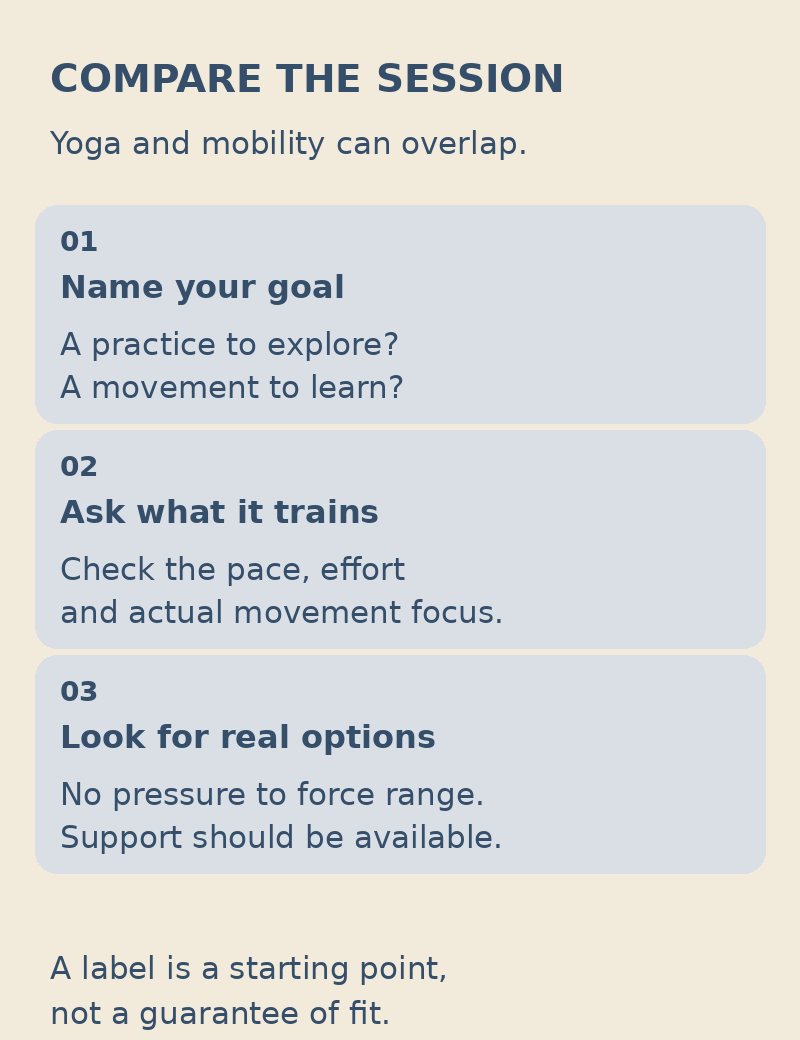
Start with a plain description of what you want from a class. Perhaps you want to learn yoga as a practice, explore attention through movement or join a class with time for quiet rest.
Alternatively, you might want help with a particular movement used in sport or exercise. A coach who can explain that task and adapt the work around it may be more useful than a class advertised only as full-body mobility.
ACE emphasises that useful range is task-specific. You do not need the same movement demands for every hobby, sport or everyday activity. More range everywhere is not a sensible universal target.
A goal such as learning a comfortable way to reach or change position gives a teacher something concrete to discuss. A goal such as fixing my whole body invites vague promises and makes progress harder to judge.
Questions to ask a yoga teacher
Ask about the style, pace and amount of floor work. Find out whether the class includes sustained poses, repeated transitions, breathing practices, meditation or quiet rest.
Ask whether it is suitable for a first class and what support is available if you cannot comfortably get to the floor or balance without help. Beginner-friendly should mean more than using simpler pose names.
If learning the wider practice matters to you, ask how the teacher approaches that. If your main interest is physical movement, ask about that too. Clear expectations prevent a perfectly reasonable class from being the wrong fit.
Questions to ask a mobility coach
Ask what movements the session focuses on and how the coach decides what is appropriate. Does the class involve body weight only, external resistance or work near the limits of a joint’s range?
Ask what options are available when a movement is uncomfortable or inaccessible. A coach should be able to explain a simpler version without making depth, speed or lack of support a badge of success.
Also ask how progress is assessed. A change in a movement you care about is more meaningful than collecting dramatic before-and-after angles without context.
Do you have to do both?
No. You do not need to add two separate programmes because both names sound useful. Some yoga classes already include the kind of controlled movement you want to practise.
If you combine them, compare the actual work. Two differently named sessions may load the same areas or demand similar effort. Adding more is not automatically a better plan.
A coach or teacher can help you place a session around your other activity. Tell them what else you do rather than treating each class as though it is the only physical demand in your week.
Neither is automatically rehabilitation
A public class is not an individual assessment. Difficulty with a movement does not tell you, by itself, whether the limiting factor is strength, pain, coordination, joint structure or something else.
Hinge Health’s clinician-reviewed explanation describes several contributors to mobility and notes the role of individual physical therapy when injuries or health conditions are involved. That is different from following a general class designed for a group.
If you have ongoing pain, a recent injury or surgery, repeated joint instability or a sudden loss of movement, seek appropriate health advice rather than trying to unlock the area with stronger stretching.
For pregnancy, a health condition or balance concerns, discuss your needs with your clinician and the instructor before starting. Check with your doctor when you are unsure what is suitable for you.
Look for control without pressure
NCCIH notes that yoga injuries can occur, even though it is generally considered safe for healthy people when practised properly with qualified instruction. A calm-looking session is not risk-free.
Do not force a joint into a position or hold your breath to complete a movement. Stop if you develop pain, tingling, numbness or dizziness, and get advice for symptoms that persist or concern you.
Be cautious of claims that a session permanently fixes posture, guarantees injury prevention or makes every joint move through an ideal range. Individual bodies and tasks differ. A teacher should respect limits rather than promise to erase them.
Common questions
Is mobility training just yoga with a new name?
No. It can draw from many movement methods, although some exercises overlap with yoga.
Is yoga only passive stretching?
No. Depending on the class, it can include active movement, balance, strength demands, breathing practices and attention.
Which should I try first?
Choose the class whose actual content, teaching and level match your goal. Ask about options before joining.
The useful choice
Choose yoga when you want the practice that a particular teacher offers. Choose mobility training when its movement goals fit your needs. If both descriptions fit the same session, that is overlap, not a contradiction. What matters is suitable teaching, clear aims and work you can do without pressure to force your body.
Sources and further reading
- NCCIH: yoga, evidence and safety
- ACE: mobility and flexibility in exercise programming
- Sports Medicine: distinctions in range-of-motion terminology
- Journal of Sports Sciences: review of mobility training in athletes
- Hinge Health: clinician-reviewed mobility explanation
- Scottsdale Physical Therapy: a clinical perspective on yoga