You finish a quiet meditation feeling refreshed. Does that mean you can subtract the session from tonight’s sleep? No. Feeling rested after a practice is not evidence that it supplied the biological functions of sleep.
Meditation is a broad family of practices involving attention, awareness or other deliberate forms of engagement. Sleep is a necessary biological process with recurring stages. They can fit into the same evening, but they are not two versions of the same thing.
This guide compares the categories, explains why sleepiness during practice is not a spiritual score and separates research about better sleep from claims about needing less sleep. It is general education, not an insomnia treatment plan.
The clearest difference
NCCIH describes meditation as a variety of practices. Some involve attending to a sensation, sound, image or repeated phrase. Mindfulness approaches involve awareness of present experience without judgement.
In those practices, you are engaging with an instruction. You may notice distraction and return, listen to a guide or attend to what is happening. You do not have to feel calm or have an empty mind for the activity to count as practice.
Sleep is not defined by choosing a focus or completing an exercise. NINDS describes a complex, active process involving the brain and body. Learning, memory and ordinary daytime functioning depend on getting enough good-quality sleep.
Meditation and sleep compared
| Question | Meditation | Sleep |
|---|---|---|
| What is it? | A family of practices | A biological need |
| Attention | Follow an instruction | No chosen task required |
| Stages | Depend on the method | REM and non-REM |
| Rest | May feel refreshing | Cannot be replaced by practice |
| Timing | Fit it around sleep | Protect enough time for it |
This table is not a complete account of every meditative tradition or unusual state of awareness. Its practical point is simpler: a period of deliberate practice is not a substitute for meeting sleep needs.
Sleep is more than lying still
NHLBI explains that sleep cycles through rapid eye movement, or REM, and non-REM phases. Non-REM sleep has three stages, including the transition from waking and deeper slow-wave sleep.
During REM sleep, the brain is active and its measured activity can resemble waking activity. That is one reason the description everything switches off is misleading. Stillness alone does not tell you what the brain is doing.
Sleep studies use measurements such as brain activity and eye movements to classify sleep. Feeling heavy, losing track of a recording or noticing a quiet mind cannot establish which stage you were in.
You do not need to identify sleep stages yourself to value sleep. Nor do you need to reproduce a particular brain-wave pattern during meditation. A physiological label should not become another target to chase.
There is no useful minutes-to-hours exchange rate
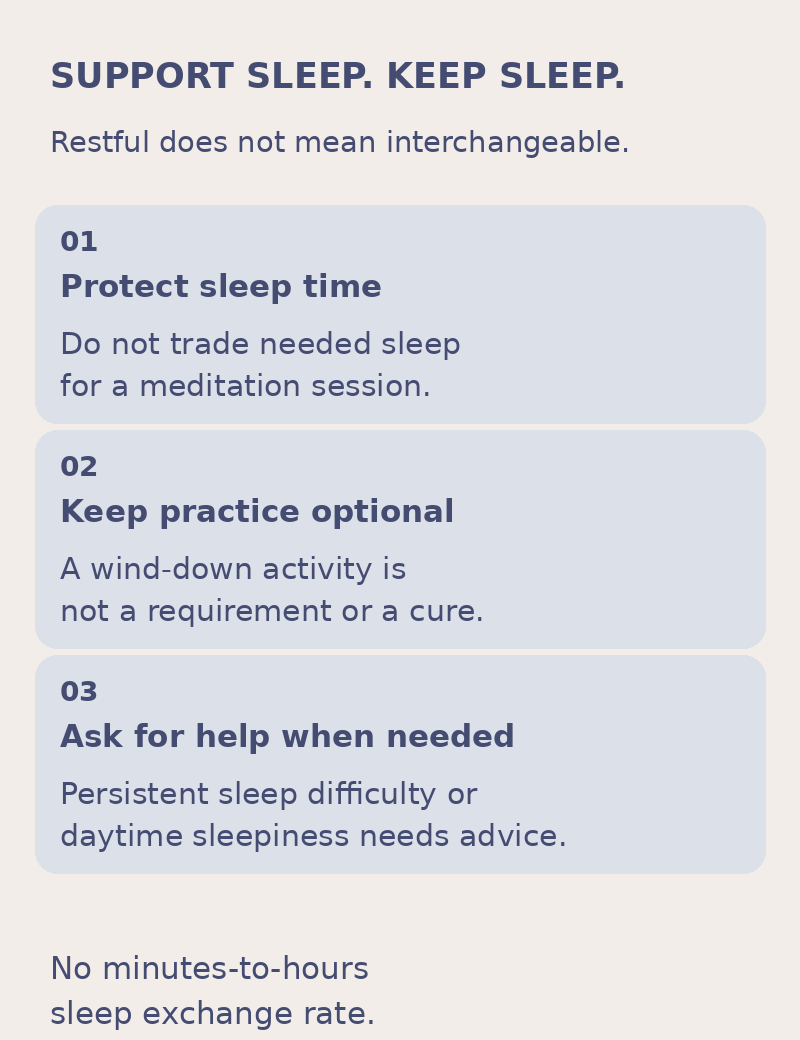
Be cautious about a claim that a short meditation replaces several hours of sleep. The medically reviewed Sleep Foundation explanation directly distinguishes feeling restored after meditation from the need for sleep.
A refreshing experience is real as an experience. It does not show that you can remove sleep from your schedule without consequences. A session that helps you unwind and a night of adequate sleep answer different needs.
The AASM and Sleep Research Society consensus recommends that adults aged 18 to 60 regularly obtain seven or more hours of sleep per night. Individual needs vary. That recommendation is not a ceiling or permission to ignore persistent tiredness.
Adding meditation by setting an earlier alarm can be counterproductive if it consistently cuts the sleep you need. Fit optional practice around sleep rather than treating sleep as spare time to reclaim.
Can meditation help sleep quality?
It may help some people, but the details matter. NCCIH’s meditation overview describes research suggesting that mindfulness approaches can improve sleep quality compared with education-based approaches. It also notes limitations in the wider evidence.
NCCIH’s sleep-disorders guidance is more cautious about treating insomnia with mindfulness alone. It reports insufficient evidence for a recommendation in a sleep-medicine guideline and describes mixed or limited findings in reviews.
These statements are not necessarily contradictory. Improving a measure of sleep quality in one group is different from establishing a treatment for chronic insomnia in another. The programme, participants, comparison group and outcome all affect what a study can show.
Most importantly, research about improving sleep does not establish that meditation replaces sleep. An approach that helps someone sleep better is supporting sleep, not making it unnecessary.
What if you fall asleep while meditating?
Drowsiness can occur during a quiet practice, particularly when you are lying down or already tired. It does not prove that you reached an advanced meditative state. Equally, it does not make you a failed student.
First consider your purpose. If you are settling for bed in a safe setting, you do not need to restart a recording simply to finish every instruction. Sleep is not a missed assignment.
If your purpose is an awake attention practice, consider a different time or a comfortable supported seat. Do not compensate by forcing your posture, holding your breath or making a tired body endure a longer session.
Repeated unintended sleepiness deserves attention beyond technique. NINDS advises seeing a doctor for sleep problems or unusual daytime tiredness. A teacher can explain an exercise, but cannot determine the cause of persistent sleepiness from a class.
Where does yoga nidra fit?
Yoga nidra is often translated as yogic sleep, but the name should not be read as a sleep-replacement claim. In many guided formats the intention is rest with awareness, although people may become drowsy or fall asleep.
Our yoga nidra and meditation comparison explains the overlap between those practice labels. The separate question here is whether a guided rest session can stand in for biological sleep. It should not be used that way.
Descriptions such as sleep-like do not establish equivalence. Neither a recording title nor a teacher’s metaphor tells you that the body has received the same sleep it would otherwise need.
A bedtime practice should remain optional
A short familiar practice may fit into a wind-down routine if you find it comfortable. It does not have to become a nightly obligation or a test of whether you deserve to sleep well.
NINDS suggests a regular sleep schedule, a comfortable room and a relaxing bedtime routine. Meditation is one possible activity, not a requirement. Reading quietly or another suitable routine may be preferable for you.
If you use a recording, choose it in advance and keep the screen dim or off while listening, as the Sleep Foundation suggests. Avoid turning the evening into a search for a perfect track or a longer session that pushes bedtime later.
If practice leaves you more distressed or alert in an unwanted way, stop rather than escalating the effort. You are allowed to choose something else.
Persistent insomnia needs its own assessment
Difficulty sleeping is not always a lack of relaxation skill. NCCIH distinguishes not allowing enough time for sleep from having a sleep disorder. Those possibilities need different responses.
Its sleep-disorders guidance identifies multicomponent cognitive behavioural therapy for insomnia, or CBT-I, as the most strongly recommended treatment for insomnia. That is a structured treatment, not simply a meditation recording or generic advice to think positively.
Speak with a health professional if sleep difficulty persists, daytime sleepiness affects your life or you remain unrefreshed despite allowing enough sleep. Loud snoring, gasping or reported breathing pauses also warrant discussion; NCCIH flags these as possible signs of sleep apnoea.
Do not use meditation to delay care or change prescribed treatment. Never rely on an inward-focused exercise to make sleepy driving safe. Safety and attention to the road take priority.
Meditation has limits too
NCCIH notes that negative experiences can occur and that research cannot establish definite safety for every person or practice. Being quiet or natural does not automatically make an exercise suitable.
Pause if inward attention or a recording increases distress. Seek suitable advice for persistent or concerning symptoms, and ask about an instructor’s training and experience when choosing guidance.
For a useful conversation with a clinician, describe the difficulty rather than naming a solution in advance: trouble falling asleep, repeated waking, or unplanned daytime sleep. Those experiences are not interchangeable either.
Common questions
Is sleep a kind of meditation?
Not in this practical comparison. Sleep is a biological process, while meditation involves a practice or instruction.
Does feeling refreshed mean I can sleep less?
No. A pleasant change in how you feel does not establish a reduced need for sleep.
Must I stay awake through a bedtime recording?
You do not need to turn bedtime into a performance test. If your aim is sleep, completing the recording is not the priority.
The useful distinction
Let meditation be a practice and sleep be sleep. An optional period of attention or guided rest can sit alongside a healthy sleep routine, but it does not create a credit you can spend on a shorter night.