One recording asks you to notice a sound in the room. Another asks you to imagine a quiet garden. Both may be called meditation, yet the instructions are different: one attends to something happening now, while the other deliberately brings an imagined experience to mind.
The difference between meditation and visualization is not a contest between a real practice and a shortcut. Meditation is a broad family of practices. Visualization can be a technique within meditation, or a separate exercise. Knowing the task helps you choose a recording or class without expecting every quiet activity to work in the same way.
What does meditation mean here?
NCCIH describes meditation as a variety of practices involving mind and body. Some focus attention on breathing, a sound, a visual image or a repeated phrase. Mindfulness practices involve awareness of present experience without judgment. There is no single instruction that represents all meditation traditions.
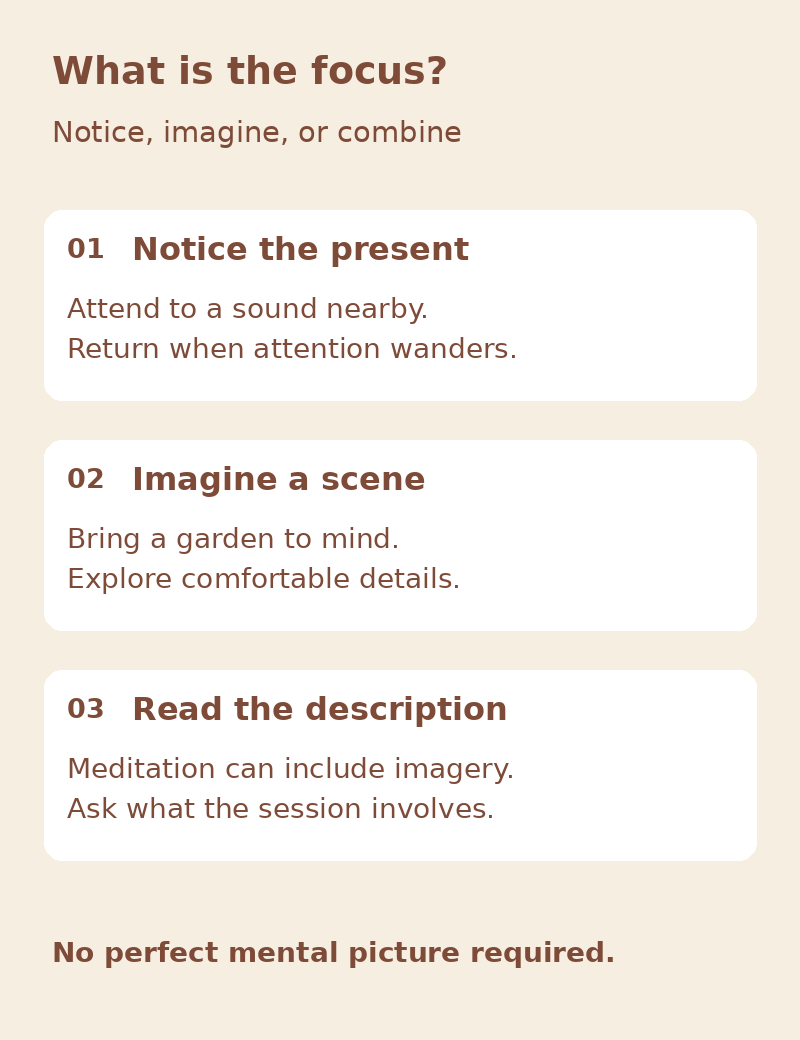
For a useful comparison, this article focuses mainly on present-moment attention practice. You might notice a sound, recognise that attention has wandered into a plan, and return to listening. You are not required to invent a scene or make thoughts disappear. Returning attention is part of the activity.
This scope matters because some meditation methods do use imagery. Cleveland Clinic lists visual-based meditation among its examples, including attention to something seen or to a mental image. Saying that all meditation excludes imagination would therefore create a false boundary.
What does visualization mean here?
Visualization deliberately brings an imagined scene, object or experience to mind. In wellness settings, a common example is guided imagery: a person or recording helps you imagine a place associated with ease. Cleveland Clinic describes building the scene through sensory details rather than merely naming a location.
The VA explains that guided imagery can involve an object, place or sound, and can be led by a trained professional, a recording or the person practising. The word imagery can therefore mean more than a vivid picture. A script may ask about sounds, warmth, texture or other imagined details as well as appearance.
This article is about that everyday relaxation context. It does not treat imagining success, rehearsing a sporting skill, spiritual imagery and clinical guided imagery as identical activities. Shared words do not make their aims, evidence or teaching methods interchangeable.
| Question | Attention practice | Guided imagery |
|---|---|---|
| Main task | Notice present experience | Bring a scene or experience to mind |
| Example | Listen to a sound nearby | Imagine a quiet garden |
| Mind drifts | Return to the chosen focus | Return to the guided scene |
| Picture needed? | No imagined picture required | May use several imagined senses |
| Overlap | Some meditations use images | Can be part of a meditation |
Noticing a garden is different from imagining one
Consider an ordinary example. You are sitting near an open window and hear leaves move. In an attention exercise, you might listen to that sound as it changes, without needing to decide what it means. The sound is part of your current surroundings.
In an imagery exercise, you might imagine walking into a garden: the colour of a path, the shade of a tree, or the feel of a bench. These details are intentionally brought to mind. You are working with an imagined setting, even though the real room is still around you.
Neither instruction is automatically more advanced. They ask for different actions. If a recording moves from listening to the room into imagining a landscape, it is changing the task. A clear teacher or script can make that transition explicit so you are not left wondering whether you missed something.
Do you need a clear mental picture?
It is easy to turn visualization into a picture-quality test: was the garden bright enough, detailed enough or convincing enough? That adds a requirement that many ordinary introductory scripts do not explain. You can ask the teacher what they mean by imagining rather than assume you must see an internal film.
The sensory prompts in Cleveland Clinic’s guide include hearing, scent and the feeling of a breeze. If visual detail does not come easily, ask whether a sound or another comfortable detail can be used instead. Or choose an attention practice that does not require constructing a scene at all.
There is no need to label yourself a failed meditator because one imagery exercise feels unclear. Meditation has many forms, and an imagined landscape is only one possible focus. It is reasonable to prefer an instruction you understand over one you keep trying to force.
Choose by instruction, not by the title of an app
A session called meditation may include a body scan, breathing exercise, visualization or several activities in sequence. A session called relaxation may also include focused attention. The label on a menu tells you less than a short description of what you will actually be asked to do.
Before starting, ask whether the exercise works with sensations already present or introduces an imagined scene. Ask whether you can keep your eyes open, change position or stop. If a script includes a beach, enclosed room or other setting that you dislike, you do not have to make yourself enjoy it.
For a first exploration, choosing a familiar, neutral instruction is a practical option. That is not a prescribed treatment or a required daily dose. The purpose is to understand the difference, not to manufacture a dramatic experience before deciding whether the format suits you.
Can visualization be a form of meditation?
Yes. NCCIH includes visual images among possible meditation focuses, and Cleveland Clinic describes visual-based meditation. A guided practice can use an image as something to return to when attention wanders. The use of imagination does not automatically place it outside meditation.
But the reverse is not true: meditation does not always require visualization. A sound-based practice or awareness of ordinary sensations can proceed without a deliberately imagined scene. It is more accurate to think of overlapping categories than two completely separate boxes.
A combined session also does not prove an extra benefit. If several methods are taught together, research on that programme cannot automatically identify which part produced an observed change. Enjoying a combination is a valid preference without needing to claim it is scientifically superior.
What does the evidence allow us to say?
NCCIH notes that much meditation research is preliminary or difficult to interpret because methods and measurements vary. Its relaxation-techniques review likewise discusses different activities in different circumstances. These sources do not establish one universal winner between every meditation and every imagery exercise.
The VA’s guided-imagery page describes an evidence map and studies in particular clinical settings. Memorial Sloan Kettering also discusses guided imagery as supportive care for symptoms and treatment experiences. Those contexts matter: an exercise used alongside medical care is not evidence that imagining wellness cures an illness.
Avoid treating a calm feeling as proof of a biological claim, or an unsettled session as proof that you are doing something wrong. This comparison does not promise changes to brain structure, immunity, pain or sleep. Such claims need evidence about a specific method, population and outcome, not the general word visualization.
When to pause or seek guidance
Inward-focused exercises can be uncomfortable for some people. NCCIH reports possible negative experiences with meditation and occasional anxiety or intrusive thoughts during relaxation techniques. If a session becomes distressing, stop rather than assuming that more effort is the solution.
Memorial Sloan Kettering advises caution with guided imagery for people with a history of trauma, abuse or mental illness, recommending work with a therapist to avoid potential triggers. A scene described as peaceful by someone else may not feel peaceful to you. You can decline the exercise without explaining private details to a group.
Do not use meditation or visualization to replace needed mental health or medical care. If you are seeking help for a health condition, discuss the approach with a qualified clinician. For the everyday distinction, our meditation guide and mindfulness comparison offer background. The simple takeaway is this: attention practice notices experience; visualization deliberately imagines experience; meditation can include either.