Laughter yoga combines deliberate laughter with breathing exercises and playful group activities. You do not need a joke, a comedy routine or a naturally bubbly personality to understand the idea. The laughter begins as an activity rather than as a response to something funny.
That can sound inviting, awkward or both. Before deciding whether to try it, it helps to separate three things: what a session involves, how comfortable you feel with the group, and what health research actually supports. Enjoying a class is not the same as receiving medical treatment.
This guide explains the method and the questions to ask before joining. It is not a breathing routine, a prescription to laugh for a set time or a substitute for professional care.
Where did laughter yoga begin?
The modern laughter yoga movement began with Madan Kataria in Mumbai. In his introductory booklet, Kataria describes starting a small laughter club in a public park. The group first used jokes and stories, then moved toward intentional laughter that did not depend on finding the same things funny.
The name reflects the combination of laughter exercises and yogic breathing. The central idea is that laughter can be invited through an activity, rather than left entirely to chance. A teacher may use playfulness and group interaction to help an initially acted laugh become spontaneous.
That history explains the format; it does not validate every health claim made about it. Promotional accounts sometimes describe simulated and spontaneous laughter as producing identical benefits. Treat that as a claim to examine, not a settled rule about every person or every outcome.
What happens in a laughter yoga session?
The founder’s guide describes clapping, breathing, playful interaction and laughter exercises. Healthline’s overview also mentions simple improvisation, movement and relaxation. A particular club may organize these differently, so ask for a description rather than expecting a fixed sequence.
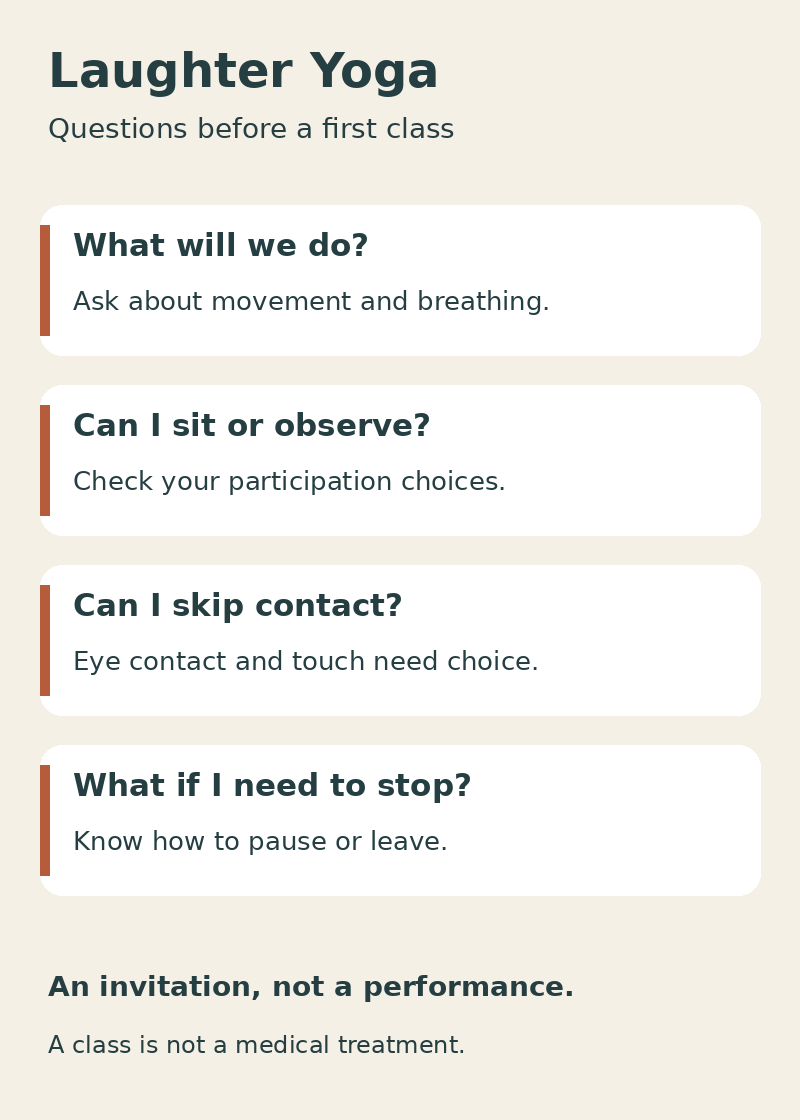
A leader might invite people to laugh while acting out an everyday situation. The purpose is participation, not telling the cleverest joke. There may be eye contact, sounds, gestures or a quiet ending. Those details matter if you prefer less noise, more personal space or the option to remain seated.
Do not assume that a lighthearted atmosphere means no physical effort. Repeated laughter and breathing exercises can feel demanding. Ask how the leader builds in pauses and what alternatives are available. You do not need to make the loudest sound or keep going for as long as someone else.
| Ask about | Useful detail to get |
|---|---|
| The activities | Whether the session includes standing, movement, breathing exercises or time on the floor. |
| Participation choices | Whether you can sit, watch first, take a break or leave out an activity. |
| Social boundaries | Whether eye contact, touch, partner work or being filmed is involved, and how to decline. |
| Health and stopping | How the leader handles discomfort and which concerns need advice from your healthcare professional. |
Is it comedy, meditation or a posture class?
Comedy usually offers something funny and lets laughter follow. Laughter yoga reverses that starting point: people begin laughing as an exercise without needing a punchline. A club should not depend on jokes at someone else’s expense.
Nor should you assume that a laughter yoga class contains a sequence of yoga postures. Its identity comes from the laughter-and-breathing approach. Check the actual movements and accessibility rather than judging the class from the word “yoga.”
Some sessions include a period called laughter meditation or finish with quiet relaxation. That does not make the whole session the same as a silent attention practice. If your main aim is stillness, ask how much of the class is active and social before choosing it.
What does the research suggest?
There are encouraging findings, but the type of evidence matters. A systematic review focused specifically on group-based laughter yoga in adults found six experimental studies with inconsistent results. Two showed short-term improvements in depressive symptoms, but the reviewers judged the overall evidence weak because of study quality and risk of bias.
The review did not establish that laughter yoga improves mental health more than other group activities. That distinction matters: a pleasant group experience, attention from a leader and time away from daily demands may all be relevant. An observed improvement does not, by itself, identify which ingredient caused it.
A separate review of laughter-inducing therapies also found promising results, alongside low study quality and substantial risk of bias. That broader category includes interventions using humor as well as simulated laughter. It should not be read as if every included study tested a standard laughter yoga class.
Another meta-analysis of randomized trials reported positive findings across several health-related outcomes, but the studies differed considerably. Only one study reported adverse events. Sparse reporting of harms is a reason for caution about what is known, not proof that an activity has no risks.
A more focused review in nurses and nursing students reported improvements in stress and several wellbeing measures. It included ten studies, most of them quasi-experimental, and called for more randomized trials and clearer protocols. Findings in a particular professional group do not establish that every community class has the same effects.
The practical conclusion is modest: you can consider a session as an optional recreational or wellbeing activity, but the evidence does not justify promising a cure, guaranteed mood change or replacement for treatment. Do not change medication or delay mental or physical healthcare because a class is advertised as therapeutic.
You do not have to perform happiness
The word “deliberate” describes how an exercise starts. It should not become an obligation to pretend that your life is easy. You can feel curious about the class while still being sad, tired or uncertain.
Cleveland Clinic’s discussion of laughter warns against using humor to avoid processing difficult feelings. That is useful context here, though its article is about laughter generally rather than a trial of laughter yoga. A social activity can sit alongside honest feelings; it does not need to cover them up.
Before joining, ask whether observing quietly is welcome. If a leader treats discomfort as a personal failure, pressures you to disclose private experiences or insists that everyone must feel joyful afterward, you can choose another setting. These are boundaries to look for, not a test of how outgoing you are.
Safety deserves more than a cheerful slogan
Laughter Yoga International’s own precautions say to stop if pain, discomfort or breathlessness occurs and seek medical advice. Its guidance also flags circumstances such as hernia, heart concerns, pregnancy, epilepsy and recovery from surgery as reasons to get individual advice before taking part.
That is not an exhaustive screening checklist. If you have a health condition, are pregnant or are recovering from a procedure, discuss the planned activity with your healthcare professional. Give them the class description rather than asking about “yoga” in the abstract. A club leader cannot replace individual medical guidance.
This introduction does not prescribe forceful breaths, breath-holding or prolonged laughter. Do not push through symptoms to finish a group exercise. Stop the activity if you feel unwell; severe difficulty breathing or a tight, heavy chest needs emergency medical help, not encouragement to laugh harder. Contact your local emergency service for those symptoms.
Also consider ordinary practical comfort. Ask about seating, steps, room ventilation, noise and access to a quiet space. A session that works for one participant may not fit another, even when both enjoy the basic idea.
How to decide whether a class fits
Start with a clear description and a leader who welcomes questions. Ask what training they have in laughter yoga, which activities are planned and how people opt out. A training certificate describes preparation for that method; it is not automatically a healthcare qualification.
You can also ask how the group handles consent for photographs or recordings. Agreeing to attend is not the same as agreeing to appear in promotional material. For an online class, check whether recording is enabled and whether keeping your camera off is allowed.
Afterward, a useful question is simply whether the setting and activities suited you. You do not need to decide that laughter yoga is either a miracle or a waste of time. A respectful, enjoyable session can be worthwhile on its own terms, without a medical promise attached.
Sources
- Madan Kataria: introductory guide to laughter yoga and its class elements
- Laughter Yoga International: precautions and medical advice
- Healthline: overview of laughing yoga
- Bressington and colleagues: review of group-based laughter yoga in adults
- Van der Wal and Kok: review of laughter-inducing therapies
- Stiwi and Rosendahl: meta-analysis of laughter-inducing interventions
- Cleveland Clinic: laughter and emotional wellbeing
- Erkin and Kocacal: review of laughter yoga in nurses and nursing students
- NHS: breathlessness and signs that need emergency help