Svaroopa Yoga is a named approach to hatha yoga developed by Swami Nirmalananda Saraswati, formerly known as Rama Berch. Its teaching emphasizes supported postures, a slower pace and what the method calls “core opening”: a progressive release of tension around the spine.
The phrase can be confusing if you expect an abdominal workout. Here, “core” points toward the spine and the method’s inward, spiritual focus, rather than a class built around crunches or planks. Blankets, chairs and other supports are part of how its teachers organize the practice.
This guide explains that vocabulary and what to ask before a first lesson. It does not teach a spinal treatment or a home sequence. Supported yoga can still require individual changes, especially when you have pain, an injury or a health condition.
Where does Svaroopa Yoga come from?
The founder’s own account describes developing variations of familiar yoga postures while teaching students. Svaroopa Vidya Ashram identifies Swami Nirmalananda Saraswati as its founder and spiritual head and describes its teaching in relation to Kashmiri Shaivism.
That background matters because Svaroopa is more specific than a general label for gentle yoga. It belongs to a particular teaching tradition with its own language, sequencing and training. Two classes can both use blankets without teaching the same method.
The founder explains the name as referring to one’s own Self or Divine Essence. This is the tradition’s spiritual explanation, not a medical description. You can understand where the name comes from without treating a spiritual belief as a measured physical result.
What does “core opening” mean?
Official teaching describes a sequence intended to release tensions associated with the spine, working progressively from the tailbone upward. In its own account, that physical emphasis supports an inward experience of stillness and awareness.
Read this as the method’s explanation of its practice. It does not mean that every back problem begins at the tailbone, that all bodies need the same sequence, or that a feeling during a pose confirms a change inside the spine.
Nor should the phrase be confused with core strengthening. If your aim is to build strength or meet a rehabilitation goal, ask whether the actual class addresses that aim. A quieter session may be worthwhile without doing the same job as a strengthening programme.
How are props used?
Descriptions of Svaroopa commonly mention folded or rolled blankets, chairs, blocks and head support. The intention is to provide enough support that the student is not struggling to hold the chosen position. The teacher pays attention to the arrangement, rather than treating a prop as an optional decoration.
A first-person account published by We Blog the World describes this emphasis as “Support = Opening = Release.” That is useful as a summary of the teaching approach, not as a guarantee that a particular stack of blankets will produce a particular result.
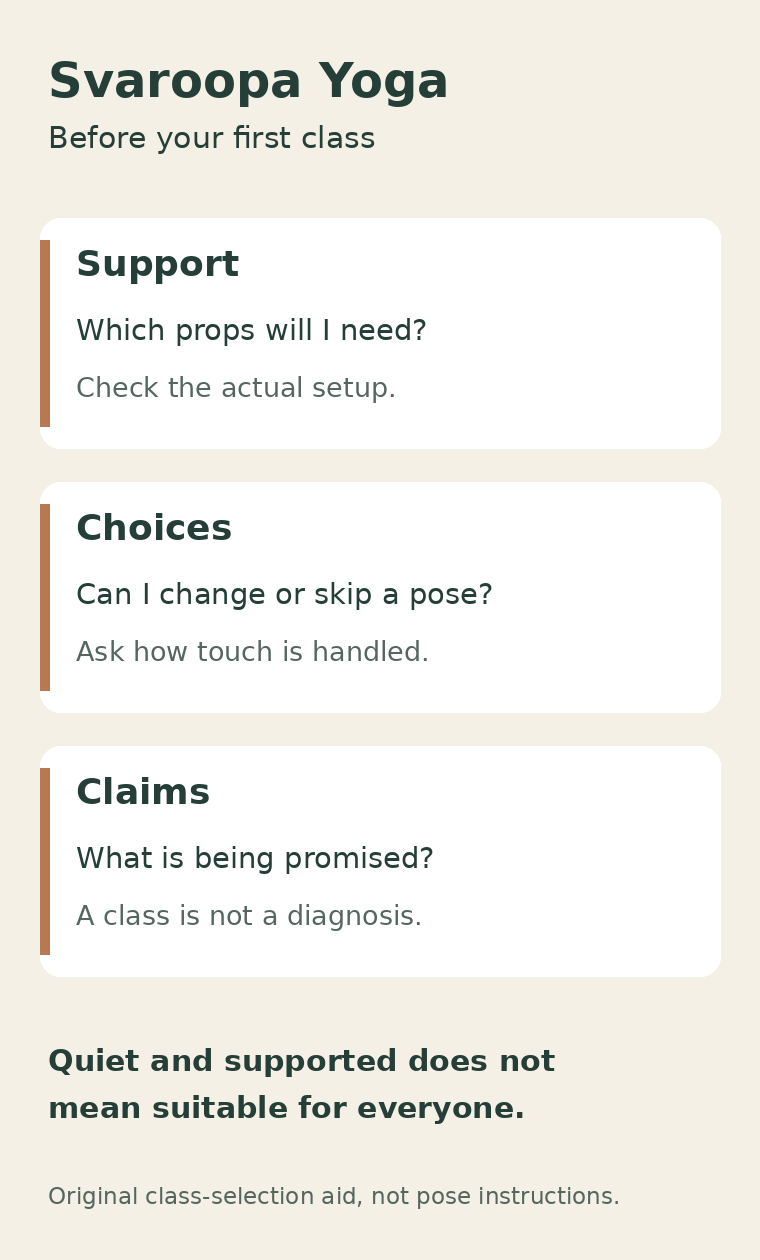
Ask which equipment the lesson needs and whether it is supplied. At home, a soft pillow, a dense folded blanket and a yoga block do not necessarily provide the same contact or height. Let the teacher explain acceptable substitutions instead of assuming that anything soft will work.
Our introduction to yoga props explains common equipment. For Svaroopa-specific arrangements, get instruction from someone trained in the method. A photograph cannot check whether your support is stable or whether the position suits you.
| Term | A practical question |
|---|---|
| Core opening | How does this differ from the strengthening or stretching I already do? |
| Support | Which props and substitutions are suitable for this lesson? |
| Spinal release | What should I do if a position causes pain or unfamiliar symptoms? |
| Adjustment | Can you explain the change verbally instead of using touch? |
| Inner awareness | Does the class include meditation, chanting or other spiritual practices? |
What might happen in a class?
Yogapedia describes classes that begin with relaxation in Savasana, include breathing work and move through supported variations of familiar postures. The We Blog the World account describes relaxation at both the beginning and the end, with a theme connecting the lesson.
These accounts explain common features, not a fixed timetable for every teacher. Ask how much of the session involves lying down, sitting, kneeling or standing. A class can move slowly while still asking you to change levels or bear weight in a way that is difficult for you.
You may also encounter a repeated position used to notice how the session feels before and after. Treat that as an observation, not a test you must pass. Greater range is not the only possible observation, and reaching farther does not by itself establish that a movement was suitable.
What should you check for an online lesson?
Ask whether the session is live and whether the teacher can see your setup. A recording cannot notice that a chair moves, a blanket slips or a transition is difficult. Have enough clear space to enter and leave positions without rushing, and ask for help before trying an unfamiliar arrangement.
Also check whether the session is mainly posture practice or includes a wider spiritual programme. The ashram offers meditation as well as yoga classes, so a programme name alone may not tell you its content. Decide what you want to take part in before the lesson begins.
What is the “Magic Four”?
A teaching article by the founder in Yoga International introduces a group of foundational postures called the Magic Four. The name belongs to the method’s teaching material; it does not mean that four positions are a universal answer to back pain.
The important point for a newcomer is that order, support and the way a posture is taught are part of the method. Remembering four pose names is not the same as learning the practice. A familiar-looking lunge or twist may be set up differently from one you have tried elsewhere.
Learn the relevant versions with a teacher rather than combining online descriptions into a self-prescribed spinal routine. There is no need to force a forward bend, a twist or a breathing exercise to make a named sequence “work.”
Is it the same as restorative yoga?
No. There can be overlap in props, a quiet setting and supported positions. Svaroopa is a named method with a particular spine-focused explanation and spiritual background. Restorative yoga is generally associated with resting in supported postures.
If you mainly want comfortable rest, read the class description rather than choosing by its photograph. Our restorative yoga guide discusses that separate approach. Ask whether a Svaroopa session includes sustained holds, movement between positions, individual adjustments or breathing instruction.
You do not have to rank one approach above the other. The more useful comparison is between what the lesson asks of you and what you want from it. Shared equipment does not make two practices interchangeable.
Touch and breathing should remain choices
Hands-on adjustments feature in published descriptions of Svaroopa. Before class, ask how the teacher seeks permission and whether verbal guidance or a different position is available. You can decline touch or change your mind without having to defend that choice.
A teacher’s intention to help you release tension is not a reason to endure pain, pressure or distress. Stop and speak up if assistance feels wrong. Likewise, you do not need to produce a particular sensation or emotional response to show that you are learning.
Breathing instruction needs its own introduction. Keep breathing comfortable, and ask for an ordinary-breathing alternative if a technique feels difficult. NCCIH advises yoga beginners to avoid forceful breathing. Do not add breath holds or increased force to a written overview of this method.
Keep health claims separate from class descriptions
Svaroopa materials use phrases such as “spinal decompression” and sometimes make strong promises about pain. Those are claims to evaluate, not a diagnosis or a result this guide can promise. Feeling relaxed after a lesson does not establish why your back hurts or whether an underlying condition has changed.
NCCIH explains that research uses many different styles of yoga, which makes results difficult to compare. Evidence about yoga in general should not be presented as proof that a particular Svaroopa sequence treats a spinal condition.
A systematic review of randomized yoga trials also noted the need for better reporting of safety data. Neither a gentle label nor the presence of props establishes that an activity is risk-free. Ask for evidence relevant to the actual method and condition when a provider proposes a therapeutic result.
How to decide whether to try a lesson
Look for a teacher who can describe the class plainly: the positions involved, required equipment, options for changing or leaving out a pose, and how touch is handled. Ask about training in this particular method, rather than assuming that general yoga experience means the same thing.
If you are pregnant, have an injury or have a health condition, discuss your needs with an appropriate health professional and the instructor. NCCIH notes that conditions including lumbar spine disease, balance difficulties and severe high blood pressure may call for changes. A general class is not a substitute for individual assessment.
Interest in a slower, supported and inward-focused practice is a reasonable starting point. Expect clear instruction and room to choose, not a promise that your spine will be fixed. The best first conversation makes both the practice and its limits easier to understand.
Sources
- Svaroopa: the founder’s account of the method and its name
- Svaroopa Vidya Ashram: teaching background
- SVA Blog: the method’s explanation of spinal release
- Yogapedia: Svaroopa terminology and class features
- We Blog the World: a practitioner’s class account
- Yoga International: the founder on the Magic Four
- NCCIH: yoga evidence and safety
- Cramer and colleagues: systematic review of yoga safety