Scaravelli yoga usually means yoga inspired by Vanda Scaravelli, whose teaching explored the relationship between gravity, breathing and the spine. It is less a fixed system of poses than an approach to discovering how movement can become more attentive and less forced.
The word inspired matters. Accounts of Scaravelli’s teaching emphasize that she did not want her work organized into a rigid method. Teachers influenced by her may share important interests while offering quite different lessons.
If you are curious about this approach, start with its attitude toward movement rather than trying to reproduce a special spinal wave. The useful questions are how a teacher introduces the work, what support is available and whether the practice respects your needs.
Who was Vanda Scaravelli?
Scaravelli studied with B.K.S. Iyengar and T.K.V. Desikachar before developing her own exploration of yoga. Accounts published by Yoga International and on Diane Long’s website describe her as beginning yoga in midlife and later teaching a small number of students individually.
Her book Awakening the Spine is an important written source for the approach. Its publisher describes an emphasis on working with the body rather than against it, using breath, grounding and gravity. The book can offer context, but photographs of advanced postures are not a beginner’s practice plan.
Long, one of her long-term students, stresses that Scaravelli’s teaching cannot simply be reduced to a technique. The Inner Yoga Trust also uses the term Scaravelli-inspired to acknowledge influence without suggesting a single standardized sequence.
That background helps explain why two teachers may use the same label without teaching the same class. Ask about their own study and approach rather than assuming the name refers to a uniform syllabus or guaranteed experience.
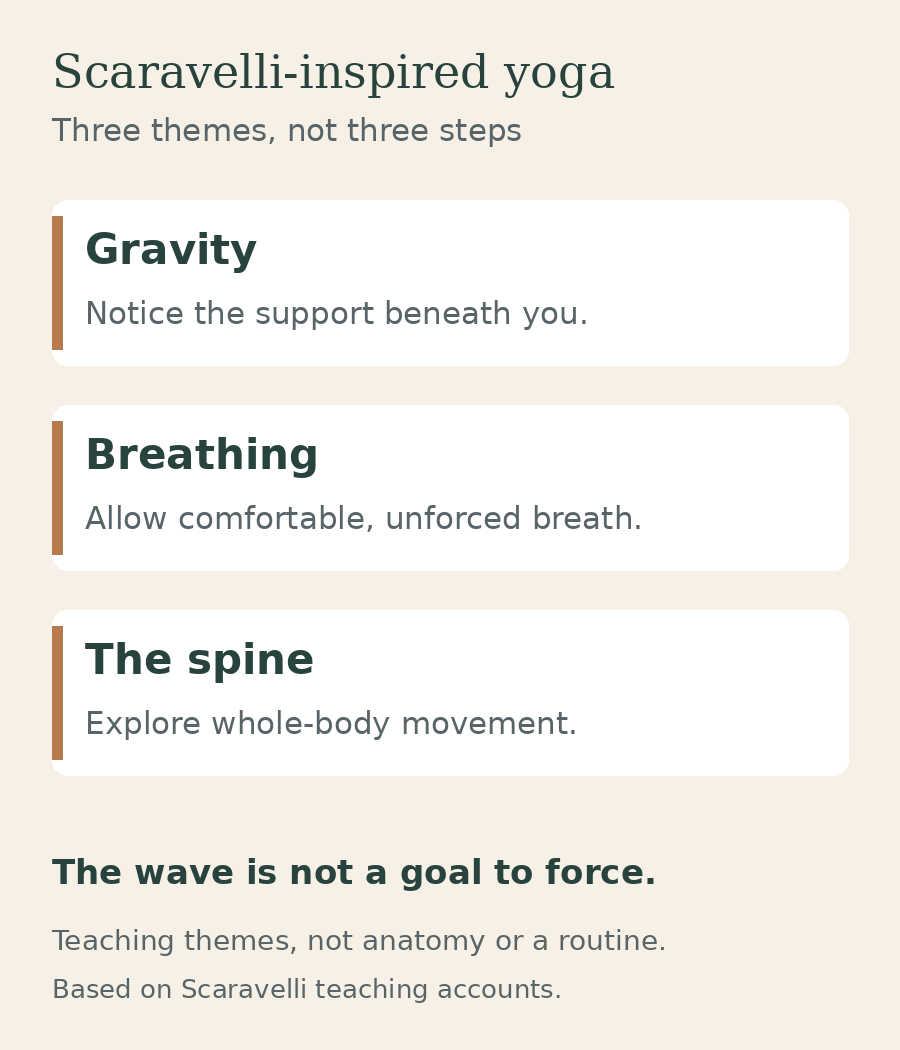
Gravity, breath and the spine
These are the recurring themes in descriptions of Scaravelli’s work. Teachers invite attention to the support beneath the body, the way breathing happens and the relationship between the spine and the rest of a movement.
In this teaching language, grounding is not an instruction to become heavy or press down as hard as possible. Diane Long’s account specifically warns against an overemphasis on grounding that misses the lightness of the movement. It is an exploration of support, not a strength test.
Similarly, attention to the spine does not mean trying to move each vertebra separately or forcing an exaggerated curve. The teacher may use images to direct attention, but an image is not a complete anatomical explanation.
You can explore the quality of a familiar movement without chasing a new shape. Notice whether you are unnecessarily gripping, whether you can breathe comfortably and whether a smaller version is easier to understand. Qualified instruction helps turn those observations into appropriate choices.
| Term | What to clarify |
|---|---|
| Grounding | How to notice support without pushing down or becoming rigid. |
| Undoing | Which effort can be reduced while keeping enough support to move. |
| Wave | What the image means, without trying to force a spinal ripple. |
| Breath awareness | How to observe breathing comfortably, with no need to deepen or hold it. |
These are questions for a lesson, not a set of movements to practise in order.
What does undoing mean?
Undoing is a word often associated with Scaravelli’s teaching. It refers to investigating unnecessary tension and habitual effort rather than adding more force to achieve a pose. It is an attentive process, not simply collapsing into a position.
Nan Wishner’s account on Diane Long’s website describes relaxation as alert rather than passive. That distinction is useful: you remain able to notice, respond and choose. A posture should not become something you endure while waiting for a promised release.
Doing less may mean reducing the range, pausing or changing the position. It does not mean abandoning all muscular support. If an instruction leaves you unstable, confused or uncomfortable, ask the teacher to explain what they intend.
There is no need to manufacture a sensation of lightness. A quiet, ordinary observation can be enough to learn from. The practice is not improved by pretending that an evocative phrase has produced a dramatic experience.
The wave is not a movement to force
Descriptions of Scaravelli’s work sometimes refer to a wave through the spine. This image can be appealing, but it is easily misunderstood if treated as a special motion that everyone must create.
In Wishner’s account, Diane Long describes the wave as a consequence of the conditions for whole-body movement, rather than an effect to strive for. That is a strong reason not to imitate a large undulation or repeatedly bend the back in search of the right feeling.
Ask a teacher to explain the image in the context of a simple, suitable movement. You should still be able to understand what you are being asked to do physically. If a metaphor remains unclear, a plain explanation or a different option is reasonable.
A useful lesson does not require everyone to experience the same thing. Your movement may remain small, and your understanding may develop slowly. Neither is a reason to push further than is comfortable.
Breathing without turning it into a performance
Accounts of the teaching emphasize becoming familiar with the breath as it is rather than immediately imposing an elaborate exercise. This interest in receptivity is part of the approach’s character.
It does not require taking the deepest possible breath or trying to coordinate every motion perfectly. If breathing becomes strained, stop the technique and return to comfortable breathing. Dizziness or difficulty breathing is not a sign that you should continue.
Some teachers may include more formal breathing practices, while others place more emphasis on observation. Ask what is involved before joining, particularly if you have a respiratory condition or have found breath-focused exercises uncomfortable in the past.
What might a class feel like?
You may encounter familiar hatha yoga postures approached through small explorations, pauses and images rather than a rapid sequence. Attention may return repeatedly to how a movement begins or how the body meets the floor.
That is a broad description, not a fixed lesson format. Teacher Catherine Annis describes her Scaravelli-inspired work as gentle yet demanding. A slower class can require concentration and physical effort, so the pace alone does not tell you whether it suits you.
Ask whether the lesson is introductory and how much standing, seated or floor-based work it contains. Find out whether alternatives and props are available. A clear description of the actual class is more helpful than a promise that it works for everyone.
For an online lesson, check what space and equipment you need beforehand. Arrange the screen so you can follow the teacher without repeatedly turning during movement. A practice about careful attention is easier to explore when the setup is simple.
Is it suitable for beginners?
Beginners can look for teachers who explain the approach through accessible movements and clear options. You do not need advanced flexibility or knowledge of Scaravelli’s book to ask questions and begin learning.
At the same time, a subtle teaching style can be unfamiliar. Tell the teacher whether you are new to all yoga or only to this approach. Ask them to connect an image with an understandable action instead of feeling obliged to guess.
Experienced students may also need to begin simply. Familiarity with achieving a posture does not automatically make an unfamiliar way of exploring it obvious. Treating the class as investigation rather than performance can make that adjustment easier.
Images, touch and personal choice
Scaravelli’s teaching accounts include natural imagery and individual hands-on work. Modern classes may use either, both or neither. The history does not tell you what will happen in a particular lesson.
Ask about physical assistance before it occurs. You can request verbal guidance, decline touch or change your mind. A teacher’s confidence in a movement is not a reason to give up your own judgment about comfort or consent.
You can also decline an image that does not make sense to you. Asking for a clearer explanation is part of learning. An exploratory approach should make room for uncertainty without treating questions as resistance.
Why teachers may teach differently
Monica Voss, writing for Esther Myers Yoga Studio, recalls that Scaravelli did not want her name used to describe a method. Voss explains that she and other teachers took the breath, gravity and the spine as starting points while continuing to develop their own work.
That account helps explain why a teacher may use Scaravelli-inspired rather than promise a single authorized routine. It does not mean every interpretation is equally clear or suitable. Ask how the teacher learned the approach and how they explain an unfamiliar cue to a new student.
The broader term somatic yoga also emphasizes experience from within, but it does not identify this particular teaching history. Shared attention to sensation is not enough to make two class labels interchangeable.
Choosing between classes
When comparing two teachers, ask how they introduce a new student to the work. One may spend a lesson exploring a small movement, while another uses several familiar postures. Neither format is automatically more faithful to Scaravelli. Look for an explanation of the purpose, opportunities to ask questions and choices that fit your needs.
After a first lesson, consider whether the cues became clearer and whether you felt able to rest or ask for another option. Those practical details are better guides to continuing than whether the class looked unusual or produced a memorable sensation.
Health claims need care
Some accounts include striking stories about Scaravelli’s health or abilities. Those stories are not evidence that this approach heals injuries, guarantees spinal flexibility or makes medical care unnecessary. A person’s biography cannot establish a treatment effect.
The National Center for Complementary and Integrative Health notes that yoga research covers many different styles and methods. General findings cannot prove a particular health benefit from Scaravelli-inspired teaching or show that it is superior to another approach.
Existing injuries, pregnancy, glaucoma, balance difficulties and other health conditions may require modifications or professional advice. Beginners should avoid extreme postures and forceful breathing. Stop for pain, dizziness or difficulty breathing, and seek appropriate care for concerning symptoms.
Scaravelli-inspired yoga offers a way to question unnecessary effort while staying attentive to movement. Choose clear instruction, maintain your boundaries and leave the dramatic shapes to one side. The point is to discover a workable relationship with your own body, not to reproduce someone else’s photograph or experience.
Sources
- Diane Long: account of Scaravelli teaching and the wave
- Yoga International: legacy and teaching context
- Inner Yoga Trust: Scaravelli-inspired terminology
- Catherine Annis: gentle yet demanding practice
- Publisher: Awakening the Spine
- Monica Voss: evolving teaching rather than a fixed method
- NCCIH: yoga evidence and safety