Yoga without wrist loading means leaving out positions where the hands carry body weight. It does not mean that every movement of the arms is forbidden, or that a class labelled “hands-free” will suit every wrist problem.
The useful task is to check the whole practice: the poses, the way you change position, any gripping and the way you finish. A sequence can contain no Plank and still ask you to push off the floor to stand up.
Decide what you need to avoid
There are several different demands on the hands and wrists. Being clear about them helps a teacher offer the right option.
- Body-weight support: pressing into the floor, a wall or a chair through the hands.
- Gripping: holding a foot, pulling a strap or squeezing a support.
- Wrist position: bending the wrist into a position that may be uncomfortable even without much weight.
- Unexpected support: using a hand to catch a wobble or push up during a transition.
This guide addresses the first demand, while asking you to check the others. If a clinician has restricted hand use, follow that specific advice. Do not translate “no weight bearing” into permission for forceful gripping, and do not assume a brace makes a pose suitable.
Audit familiar substitutions
A wall Plank still loads the hands. A chair-supported Downward Dog still uses hand support. These arrangements may change the task, but they are not no-load choices simply because the hands are higher.
Making fists also leaves the hands supporting body weight. Moving onto the forearms changes the contact, not the total task: Dolphin and Forearm Plank still ask for substantial upper-body support. They are separate poses, not automatic resting positions for everyone who wants to avoid wrist loading.
If you want a practice without leaning on the hands, choose positions that meet that condition from the start instead of replacing every palm-supported pose with a harder forearm version.
A short standing practice without hand support
The following is an optional movement outline, not a treatment or a test. Use it only if standing and these movements are already manageable without needing your hands for balance. There is no fixed hold to endure. Keep breathing ordinary, pause between movements and stop before fatigue makes support uncertain.
- Start in Mountain: stand on a firm, nonslip surface with both feet comfortably spaced. Let the arms hang and the fingers soften. Notice whether you can stand steadily before adding movement.
- Explore an arm raise: lift one or both arms only as high as comfortable, then lower slowly. There is no need to clasp the hands, press the palms together or reach overhead.
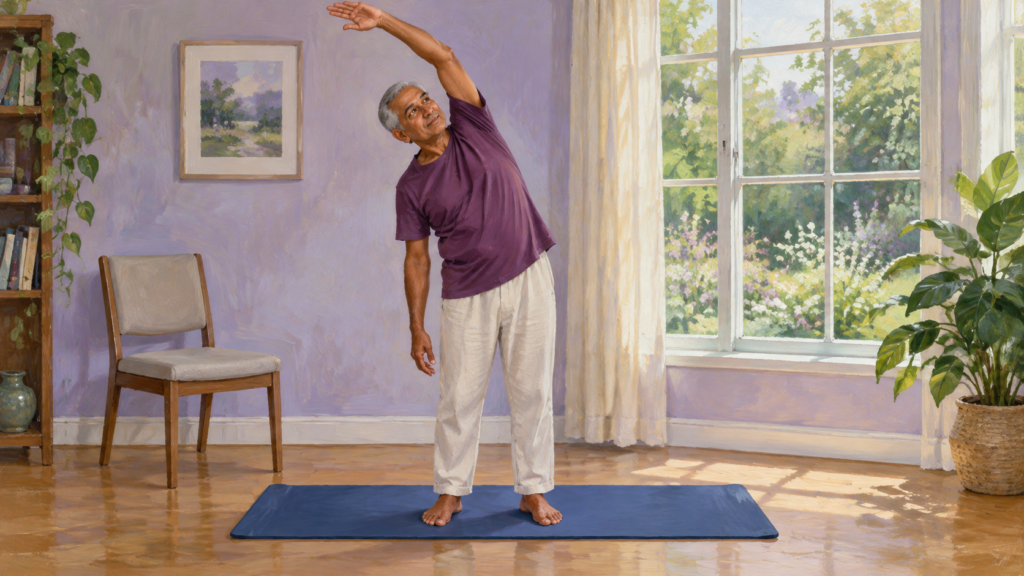
- Try a small side bend: keep both feet grounded, leave the lower arm relaxed and lean a little sideways. Return upright before changing sides. Keep the raised arm lower if that suits the shoulder. Do not pull one wrist with the other hand.
- Choose an optional shallow Chair Pose: make a small knee bend with the hips moving back a little, only if you can return to standing without pushing through the hands. Keep the arms easy. Skip this step if balance or knee comfort changes.
- Finish upright: return to a comfortable standing position and let the arms rest. End there rather than adding a floor rest automatically.
Repeat a comfortable movement if you wish, or finish after one pass. More depth, a long hold and linked movements are not required. This outline deliberately leaves out single-leg balances, deep forward folds and fast changes of direction.
If standing needs hand support, change the plan
Do not remove a needed chair or wall contact just to make the practice hands-free. That exchanges one problem for another. A suitable seated practice may be a better starting point, with the hands resting rather than pressing or gripping.
Use a stable chair without wheels and arrange supported feet. A teacher can help choose modest arm movements or side bends that do not require pulling on the chair. If getting into or out of the seat needs hand support that conflicts with your restrictions, ask for an individual plan before starting.
Our chair-versus-wall guide discusses what the contacts actually provide. Neither prop is medical clearance or a guarantee against losing balance.
Check transitions before choosing floor poses
Reclining or seated poses may place little weight through the hands once you arrive. Getting there can be different. Rolling up, arranging a bolster, pushing from the floor and standing again may all require hand use.
Do not turn a no-wrist-loading practice into a challenge to stand up from crossed legs without hands. If you do not already have a dependable route that meets your restrictions, remain at a suitable standing or seated level. The floor-transfer guide explains why the return route is a separate decision, not an entry requirement for yoga.
When a different practice is not the next step
This is general education, not diagnosis, rehabilitation or permission to exercise through an injury. Ask your healthcare professional and qualified teacher about pain, recent surgery, an injury, pregnancy or health conditions that affect movement. A wrist-free label does not assess the rest of your body.
Stop for pain, tingling, numbness, dizziness or unusual breathlessness. Get medical advice for persistent or recurring symptoms. Severe wrist pain, loss of feeling, a changed wrist shape or colour, or inability to move the wrist or hold things needs urgent assessment through the appropriate local health service. Do not use a yoga variation to test a possible injury.
A useful practice can be small and still include choices. Keep the support you need, leave out the demands you need to avoid and tell the teacher when those two requirements conflict.
For other pose choices, browse the yoga pose library. Choose practices appropriate to your needs rather than treating the list as a required routine.
Sources and further reading
- Yoga Journal: 15-Minute Hands-Free Yoga, for standing and seated alternatives and its acknowledgement that transitions may use the arms. This guide does not adopt the hands-free floor-rise challenge or deep squat.
- Di Hickman: Standing wrist-free sequence, for the option to remain standing. Its stronger lunges and twisting sequence are not reproduced here.
- Five Parks Yoga: Wrist-free classes, for the distinction between omitting hand-loaded poses and choosing an appropriate class level.
- NHS: Wrist pain, for symptoms that need medical or urgent assessment, not a yoga treatment plan.
- NCCIH: Yoga, effectiveness and safety, for qualified instruction and individual modifications.