Standing yoga poses share a starting point, not a single task. Mountain, Chair, Warrior II, Triangle and Tree all involve the feet, but they ask for different arrangements of the legs, different amounts of balance and different ways of supporting the torso.
Instead of choosing a pose by how impressive the arms look, start with the stance. Decide what you want to explore and what contact you need before adding a deeper bend, a reach or a transition.
Separate the base from the movement
A standing pose can ask you to bend both knees, move into a split stance, hinge forward, turn the torso or stand mainly on one leg. Those demands can overlap. A lunge still involves balance even with two feet touching the floor; a standing fold may use the hands for substantial support.
Labels such as strengthening, balancing and stretching are useful starting points, not sealed categories. Ask a more specific question: what is changing underneath me, and can I manage that change without losing the support I need?
Both feet roughly beside each other
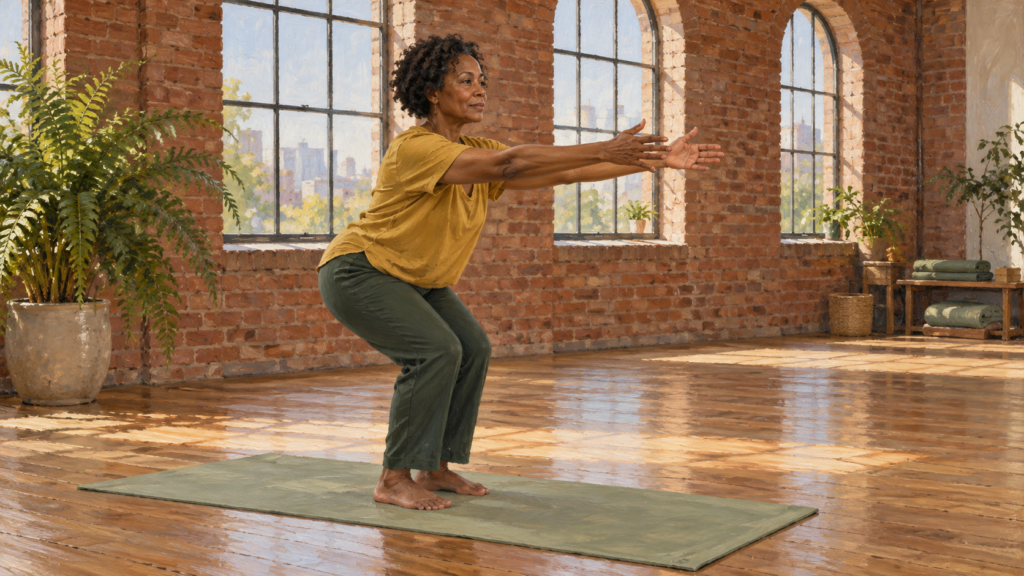
Mountain gives you an upright place to assess comfortable standing. Chair adds knee and hip bending without requiring a long step. A standing side bend changes the torso position while both feet can remain grounded.
These poses are not interchangeable just because the feet look similar. A shallow Chair may involve more leg effort than a brief upright pause. A side reach can change how steady you feel even when the feet do not move.
Do not treat feet-together standing as a rule for every body or practice. Teaching references show both together and comfortably separated feet in Mountain and Chair. Use the arrangement that suits the pose and your needs with appropriate guidance, not a narrow stance chosen only to match a photograph.
A split stance changes several choices at once
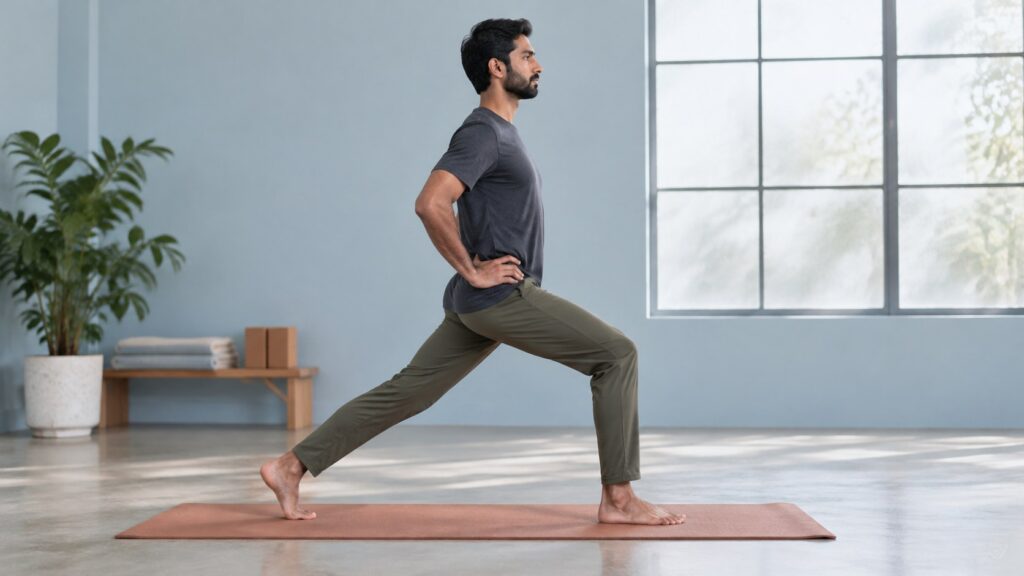
Warrior I, Warrior II and Crescent Lunge place one foot forward and the other behind, but they do not use an identical back-foot or torso arrangement. Copying the arm position while leaving the feet in another pose’s setup can make the task confusing.
Before reaching the arms up or out, learn the foot positions and direction of the torso. Stance length, side-to-side spacing, heel contact and front-knee bend are separate variables. There is no need to maximise all of them.
A shorter stance or smaller knee bend may be a useful adaptation, but it still needs to suit the actual pose. Do not force the hips toward the front while keeping a foot trapped in an uncomfortable direction. Return to a manageable upright position before resetting the feet rather than twisting over a fixed knee.
Wide stance does not mean unlimited depth
Triangle and a wide-legged forward fold use a broad base, but the torso and hand support differ. A wide stance can still feel uncertain if the feet slide, the reach is too far or getting back up is difficult.
Choose the hand support before chasing the floor. A suitably placed block or other teacher-selected support changes the reach. It does not require you to widen the feet until the hand can land lower. Keep the support stable and within a comfortable range.
Likewise, bent-knee wide stances such as Goddess are not simply wide-legged folds with the chest lifted. Knee bend, foot direction and the route back to upright are part of that separate task. A deeper squat is not a required finish to a standing practice.
One-leg poses are an optional branch
Tree, Warrior III and Standing Split change the base again. The lifted leg’s height is only one detail; the supporting leg, torso position, hand contact and way you return all matter.
Do not use a high leg as evidence that you are ready to remove a hand support. If a teacher gives you a low-foot Tree option or a supported balance, keep that arrangement as long as it is useful. There is no requirement to include a one-leg pose in every session.
Balance difficulties, dizziness or a recent fall call for individual advice, not a harder version chosen to prove confidence. The NHS balance-exercise guide uses nearby stable support in its own routine. That supports planning the environment, not the idea that a wall makes every yoga balance suitable.
Plan a standing practice without collecting every category
Use a small selection of familiar poses that serve different purposes. For example, you might choose an upright pause and a modest knee-bending pose, or a split-stance exploration followed by a supported reach. These are planning examples, not a compulsory sequence.
- Name the task: leg effort, a torso movement, a supported stretch or a balance exploration.
- Choose the base: feet beside each other, a split stance, a wide stance or a supported one-leg position.
- Arrange contact: decide whether the hands need a stable support and whether you can use it comfortably.
- Choose a return: know how you will come back to a steady position before starting.
- Keep room to stop: fewer poses with pauses can be more workable than a long linked flow.
Changing from one stance to another is its own movement. You can step back to a comfortable upright position, pause and reset. You do not need to swivel the feet quickly or follow the next pose before you are ready.
Standing is a choice, not an entry requirement
If standing is not comfortable or appropriate, a suitable seated practice is a valid alternative. If your aim is to avoid kneeling or wrist loading, check the transitions as well as the finished poses: a standing sequence can still include a hand-supported fold or a floor-level change.
This is general education, not medical advice or a fall-prevention programme. Ask a healthcare professional and qualified teacher about an injury, recent surgery, pregnancy, a relevant health condition or balance concerns. Stop for pain, numbness, dizziness or unusual breathlessness, and seek advice for persistent, recurrent or concerning symptoms.
Build the practice around support and a clear movement choice. A low arm, a smaller stance and a pause between poses are options, not signs that the pose is incomplete.
For other pose choices, browse the yoga pose library. Choose practices appropriate to your needs rather than treating the list as a required routine.
Sources and further reading
- NC State University: Standing poses, for the different foot, leg and torso arrangements across named poses. Its fixed-angle, deep-bend and binding instructions are not prescribed here.
- SELF: Standing yoga poses, for teacher commentary on overlapping strengthening, balancing and lengthening tasks. Treatment, injury-prevention and digestion claims are not adopted here.
- Yoga Journal: Balancing poses, for examples of the separate one-leg branch, not a progression through advanced balances.
- Runners Love Yoga: Essential standing poses, for examples of stance and arm choices. This guide does not adopt a universal hip angle or claim that one setup suits every knee.
- NHS: Balance exercises, for stable support and controlled movement within its own exercise routine.
- NCCIH: Yoga, effectiveness and safety, for qualified instruction and individual modifications.