A backbend is not defined by how far the head travels behind the body. Yoga poses in this family use different starting positions, support points and sources of effort. A low chest lift, a forearm-supported pose and a backbend over a prop may look similar while asking different things of you.
Choose by the demands you can manage, not by a ladder from “small” to “complete.” This guide compares those demands. It is not a sequence to work toward Wheel or instructions for deep backbending.
Ask what creates the shape
Three useful questions cut across the usual pose names:
- Are you lifting part of the body with muscular effort?
- Are the arms, a grip or contact with the floor helping maintain the curve?
- Is an external prop holding you in a position that you must be able to leave?
These are not sealed categories. A single pose may involve several kinds of support. They help you notice what is happening instead of assuming that a larger curve is stronger, more restful or more useful.
David Keil’s backbending discussion also separates poses by their relationship to the floor and by whether the practice involves a held shape or dynamic movement. Dynamic dropbacks are a different task, not a required part of learning an ordinary supported backbend.
Active lifting: small can still involve effort
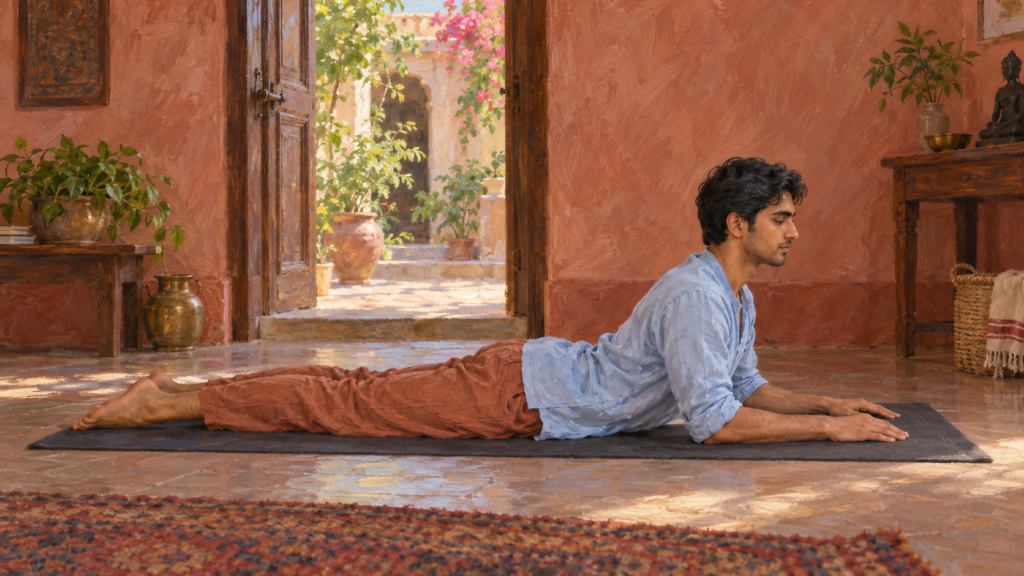
In a modest Cobra or Locust variation, the chest may rise only a little while much of the lower body stays on the floor. A small distance does not mean nothing is happening. You still need to manage the lift, head position, breathing and controlled lowering.
The hands can have different jobs. In a low Cobra they may provide light contact; pushing strongly through them can change how high the torso rises. In some Locust variations the arms remain beside the body instead of propping up the chest.
Choose the version you can lower from comfortably. There is no need to lift the arms, chest and both legs together just because a demonstration does. If lying on the front is itself uncomfortable or inappropriate, do not use a higher chest lift to try to solve that starting problem.
Forearm support: a different contact, not a guarantee
Sphinx uses forearms on the floor to support a lifted chest. That can change the hand and wrist demand, but it does not remove the backbend or the work of the shoulders and neck.
The support may let you remain in a curve that you would not hold using back-muscle effort alone. That is why “supported” and “small” are not enough to decide whether it suits you. Do not press the chest higher or drop the head back to make the shape look finished.
When learning, ask which parts should remain supported and how to lower. Keep the movement modest and stop for pinching or pain rather than repeatedly shifting the elbows to investigate a symptom.
Face-up lifting: the base changes again
Bridge starts face up, with the feet planted, and the pelvis lifts while the upper body remains partly supported. The starting orientation differs from Cobra, and so do the supporting contacts. A familiar floor position does not make the active lift equivalent to resting on the back.
Reverse Plank has another support pattern, including the hands behind the body. The shoulder reach and hand loading matter separately from the backbend. Do not choose it as an automatic substitute for a prone pose merely because the front of the body faces upward.
Bridge is not incomplete Wheel. Wheel adds a different hand position, overhead shoulder movement and a substantially different lift. Comfort in one pose does not establish readiness for the other.
Kneeling and standing add their own requirements
A kneeling backbend asks for a comfortable knee and ankle arrangement before adding the torso movement. Camel also changes how you manage the weight of the upper body. Reaching a heel is an additional demand, not a compulsory correction.
A standing chest-opening movement removes knee contact with the floor but adds the need to remain steady on the feet. Moving the chest or head back can change that steadiness. It is not automatically a safer replacement simply because you are not kneeling.
If kneeling, standing balance or a backward reach is unsuitable, ask for another arrangement rather than transferring the same depth into a different base. A chair-seated option may be useful for some people, but it needs its own teaching and stable setup.
Grips and straps can increase leverage
Holding a foot in Bow or Dancer changes how the limbs interact with the torso. A strap can bridge a reach gap, but it can also become a way to pull into more range. The presence of a strap does not prove that a pose has become gentle.
Leave stronger grips, overhead foot holds and demanding combinations of balance and backbending to individual instruction. You do not need to add a bind to make a backbend count. If reaching for the foot creates strain, omitting the reach is a real choice.
Prop-supported does not mean symptom-free
A restorative backbend can reduce the effort of holding the body up. The position still places parts of the body in a curve. Prop height, head support, the arm arrangement and the way you enter and leave all matter.
Ask a qualified teacher to show the exact setup. Do not slide a hard object under the waist or copy an approximate block location from a photograph. This guide does not prescribe a block position, blanket height or long hold.
If a prop arrangement causes pain, numbness, tingling or restricted breathing, leave the position instead of waiting for gravity to deepen it. More equipment is not always more support.
A practical selection check
- Choose an appropriate starting position. Can you comfortably lie on the front or back, kneel, sit or stand, and return from that level?
- Identify the additional demand. Is it a chest lift, pelvic lift, hand-supported hold, backward reach or supported rest?
- Separate the variables. Arm position, leg movement, head position and depth do not all need to change together.
- Know the return. Keep enough energy to lower or come upright with control. Do not rely on momentum or someone pushing you deeper.
- Choose whether to continue. You can pause or finish without adding a deeper backbend or a strong opposite movement.
These choices do not guarantee that a pose is suitable. They make the questions clearer when you work with a teacher. A backbend can stay low, brief and unbound; it can also be left out.
Symptoms and medical limits are separate from flexibility
This is general education, not treatment for back pain, a posture condition or an emotional problem. Research about yoga programmes does not establish a specific result from one backbend.
Ask your healthcare professional and qualified teacher about injury, recent surgery, pregnancy, spinal or joint conditions and other restrictions. A medical limit is not a flexibility challenge to work around.
Stop for pain, pinching, numbness, tingling, dizziness or unusual breathlessness. Seek advice for persistent, recurring or concerning symptoms. Ordinary breathing is useful to notice, but being able to breathe is not proof that a position is appropriate.
For other pose choices, browse the yoga pose library. Choose practices appropriate to your needs rather than treating the list as a required routine.
Sources and further reading
- Yoga Journal: Types of Yoga Backbends, for active, assisted, bound and prop-supported distinctions. Its universal safety, treatment and maximal-benefit claims are not adopted.
- Yoga International: Making Backbends Accessible, by Jivana Heyman, for different starting positions and support choices. Its clinical, digestion and emotional-release claims are not adopted.
- Yoganatomy: Backbending in Yoga, by David Keil, for floor relationships, dynamic movement as a separate task and the risk of forcing depth. Advanced techniques and universal muscle cues are not prescribed here.
- Yoga Journal: Gentle Backbend Options, by Sarah Ezrin, for questioning the need for intense backbends and recognising Bridge as its own practice. Its sequence, fixed holds and head-loading cues are not reproduced.
- Yoga Basics: Backbending Poses, for examples across the family, not a universal progression or equal-intensity counterpose rule.
- NCCIH: Yoga, effectiveness and safety, for qualified instruction and individual modifications.