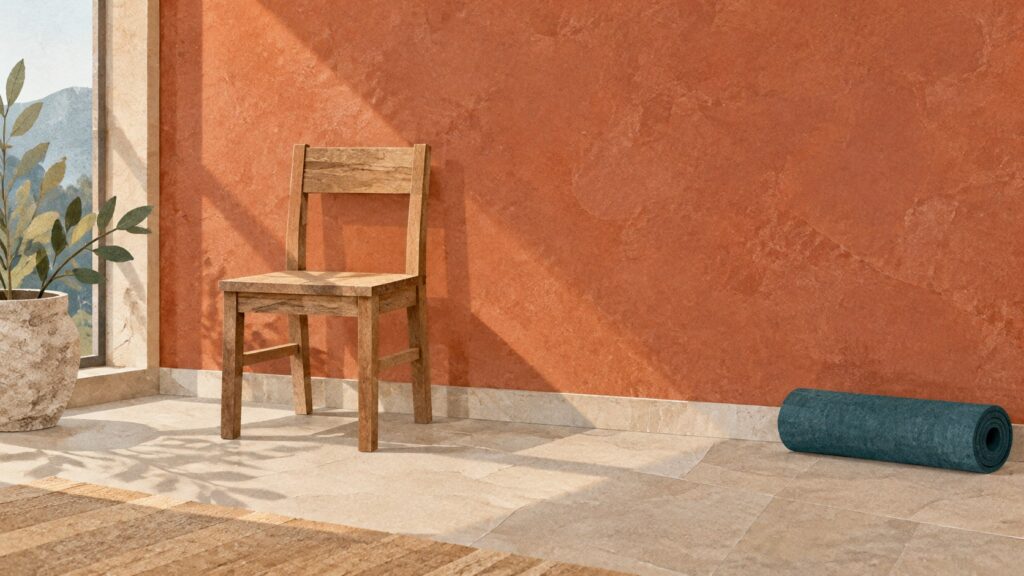
A chair and a wall can both support a yoga practice, but they do different jobs. A wall gives a fixed upright surface. A chair can provide a seat or a hand contact at a particular height, but it is a separate object that can move, tip or fold. The useful question is not which prop is better. It is what support you need for the position you are choosing.
This guide compares ordinary seated and standing support. It is not an inversion lesson, a rehabilitation programme or permission to load furniture in unfamiliar ways. Neither prop guarantees that a pose is suitable or prevents a fall.
Start with the job, not the pose photograph
Decide whether you need somewhere to sit, a surface to touch while standing, or a higher place for your hands. These are separate needs. A wall cannot replace a seat. A chair back is not the same surface as a wall, and a chair that works for sitting is not automatically suitable for leaning or pulling.
If you are unsure what contact you need, ask a qualified teacher to help choose the setup. If balance problems, falls, dizziness, pain or a medical condition are part of the question, seek advice from the health professional involved in your care as well.
What a wall offers
A clear, solid wall provides a broad upright surface without a piece of furniture standing between your feet. Depending on the practice, you might face it, stand beside it or sit with your back near it. These are different arrangements, not instructions to press every part of the body against the wall.
The contact height can often be changed without moving equipment. That can be useful when a teacher asks you to adjust where your hands rest. However, reaching higher or lower changes your position too. Keep the contact within a comfortable reach rather than stretching toward an arbitrary mark.
A wall does not give you a handle to grasp or a place to sit. Do not mistake a light hand contact for the kind of support needed if you cannot stand steadily. A nearby wall is not a substitute for personal assistance when that is needed.
What a chair offers
A suitable chair can make a seated practice possible without getting down to the floor. It can also provide a hand contact in some standing practices. These uses should be assessed separately: moving your hands to the back of a chair changes the direction of force compared with simply sitting on its seat.
The NHS sitting-exercise guide specifies a solid, stable chair without wheels. For that routine, it recommends a seated fit with feet flat on the floor and knees bent at right angles. Its strength-exercise guide also says the chair must not slip on its surface. Those are useful basic checks, not approval for every yoga arrangement.
A chair has a set seat and back height. If those heights make you hunch, reach or feel unsupported, another setup may be more suitable. Do not solve a height mismatch by balancing the chair on books, loose blocks or cushions.
Compare the contact you actually need
- For seated movement: choose a suitable seat if floor sitting does not work for you. A wall behind a floor seat does not remove the need to get down and back up.
- For a standing hand contact: a wall offers a broad surface; a suitable chair offers a more limited contact at its own height. Check reach and steadiness before adding movement.
- For hand support during a forward hinge: wall and chair arrangements place the hands differently. Do not assume the same foot distance or depth transfers unchanged between them. Ask for help adapting the position.
- For a planned seated rest: a chair may provide the seat you need. Plan how you will reach and use it rather than treating furniture behind you as an automatic landing place.
Check the whole space
Look at the floor, the support and the path between positions. Remove clutter and loose items. Avoid slippery contact surfaces. A door that may open, a mirror, a radiator or an uncertain partition is not interchangeable with a clear solid wall.
For a chair, check for rocking, visible damage, loose parts and uncertainty about a folding mechanism. Follow the maker’s directions. Bracing a chair against a wall may be part of a suitable setup, but it does not repair damage or make every chair safe to load in every direction. Adding a mat is not proof that the chair cannot move.
Arrange support before starting. If it needs moving, return to a steady position first. Do not reach across a room or drag a chair while balancing on one leg.
Using both is not a failure
A teacher may choose a chair near a wall because each supplies a different contact. The extra prop still needs a clear purpose and a stable setup. More equipment is not automatically more support if it blocks your feet, restricts movement or creates a trip hazard.
There is no requirement to graduate from a chair to a wall and then to no support. You can keep the contact that suits the practice. Removing it changes the task; it is not a measure of the value of your yoga.
When neither is enough
If you need to cling, make a sudden grab or strain to stay upright, stop the exercise rather than trying a harder version. Choose a more suitable position with guidance. Stop for pain, numbness, dizziness or unusual breathlessness. Seek medical advice for persistent, recurrent or concerning symptoms.
A chair and wall are tools, not treatments for balance or joint problems. The right choice may be a supported seated practice, individual instruction or postponing the movement until your needs have been assessed.
For other pose choices, browse the yoga pose library. Choose practices appropriate to your needs rather than treating the list as a required routine.
Sources and further reading
- NHS: Sitting exercises, for stable-chair selection and seated fit within its own routine.
- NHS: Strength exercises, for non-slipping chair support and examples of chair and wall contact. Its exercises are not reproduced as a yoga prescription here.
- Yoga International: A Joint-Focused Yoga Sequence for Arthritis, by Amber Burke, for examples of adapting standing or seated support and the boundary between teaching and individual medical advice. This comparison does not adopt disease-treatment claims or prescribe that sequence.