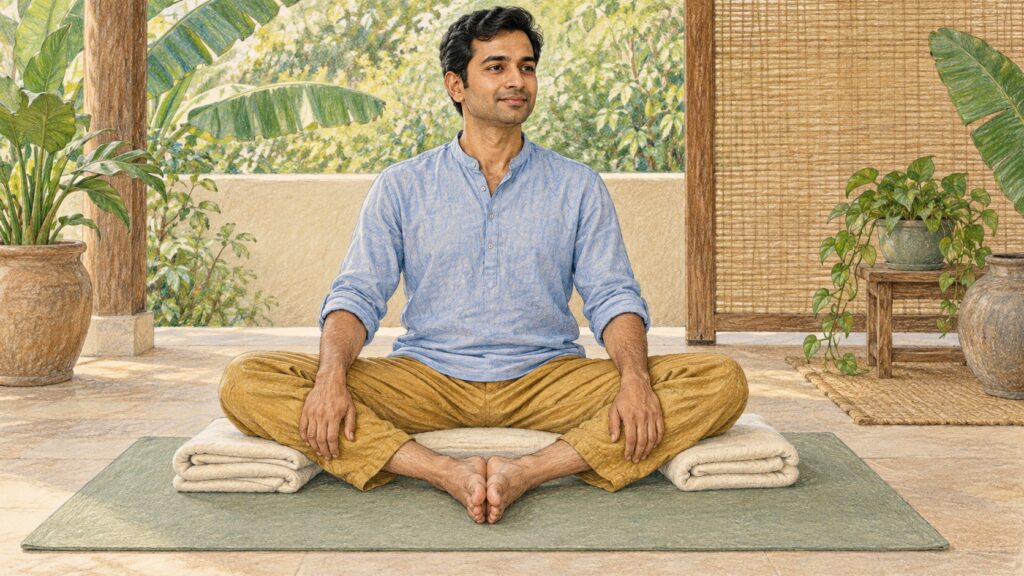
Butterfly and Fire Log are both seated poses with bent knees opening out to the sides. They are not the same position with different names. Butterfly brings the soles of the feet together; Fire Log arranges the shins roughly one above the other, with an ankle near the opposite knee.
That difference matters more than how close the knees are to the floor. A comfortable Butterfly does not show that your legs are ready for a Fire Log stack. Neither pose is a test you need to pass, and either can be left out.
Start by identifying the feet and shins
In Butterfly, also called Bound Angle or Baddha Konasana, the feet meet in front of the body. Moving them farther from or closer to the pelvis changes the size of the diamond formed by the legs. You do not need to pull the heels tightly inward.
In Fire Log, or Agnistambhasana, the shins lie roughly across the front of the body. The familiar stacked version places the upper ankle above the lower knee and the upper knee above the lower ankle. Depending on the class, you may hear Double Pigeon or Square Pose.
The NC State Yoga I and II reference lists both shapes separately. It describes soles together for Bound Angle and the ankle-and-knee stack for Fire Log. Those are useful identification cues, not instructions to force your legs into either arrangement.
The knees are not the part to push
Both poses depend on the available movement at the hips while the knees remain bent. Pulling a foot into place or pressing a knee downward is not a sound way to create the missing range.
Butterfly’s two legs open away from the centre. Fire Log gives the legs different jobs because one shin sits above the other. A high upper knee in Fire Log is not an invitation to use a hand, elbow or forward fold to close the gap.
Nor is the height of the knees in Butterfly a score. Sit with the support and foot distance that suit you. If a joint feels painful, pinched or pressured, leave the position rather than trying to make its outline more symmetrical.
Compare the support you actually need
- Under the seat: Either pose may use a folded blanket to raise the pelvis. The useful height is individual, not a fixed number of layers.
- Under the legs in Butterfly: Suitable supports can meet the outer thighs so the legs do not hang unsupported. They should fill the space, not press the knees down.
- For a Fire Log preparation: A supported version can place the upper foot or ankle on a stable block in front of the lower shin instead of forcing a full stack. It changes the arrangement rather than merely cushioning it.
- For either pose: If supports slide, rock or become difficult to manage, choose a simpler position. More props do not automatically make a setup suitable.
Kat Heagberg’s Yoga International guide describes the block-in-front option and stresses that a pose that feels natural to one person may not suit someone else. Our separate Fire Log guide explains a supported upright preparation. It is not a requirement to stack the legs afterward.
What if Butterfly is comfortable but Fire Log is not?
Keep the distinction simple: one position feels manageable and the other does not. You do not need to diagnose tight hips, assume you are practising incorrectly or work harder to earn the second pose.
The distance between the feet and the pelvis in Butterfly can be adjusted without placing one shin on the other. Fire Log adds a specific relationship between the upper ankle, lower knee and two shins. That is a different task, not merely a deeper version of Butterfly.
Do not move directly from one to the other by dragging an ankle across a knee. Return to a comfortable position first. Learn any unfamiliar leg arrangement with a teacher who can see how you move.
Upright sitting and forward folding are separate choices
Pictures often show a forward fold in both poses. You can leave it out. An upright version lets you assess the legs without adding the weight and movement of the torso.
If you need to grip the feet, hold the breath or round down to stop noticing knee pressure, the setup needs to end, not deepen. A fold should never become a tool for forcing a knee toward the floor.
Keep the Butterfly guide separate from this comparison when learning the individual pose. There is no need to repeat both tutorials in one session or compare how far forward you can reach.
Choose according to the purpose of the session
If you want a quiet seat for attention or breathing, you do not need either of these hip-stretching arrangements. A comfortable simpler seat or a suitable chair may be a better match. Ordinary breathing does not require a leg stack.
If you are exploring seated movement, choose a familiar version that you can arrange and release without strain. Check whether the support stays put, the torso can remain comfortable and the breath remains normal. Decide how to leave before staying longer.
Fire Log changes sides when the upper and lower legs change roles. Assess each arrangement separately. Butterfly does not have that same top-leg distinction, but sensations can still differ between the two sides of the body.
Neither pose is compulsory preparation for the other. You can use another position or omit hip stretching entirely. See the yoga pose library without treating any one shape as a milestone.
When to get individual advice
This is general education, not medical advice. Ask your healthcare professional about suitable activity if you have hip, knee, ankle or back problems, recent surgery, pregnancy or another relevant condition. A qualified teacher can help choose movement within that advice.
Stop for pain, pinching, numbness, tingling or a feeling of joint pressure. Do not sit through numbness to build tolerance. Release the legs slowly and seek advice if symptoms persist or concern you.
The sources here describe pose arrangements and teaching options. They do not establish that Butterfly or Fire Log treats a condition, prevents injury or produces a guaranteed health result. A suitable choice is one that fits your circumstances, not the one with the more dramatic shape.
Sources and further reading
- NC State Yoga I and II: Seated Poses, for the separate Bound Angle and Fire Log arrangements and support examples. No instruction to push knees toward the floor is adopted here.
- Yoga International: Double Pigeon Variations and Prop Tips, by Kat Heagberg, for individual differences, the block-in-front option and permission to choose another pose. Deeper variations are not taught here.
- NCCIH: Yoga: What You Need To Know, for general safety and individual modifications.