A yoga pose can have an English name, a Sanskrit name and a nickname used in a particular class. Learning a few recurring words makes those labels easier to recognise. It does not mean you must memorise a dictionary before joining a class.
This guide is a naming reference, not a sequence or a set of instructions for trying the poses mentioned. Use the name to ask a clearer question, then learn the actual setup and suitable options with your teacher.
Why many names end in asana
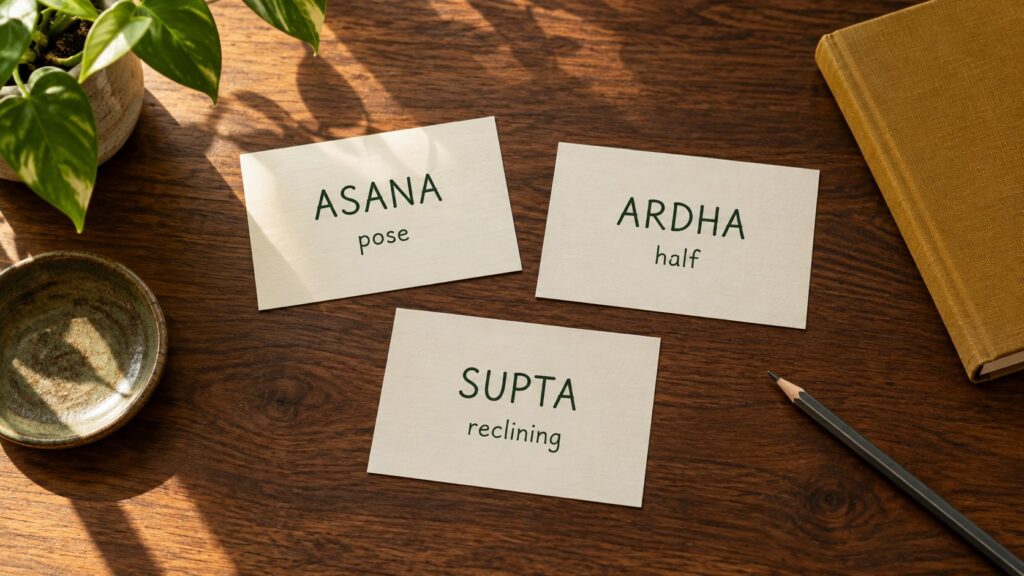
Asana means seat and is commonly used for a yoga posture. It often joins the word before it rather than appearing separately. Danda and asana form Dandasana, usually called Staff Pose. Trikona and asana form Trikonasana, Triangle Pose.
You will therefore see a long name written as one word or as several words. Looking for familiar parts is more useful than treating the whole label as a spelling test. These are common teaching translations, not a full Sanskrit grammar lesson.
Eight useful words to recognise
Ardha: half
Ardha appears in Ardha Uttanasana, Standing Half Forward Bend, and Ardha Chandrasana, Half Moon Pose. The word describes the name, not the value of the practice. A pose called “half” is not half as worthwhile, and it is not automatically easy.
Supta: reclining
Supta identifies a reclining form. Compare Virasana, Hero Pose, with Supta Virasana, Reclining Hero. The extra word changes the position and the demands. It does not mean “restful for everyone” or give permission to lie back from a kneeling seat without learning the separate setup.
Parivrtta: revolved
Parivrtta indicates a turn or revolved form. Janu Sirsasana and Parivrtta Janu Sirsasana are not interchangeable instructions: the latter is Revolved Head-to-Knee Pose, with a side-bending and rotational element. Adding the word does more than rename the same forward fold.
Utthita: extended
Utthita appears in Utthita Trikonasana, Extended Triangle, and Utthita Parsvakonasana, Extended Side Angle. “Extended” is part of the label, not a demand to reach farther than is comfortable. A hand on a support does not make the name invalid.
Adho: downward
Adho is familiar from Adho Mukha Svanasana, Downward-Facing Dog. In this name, mukha means face and svana means dog. Reading the parts explains the English label, but the translation alone cannot tell you how to place or load your hands.
Urdhva: upward
Urdhva Mukha Svanasana is Upward-Facing Dog. The similar ending can make it easy to confuse with Downward-Facing Dog on a written class plan. The changed direction word matters. Ask for a demonstration rather than guessing from the last word.
Baddha: bound
Baddha appears in Baddha Konasana, Bound Angle Pose, commonly called Butterfly. Here kona means angle. The word “bound” does not always mean that the hands clasp behind the body. Do not infer a hand grip or a deeper version from that word alone.
Eka pada: one foot or one leg
Eka means one and pada refers to a foot or leg in these names. The phrase appears in several very different postures. It identifies part of the arrangement, not a single family with one standard difficulty level.
English names are not always literal translations
Some labels describe an animal or an object: Vrksasana is Tree Pose, Bhujangasana is Cobra and Dandasana is Staff. Others refer to a named figure, such as Marichi in Marichyasana. English class names may shorten a longer Sanskrit label or use a familiar visual nickname instead.
This is why Butterfly and Bound Angle can refer to the same broad shape, while two names that sound closely related can refer to different practices. The useful question is “Which version do you mean?” rather than “Which name is the only correct one?”
Keep the number when a name has one
Marichyasana I and Marichyasana III share a name but identify different forms in common teaching references. The first is associated with a forward-fold version; the third with a seated twist. Warrior I, II and III also name different arrangements rather than three interchangeable spellings.
When saving a class note, keep the number and any words such as supta or parivrtta. Writing only “Marichi” or “dog” can remove the detail needed to understand the teacher’s plan later.
Why spellings and pronunciations can look different
Sanskrit written in the Roman alphabet may include marks above or below letters, while many class schedules omit them. English-language sources also use different spelling conventions and pronunciation guides. This page uses simplified Roman spellings for readability.
If two resources use similar names, compare the English label, the full Sanskrit name and the demonstrated setup before deciding they mean the same thing. Ask your teacher to say an unfamiliar word slowly. A written English sound guide is only an aid, not a substitute for hearing the language.
A simple way to keep your own pose notes
- Write the name your teacher used, including any number.
- Add the English name or a brief description of the position.
- Record the option you actually practised, such as hand on a block or top arm lowered.
- Mark questions for your teacher instead of filling gaps from the name alone.
For example, “Parivrtta Janu Sirsasana: small seated side reach, no foot hold” is more useful than “head to knee, go deeper.” The note records your version without turning the pose name into a range target.
A name is not a safety instruction
Words such as half, easy, reclining, supported and extended do not establish that a pose is appropriate for you. A support changes an arrangement; it does not remove every demand. Similarly, recognising the name of an arm balance or inversion does not prepare you to attempt it.
Use a suitable class and qualified teaching for movement instructions, and seek individual healthcare advice for an injury or relevant health condition. If you want to choose a practice rather than study its names, begin with the beginner pose library. Understanding the label should make communication easier, not create another standard you have to meet.
Sources and further reading
- Yoga Journal: A Sanskrit Glossary, by Rina Deshpande, for asana as seat and the role of Sanskrit vocabulary in yoga study.
- Yogateket: Yoga Pose Names in Sanskrit and English, for recurring word parts and paired names.
- Yoga Journal: A-Z Pose Library, for English/Sanskrit pairs, numbered forms and named variations.
- Yoga International: Half Bow as a complete practice, by Allison Ray Jeraci, for why a pose called half is not a lesser practice. This naming article does not reproduce its advanced movement instructions.