Wide-Angle Seated Forward Bend, or Upavistha Konasana, begins with sitting on the floor and opening the legs into a comfortable V. From that seat, you may lean forward a little from the hips. The useful question is not how wide your legs can go or whether your chest reaches the floor. It is whether you can keep a steady seat, comfortable knees and an unforced breath.
This is the seated pose, not the standing wide-legged forward fold. The floor supports your seat, and you can use your hands in front to manage a small hinge. This guide is general education, not medical advice. Ask your healthcare professional before trying it if you have a back, hip, groin or knee injury, ongoing pain, osteoporosis, recent surgery, pregnancy-related concerns or another condition that may affect the movement.
A wide angle does not mean a maximum angle
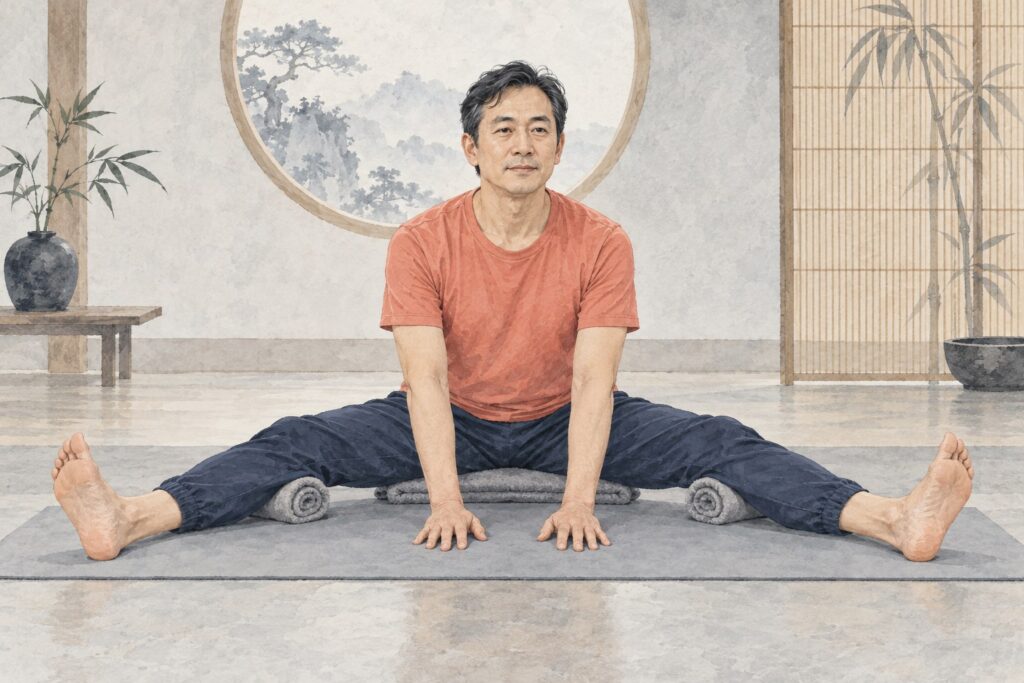
The name describes the broad shape: two legs apart, a seated base and a forward bend between the legs. It does not set a required measurement. Begin with a modest V that lets you sit upright without straining. Opening farther can make the seat and fold harder to manage.
This is not a middle-split challenge. There is no need to slide the heels farther away each time you breathe out. The leg width can stay unchanged throughout a short practice. If the inner thighs feel pulled before you even lean, narrow the position.
Prepare the seat first
Set up on a firm, level surface with space on either side. Keep a folded blanket under your hips if it helps you sit upright. Have two small blanket rolls or towels nearby for under the knees. Avoid slippery supports that move as you place your hands down.
Before spreading the legs, sit with them in front of you and notice whether your pelvis tips backward and your lower back rounds. You may find a higher seat or softly bent knees more manageable. Make those adjustments before asking the body to fold.
A small, supported starting version
- Sit on the floor or a firm folded blanket with your legs in front. Let the torso rise without forcing a large arch in the lower back.
- Open the legs into a comfortable V. Stop well before you feel a strong pull in the groin or inner thighs.
- Keep the fronts of the knees and the toes facing upward rather than rolling the legs inward. Do not twist the feet to force the knees into place.
- Soften the knees as needed. Place a small roll beneath each knee if that gives the legs a comfortable resting point.
- Place your hands on the floor in front of you, close enough that you can stay tall. Pause here and check that the seat itself feels comfortable.
- Lean forward a little from the hip creases. Let the hands take light support and stop before the back collapses or the knees roll inward.
- Take a few easy breaths, then walk the hands back toward you and return upright slowly. Bring the legs together with care rather than jerking them inward.
You may stay at step five without adding a fold. The upright setup is useful for learning which leg width and support arrangement suit you. If the seated position remains uncomfortable, skip it and ask a teacher about another option.
What should the knees and feet do?
Yoga Journal’s beginner guidance for Upavistha Konasana recommends bent knees and thin blanket rolls when a forward bend is difficult, while keeping the kneecaps directed upward. A soft knee is an option, not something to straighten at the first opportunity.
Look at the whole leg rather than yanking the toes back. If the knees roll toward the floor as you lean, make the fold smaller and check the width. Avoid pressing the backs of the knees down or pushing into a feeling of locking. A painful or unstable knee is a reason to leave the pose.
Let the hands support, not drag
Put your palms or fingertips where you can reach without dropping the chest. They can stay close to the seat. You do not need to walk them farther forward on every breath, hold the big toes or use the arms to haul yourself toward the floor.
If your hands seem to be the only thing stopping you from falling forward, return upright and reduce the lean. Aim for a position you can leave with control. A small movement with an easy return is preferable to getting stranded in a deep fold.
If the lower back rounds immediately
Try narrowing the V, sitting on a firmer folded blanket, bending the knees more or leaving out the forward lean. These changes address the starting position instead of trying to pull a rounded back straight after you have already folded.
Do not force a pronounced backbend to counter the rounding. Keep the torso comfortably long and accept a more upright position. If you cannot find a comfortable seat, another pose may be the better choice. Existing back symptoms need individual guidance, not a deeper experiment with the fold.
Do you need to feel a strong stretch?
No. You may notice a mild stretch around the inner thighs or backs of the legs, but intensity is not a score. More width, more depth and a longer hold all change the demand. Avoid increasing them together, and do not assume that stronger sensation means better practice.
Sharp pain, groin pinching, tingling, numbness or a pulling sensation at an injured area are reasons to stop. Do not bounce, ask a partner to push your back or use someone else’s body weight to increase the stretch. Comfortable breathing is a useful check, but it is not medical clearance.
How it differs from other forward bends
In the two-leg seated forward bend, the legs remain in front of the body. Here they open apart and the torso inclines into the space between them. That makes leg width and the direction of the knees part of the setup.
Head-to-Knee Pose has one knee bent to the side and one leg extended. Upavistha Konasana does not require that bent-leg arrangement. The standing wide-legged fold is different again: it asks you to support your weight through the feet while hinging. Being comfortable in one version does not automatically establish readiness for the others.
A short practice without a depth target
Use this pose after comfortable movement, not as a test of how quickly you can open the legs. Set the seat, choose a moderate V and try a small lean for a few easy breaths. Return upright before strain builds. Rest with the legs in a comfortable position afterward.
You do not need a timer, repeated rounds or a daily flexibility target. Notice whether the setup felt steady and whether the exit was easy. Those observations are more useful than measuring the distance from your chest to the mat.
What about a chair or bolster?
Chair and torso-supported variations exist, but a prop does not make every variation suitable for every person. A qualified yoga teacher can help set the support height and leg position. Do not copy an unfamiliar chair variation that requires holding the legs off the ground simply because it uses a chair.
For this introduction, the simplest choices are a supported seat, soft knees and a smaller lean. If getting down to the floor or back up is difficult, choose a different movement with your teacher rather than making the transition itself a struggle.
Keep health claims separate from the pose
This guide describes a movement and its options. It does not claim that Upavistha Konasana treats anxiety, back pain, reproductive problems or another medical condition. A pose can feel quiet or offer a stretch without being a treatment.
The National Center for Complementary and Integrative Health discusses research on yoga programmes and notes that injuries can occur. It advises qualified instruction and individual modifications for relevant health conditions. General yoga research should not be turned into a promise about one posture.
Common questions
Must my chest touch the floor?
No. A small forward hinge or an upright seat is enough for this introduction. Do not round or force the back to reach a surface.
How far apart should my legs be?
Only as far as you can sit comfortably and manage the movement. There is no required angle and no need to approach splits.
Can the knees stay bent?
Yes. Small supports beneath them are an option. Keep the kneecaps facing upward without forcing the joints.
What if I feel groin pain?
Come out. Do not use a wider stance or stronger pull to work through pain. Seek advice if symptoms persist or you have an injury.
Sources and next steps
- Yoga Journal: Wide-Angled Seated Forward Bend, used for the pose setup, modest version, raised seat and supported-knee options.
- NCCIH: Yoga, effectiveness and safety, used for general safety and individual-modification guidance, not pose-specific treatment claims.
For other shapes to compare, explore our beginner yoga pose library. Choose a comfortable option rather than treating every pose as a requirement.