Yoga after running is a short, gentle practice done after your run to help your body settle and your muscles relax. You do not need to be flexible or experienced to try it. This guide shows you a simple beginner routine, how long to hold each pose, how often to practice, and the mistakes most new runners make. Everything here is easy to follow at home with a mat or a towel.
This article is general education, not medical advice. If you have an injury, a health condition, or ongoing pain, check with your doctor before you start.
What is yoga after running?
Yoga after running is a gentle set of poses done after a run to help the body wind down. It is not a workout. The goal is to stretch tired muscles, slow your breathing, and give your legs time to recover. Most sessions are short and easy.
Why do runners add yoga?
Many runners use yoga to care for the tight hips, calves, and hamstrings that running builds. Running repeats the same motion again and again, so some muscles get stiff while others do little work. A short yoga session moves the body in new ways, and many people say it helps them feel less sore the next day.
Is yoga after running good for beginners?
Yes, yoga after running is a good fit for beginners because the poses are simple and slow. You only need a few basic poses and a little floor space. Start with five to ten minutes and build from there. There is no test to pass and no level to reach.
How do you start safely?
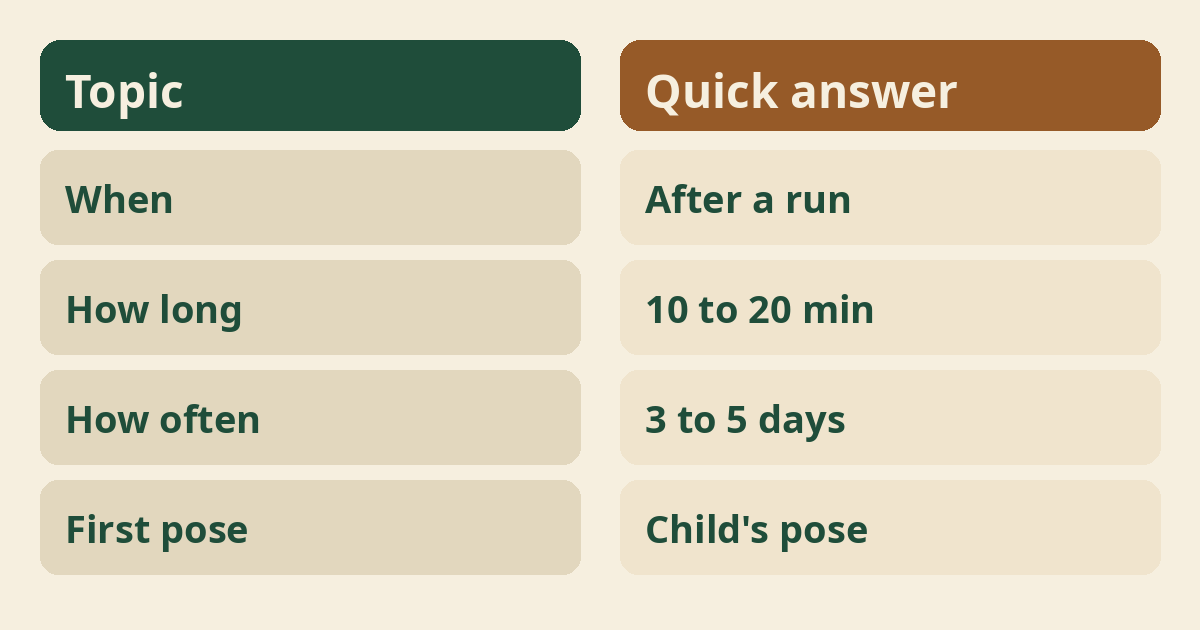
The safest way to start is to cool down first and keep every stretch mild. Walk for a few minutes after your run so your heart rate comes down. Then move into easy poses on a mat. Never push a stretch into pain, even a little.
Step 1: cool down first
Always walk for three to five minutes before you start any stretching. Stretching right after hard running, while your heart is still pounding, can feel rushed and shaky. A short walk lets your breathing settle. It also gives your muscles a gentle bridge into the poses.
Step 2: start with easy poses
Begin with two or three simple poses that target your legs and hips. Good first choices are child’s pose, a gentle lunge, and a seated forward fold. Move slowly between them. If a pose feels strong, back off until it feels mild.
Step 3: hold each pose gently
Hold each pose for about 30 seconds to two minutes without bouncing. Bouncing or forcing a stretch can strain a tired muscle. Instead, settle into the pose and let it soften on its own. Long, calm holds work better than deep, hard ones.
Step 4: breathe slowly through it all
Slow, steady breathing is the heart of the practice. Breathe in through your nose and out through your nose or mouth. Let each breath be long and even. If you are new to this, our guide on belly breathing for beginners is a good place to learn the basics.
Step 5: finish lying down
End every session with a few quiet minutes lying on your back. Rest on the floor with your arms relaxed and your eyes closed. This gives your body a moment to absorb the work. Many runners say this quiet finish is the best part of the routine.
How long should a session be?
Ten to twenty minutes is enough for most beginner sessions. Short and regular beats long and rare. A tired body after a hard run may only need ten minutes. On easy days you can stay a little longer if it feels good.
How often should you practice?
Doing yoga after most of your runs, about three to five times a week, works well for many beginners. The right number depends on how much you run and how your body feels. Our article on how often you should do yoga explains how to find your own rhythm. Rest days still count as practice days if you stretch gently.
What are the breathing basics?
The basic rule is to breathe slowly and let the breath lead each movement. In most poses you lengthen on the inhale and settle on the exhale. Keep the breath quiet and smooth. If you cannot breathe easily, the pose is too deep.
What does a simple sequence look like?
A simple sequence moves from the floor, to gentle lunges, to a seated fold, and ends lying down. Start on your hands and knees, move to a low lunge on each side, then sit and fold forward. Finish on your back with your knees bent or your legs up a wall. The whole flow takes about fifteen minutes.
Which poses help tight hips?
Low lunges and seated hip openers are the most useful poses for runners with tight hips. Running shortens the hip flexors, so gentle opening feels good for many people. Go slowly and stay mild. Our guide on yoga for hips for beginners has more detail on these poses.
Which poses help legs and calves?
Standing forward bends and gentle downward dog are common choices for tired legs and calves. Keep a soft bend in your knees so the stretch stays comfortable. Tight calves often respond better to many short holds than one long, hard push. Let gravity do the work.
Is child’s pose good after a run?
Child’s pose is one of the best resting poses after a run. It gently stretches the hips, thighs, and lower back while letting your whole body relax. You can stay in it for two minutes or more. Learn the setup in our article on child’s pose for beginners.
Can cat-cow loosen a tight back?
Cat-cow is a gentle way to wake up and loosen a stiff back after running. Move slowly between rounding and arching your spine, matching each movement to a breath. It takes about a minute. Our article on cat-cow pose for beginners walks through it step by step.
Does butterfly pose help runners?
Butterfly pose opens the inner thighs and hips, two areas runners often find tight. Sit tall, bring the soles of your feet together, and let your knees fall out to the sides. Do not press your knees down with your hands. Read more in butterfly pose for beginners.
Should you do standing poses after running?
Gentle standing poses are fine after a run as long as your legs feel steady. Simple poses like a standing forward fold or a mild side stretch work well. Skip strong balancing poses on very tired legs. Hold a wall or chair if you feel wobbly.
What benefits do runners notice?
Many runners say they feel looser, calmer, and less stiff after adding short yoga sessions. Some report easier movement on rest days and better body awareness while running. Results vary from person to person, and no benefit is guaranteed. For a careful overview of what research suggests about yoga in general, see the National Center for Complementary and Integrative Health resource from the National Center for Complementary and Integrative Health.
Can yoga improve flexibility over time?
Many people find that regular gentle practice slowly improves flexibility, though results vary. The change is gradual, usually over weeks and months, not days. Short sessions after runs add up. Our guide on yoga for flexibility for beginners covers this in more depth.
Does yoga help with balance?
Yoga can help many people feel steadier, and better balance may support smoother running form. Single-leg poses train the small stabilizing muscles in your feet and ankles. Start with easy holds near a wall. See our article on yoga for balance for beginners for a safe starting point.
What are the most common mistakes?
The biggest mistakes are stretching too deep, skipping the cool down, and holding the breath. New runners often treat stretching like a race and push for more. Mild and calm always wins over deep and forced. When in doubt, do less.
Why is pushing too deep a problem?
Pushing a stretch too far on tired muscles raises the chance of a strain. After a run your muscles are warm and loose, which can trick you into going too far. Stay at about half of what feels possible. The stretch should feel pleasant, never sharp.
What props make it easier?
A mat, a strap or belt, and a cushion cover almost everything a beginner needs. A strap helps you reach your feet without rounding your back. A folded blanket under the hips makes seated poses easier. For ideas on simple home setups, see yoga props for beginners.
Should you stretch on very tired legs?
Gentle floor poses are fine on tired legs, but keep the effort very low. After a long or hard run, choose resting poses like child’s pose or legs up the wall. Skip anything that feels like work. Recovery is the goal, not another workout.
Who should be careful with yoga after running?
Anyone with an injury, joint problem, dizziness, or a health condition should talk to a doctor first. The same goes for new runners who feel chest pain, unusual shortness of breath, or sharp pain anywhere. A doctor can say what is safe for you. Start gentle and stay honest about how your body feels.
What if you have a bad back?
People with back trouble should get medical advice before stretching after a run. Many poses can be adjusted, but some may not suit certain backs at all. A doctor or physiotherapist can guide you. Our article on doing yoga with a bad back explains the gentle options.
Is yoga after running a treatment?
No, yoga after running is not a treatment, a cure, or a fix for any injury or illness. It is a gentle wellness practice that many people enjoy. If something hurts in a way that does not feel normal, stop and see a doctor. Yoga is not a replacement for medical care.
How do you progress over time?
Progress means longer holds, a few more poses, and more comfort, never more force. After a few weeks you might hold poses for two minutes instead of one. You can add one new pose at a time. Slow and steady progress is the safest kind.
Should you work with a teacher?
A qualified teacher can check your form and adjust poses to your body, which helps many beginners. Even a few sessions, in person or online, can teach you a lot. Look for someone with training and experience with runners. Bring your questions and mention any injuries.
What mindset works best?
The best mindset is patient and curious, treating yoga as recovery time rather than training. You are not chasing a perfect pose. Notice how your body feels and let that guide you. Some days will feel stiff, and that is normal.
Can you stretch at your desk on rest days?
Yes, simple desk stretches on rest days keep the habit going without any equipment. Neck rolls, seated twists, and shoulder releases take only a minute or two. Our guide on yoga at your desk for beginners has easy options. Small efforts between runs still help many people feel looser.
Can yoga replace regular stretching?
Yoga can cover most of what a runner needs from stretching, since the poses stretch all the main running muscles. It also adds breathing and relaxation that plain stretching lacks. Some runners keep a mix of both. There is no single right answer, so do what you will actually repeat.
What if you feel pain in a pose?
If any pose causes sharp or pinching pain, come out of it right away and rest. Mild stretching discomfort is normal, but pain is a stop signal. Try a gentler version or skip that pose. Pain that stays after practice is a reason to see a doctor.
Where to read next
For a calm, beginner-friendly start, Ranjana Sinha’s Begin Where You Are is written for people who want simple steps. Our guide to starting a home yoga practice adds a gentle routine you can follow at home.
Frequently asked questions
Should I do yoga before or after running?
After is best for most beginners, since warm muscles stretch more comfortably and the practice helps the body settle.
How soon after a run can I start yoga?
Walk for three to five minutes first, then begin once your breathing feels calm.
How long should a beginner session last?
Ten to twenty minutes is plenty when you are starting out.
Do I need to be flexible to do yoga after running?
No, yoga is how many people gently build flexibility, not a requirement you need first.
Can yoga stop running injuries?
Yoga is not a proven way to prevent injuries, though many runners feel it keeps their bodies moving well.
The bottom line
Keep it short, keep it gentle, and let your body recover.